

Vetting and screening are processes used to check that people working in health and social care are safe, suitable, and able to carry out their role. These checks take place before employment begins and may continue during employment.
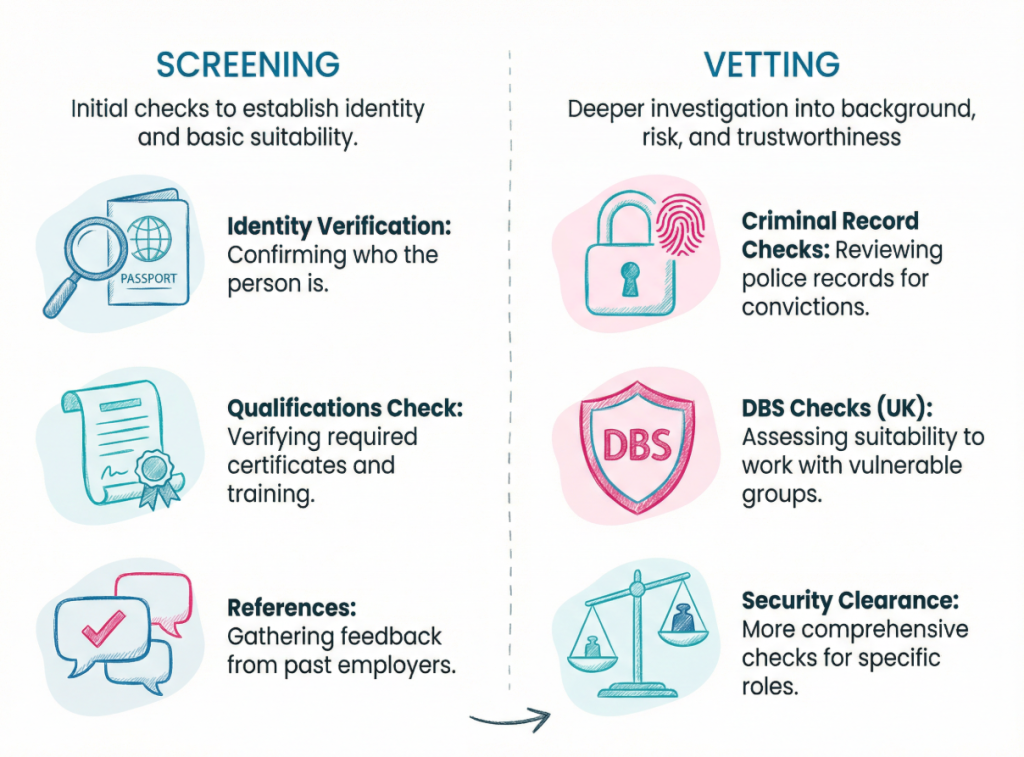
Vetting and screening are terms commonly used in safer recruitment. They are not formally defined in law. In practice, vetting refers to checks on a person’s background and any potential risk. Screening refers to checking factual details such as identity, qualifications, and work history.
Together, they support safeguarding. They help protect people who rely on care services. Put simply, they act as an early filter before someone is trusted with direct care.
Why Are Vetting and Screening Important?
People who use care services may depend on staff for personal care, support, or treatment. This creates a position of trust that must be handled carefully.
If checks are not carried out properly, unsuitable individuals may gain access to vulnerable people. That said, checks alone do not remove all risk. They form one part of a wider safeguarding approach.
Vetting and screening help by:
- Protecting individuals: Reducing the risk of abuse or neglect
- Maintaining trust: Reassuring families and service users
- Meeting legal duties: Supporting safeguarding law and guidance
- Supporting safe practice: Encouraging accountability in organisations
The Safeguarding Vulnerable Groups Act 2006 introduced systems to prevent unsuitable individuals from working with vulnerable groups. It shaped how recruitment checks are used today.
What Is Included in Vetting?
Vetting focuses on whether a person is safe to work in a care role. It looks at behaviour, history, and potential risk.
Common vetting checks include:
- Criminal record checks: Identify offences that may indicate risk
- Barred list checks: Confirm if a person is legally barred from working with certain groups, where the role is eligible
- References: Provide insight from previous employers
- Employment history: Reviews gaps or inconsistencies
- Interview assessment: Explores values and attitudes
The Disclosure and Barring Service provides criminal record checks and maintains barred lists. Employers are responsible for carrying out other vetting checks.
What Is Included in Screening?
Screening confirms that the information given by a candidate is accurate. It focuses on factual checks.
Screening includes:
- Identity checks: Verifying official documents
- Qualification checks: Confirming certificates and training
- Right to work checks: Ensuring legal permission to work
- Health checks: May be carried out where appropriate and in line with employment and equality law
- Professional registration: Confirming registration with required bodies
For example, a nurse must be registered with the Nursing and Midwifery Council before they can practise.
When and How Vetting and Screening Are Carried Out
Vetting and screening take place at several stages.
- Before employment: Key checks are usually completed before starting
- During recruitment: Interviews and references are reviewed
- After employment starts: Monitoring and supervision continue
- When roles change: New checks may be required
In some settings, work may begin before all checks are complete if a risk assessment and supervision are in place.
How DBS Checks Work
DBS checks are a central part of vetting. They provide information about a person’s criminal record.
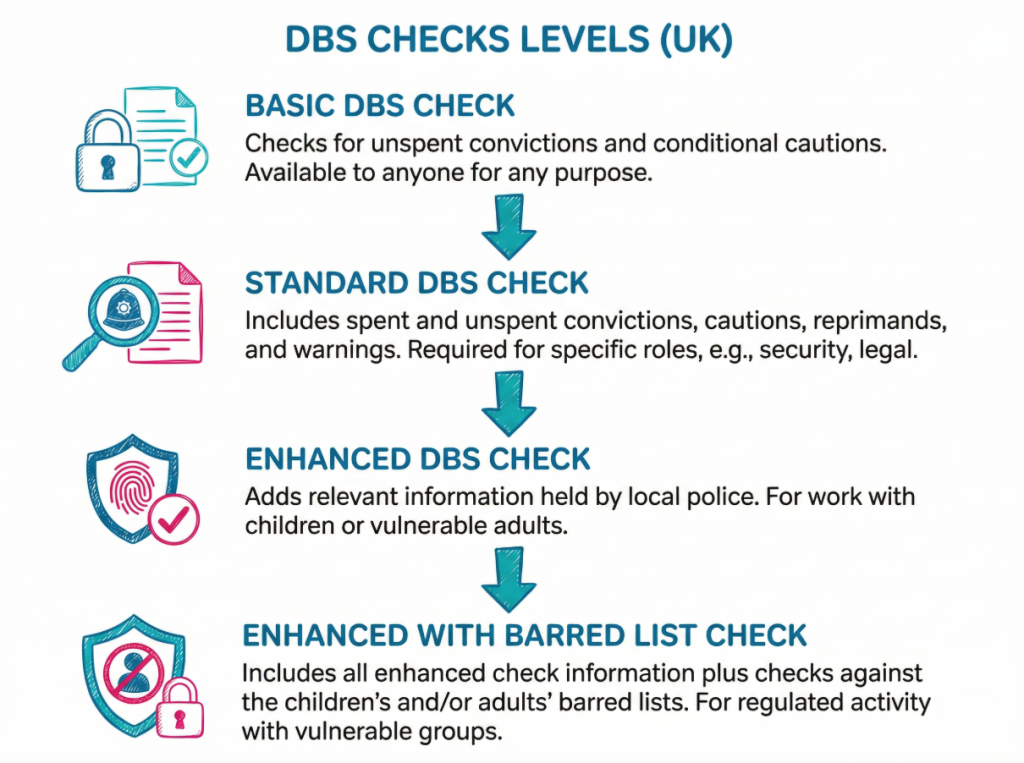
There are three main levels:
- Basic check: Shows unspent convictions
- Standard check: Shows spent and unspent convictions
- Enhanced check: Includes additional information from police records
For roles involving regulated activity, an enhanced check may include a check of one or both barred lists. This depends on eligibility rules.
How Vetting and Screening Work in Practice
Vetting and screening follow a structured recruitment process.
Step by Step Recruitment Process
- Define the role: Duties and safeguarding responsibilities are outlined
- Review application: Qualifications and experience are checked
- Verify identity: Official documents are confirmed
- Request references: Previous employers provide feedback
- Carry out DBS check: Criminal record checks are completed, with barred list checks where eligible
- Hold interview: Attitudes and values are explored
- Make decision: Suitability is assessed
- Start induction: Safeguarding training begins
Where Vetting and Screening Apply in Practice
Vetting and screening apply in all care settings.
- Care homes: Staff provide personal care
- Hospitals: Workers support patients who may be vulnerable
- Community care: Staff work in people’s homes
- Schools and childcare: Staff work with children
The level of checks depends on the role.
Real Life Scenario Example
A care home recruits a new care assistant.
- Identity and qualifications are checked
- References confirm work history
- An enhanced DBS check is completed where eligible
- The interview explores safeguarding awareness
After starting:
- Complete training: Safeguarding training is provided
- Supervision: Work is monitored
- Report concerns: Issues are raised if needed
How Vetting Links to Regulated Activity
Regulated activity refers to work that a barred person must not do.
Examples include:
- Personal care: Washing, dressing, eating support
- Daily living support: Routine assistance
- Healthcare: Treatment or clinical support
People working in these roles must meet safeguarding requirements. It is against the law for a barred person to carry out regulated activity.
Common Mistakes in Vetting and Screening
- Rushing recruitment: Staff start before checks are complete
- Ignoring gaps: Missing employment history is not reviewed
- Weak references: Concerns are not followed up
- Over relying on DBS: A clear check is treated as full assurance
- Poor monitoring: Behaviour is not reviewed after hiring
How Ongoing Monitoring Supports Safety
- Supervision: Regular review of work
- Appraisals: Performance discussions
- Training updates: Keeping knowledge current
- Reporting concerns: Acting on risks
- Repeat DBS checks: May be carried out based on policy, as there is no set legal interval
Legal and Professional Responsibilities
Relevant legislation and guidance include:
- Safeguarding Vulnerable Groups Act 2006: Introduces the barring system
- Protection of Freedoms Act 2012: Refines regulated activity and DBS checks
- Safer recruitment guidance: Supports safe hiring practice
Employers and staff share responsibility for safe care.
Final Thoughts
Vetting and screening support safe recruitment in health and social care. They help confirm that workers are suitable and safe to work with vulnerable individuals.
These processes include background checks, identity checks, and ongoing monitoring. They work alongside safeguarding practices.
Strong systems and responsible staff help reduce risk and support safe care.
Subscribe to Newsletter
Get the latest news and updates from Care Learning and be first to know about our free courses when they launch.


