

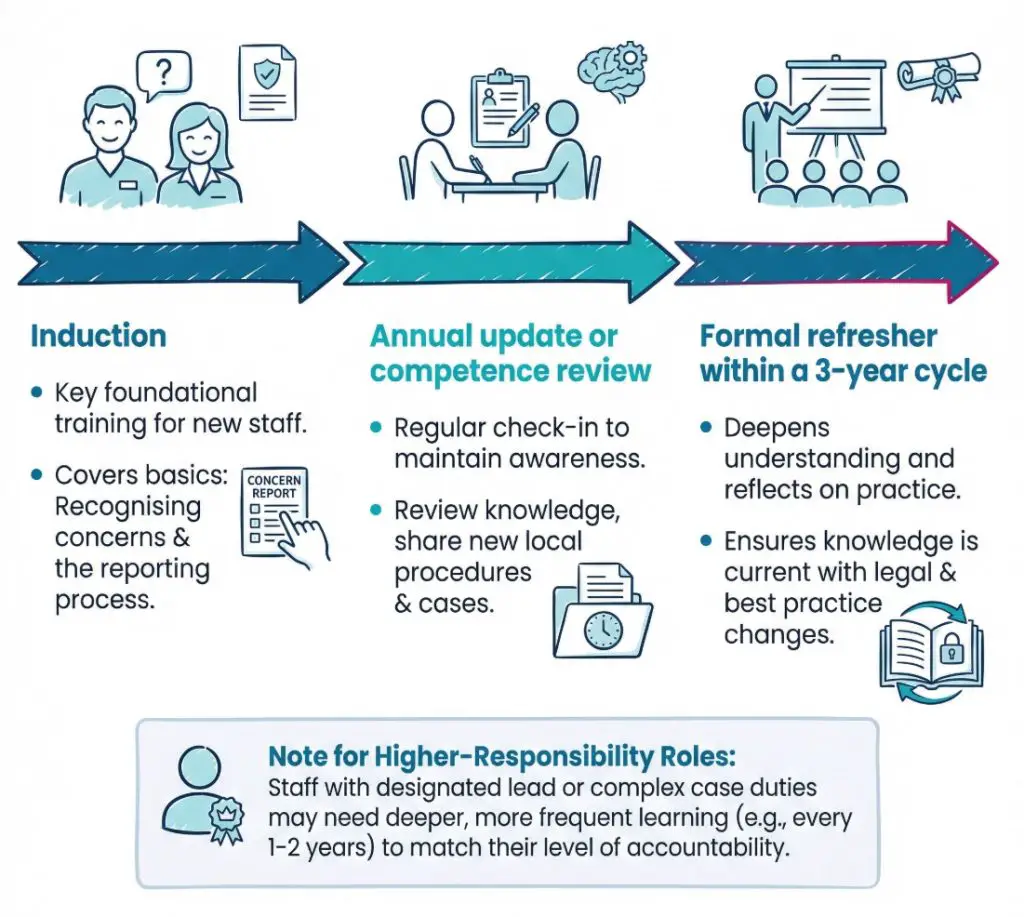
Safeguarding training should not sit on a shelf for three years and then reappear when the renewal date comes round. Most services work better when they treat it as a rolling part of safe care. The broad pattern is simple. A formal refresher often falls within a three year cycle, while knowledge, confidence and competence should be reviewed every year and sooner when roles, risks or local procedures change.
That is the clearest way to answer the question. It is not just “every year” and it is not just “every three years”. It is usually both. Current frameworks from the Royal College of Nursing on adult safeguarding competencies, the RCPCH safeguarding competencies for health care staff, the Skills for Care statutory and mandatory training guide and the NHS England safeguarding framework all point in that direction.
A service can meet a timetable and still leave staff unsure what to do when a real concern appears. That is the problem. A support worker may notice a change in behaviour. A receptionist may hear a disclosure. A nurse may spot a pattern that does not fit the care plan. A manager may see repeated low level incidents that add up to something more serious. Each person needs current knowledge, not old slides.
“The safest approach is a yearly review of competence, with formal refresher learning sitting within a three year cycle.”
This also helps the person receiving care. Safeguarding is not only about training records. It is about whether staff can recognise harm, record concerns properly, and pass them on without delay.
Why yearly updates still deserve attention
A yearly update keeps safeguarding live. Staff may remember the broad idea of abuse or neglect, yet still hesitate when faced with a real situation. They may be unsure whether a concern is serious enough, whether a pattern counts, or who they should contact first. That hesitation can slow everything down.
The child safeguarding competency framework from RCPCH recommends a yearly update for level 1 and level 2 staff. Adult safeguarding guidance from the RCN also places weight on annual review of competence. Meanwhile, Skills for Care uses a three year minimum refresher period in adult social care while also pointing employers toward competence checks and updates when risks change.
That yearly review does not have to mean the same long course repeated again and again. It could be a short taught session, a supervision discussion, scenario work, reflective learning from incidents, or a review of local referral routes. Shorter. Sharper. More useful.
A fair counterpoint is that some organisations worry annual updates create training fatigue. There is some truth in that. People stop engaging if the content is stale and generic. Still, that is a design problem, not a reason to leave knowledge untouched for too long. A better yearly update is usually more effective than a longer course every few years that staff barely remember.
Useful yearly content often includes:
- Recognising early signs: Staff need to spot changes in mood, behaviour, appearance, family dynamics, finances or care routines before harm becomes obvious.
- Recording concerns clearly: Notes should separate facts from opinion and show what was seen, heard or disclosed.
- Using the right route: Local contacts and referral pathways can change, so staff should know where concerns go now, not where they went two years ago.
- Learning from cases: Incident reviews, complaints and audits can reveal recurring gaps that training should address quickly.
“Annual updates work best when they refresh judgement, not just memory.”
Why the timing changes by role, level and setting
Not every role needs the same depth of safeguarding learning. The person answering the phone, the worker delivering daily care, the nurse assessing risk, and the manager leading a service each carry different responsibilities. A single training package for everyone may look tidy, but it often misses what people actually need.
Adult safeguarding guidance from the RCN sets out levels of competence, with different learning expectations over a three year period. The RCPCH framework does something similar for children and young people, with an added focus on annual updates and appraisal. The CQC safeguarding guidance also looks for staff to have up to date training and to use it well in real services.
A caveat here is that a role based model should not become too rigid. Front line work changes quickly. Someone in a non clinical post may still be the first person to hear a disclosure. So while training levels differ, basic awareness should stay strong across the whole organisation.
The table below shows the usual pattern.
| Role group | Usual update pattern | Why it differs |
|---|---|---|
| Awareness roles | Induction, yearly update, formal refresher within three years | These staff may notice concerns first and need clear reporting knowledge |
| Direct care roles | Induction, yearly update, role relevant refresher within three years | These staff observe patterns, record concerns and may speak directly with people at risk |
| Assessment and decision making roles | Annual review, case based learning, deeper refresher within three years | These roles involve judgement, escalation and more detailed documentation |
| Leads and managers | Annual review, supervision, audit learning and advanced refreshers | These roles shape culture, policy, escalation and quality assurance |
Different settings also shape the answer. A care home, supported living service, GP practice, mental health service and community provider will not all face the same risks. The NICE guideline on safeguarding adults in care homes shows how culture, policy, reporting systems and staff awareness all sit together. The NICE guidance on child abuse and neglect does the same for children and young people.
“The right update cycle depends on role, risk and the kind of contact staff have with people using the service.”
What a good safeguarding update should cover
A good update should help staff connect the policy to ordinary working life. It should cover warning signs, yes, but it should also show how those signs appear in real settings. A resident becoming withdrawn. A person whose money is always controlled by someone else. A parent who seems afraid to speak openly. A person with communication needs whose distress is brushed off as difficult behaviour.
Training also needs to revisit what happens next. Staff can recognise a concern and still record it badly. They may use vague language, mix opinion with fact, or pass the issue on verbally without enough detail. That weakens the response. The NHS England safeguarding framework and CQC guidance on safeguarding people both reflect the wider point that safeguarding depends on systems being clear and staff using them well.
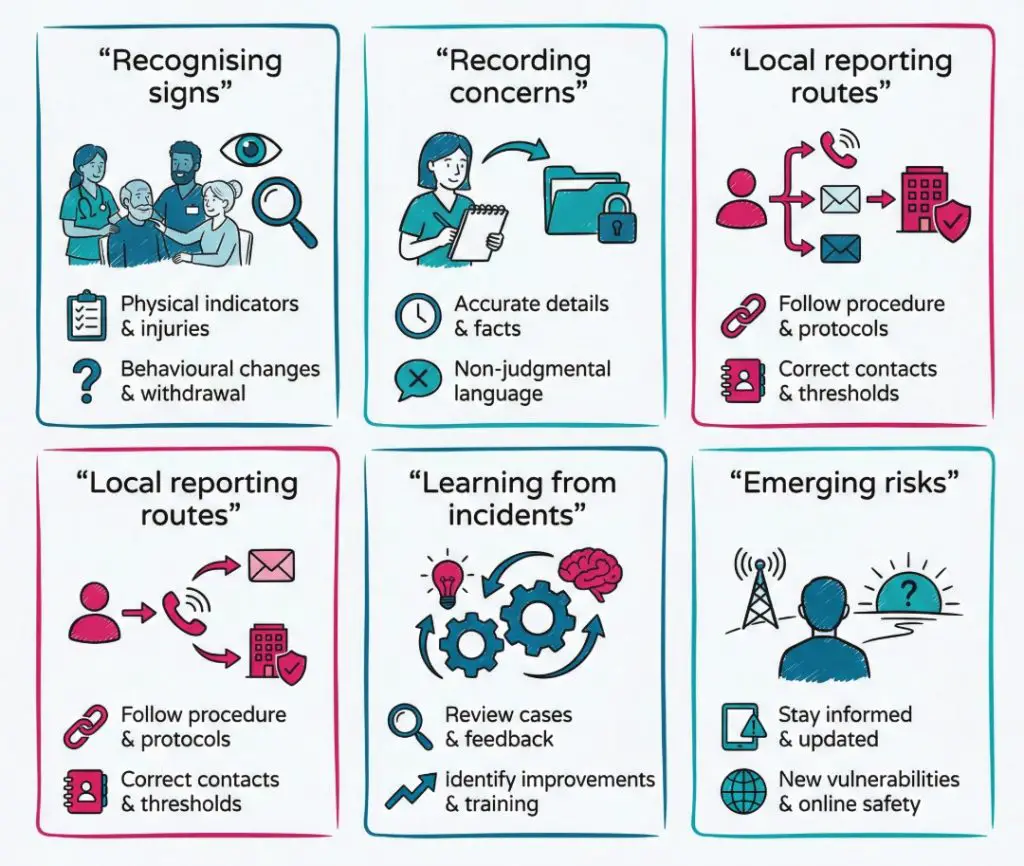
A solid update usually includes these areas:
- Recognising abuse and neglect: Staff should revisit physical, emotional, sexual, financial and organisational abuse, alongside neglect, self neglect and coercive control.
- Recording what happened: Good records describe what was observed or said, when it happened, and who was told.
- Knowing local routes: Internal leads, external contacts and escalation steps should be clear to every member of staff.
- Learning from reviews: Training should reflect complaints, audits, safeguarding reviews and patterns seen in the service.
- Emerging risks: Online exploitation, digital financial abuse, closed culture concerns, domestic abuse and sexual safety may need greater attention than they did a few years ago.
Context also counts. Some staff now hear terms such as contextual safeguarding. In plain language, that means looking at harm beyond the home, including peer groups, online spaces, schools, neighbourhoods or institutions. It is a wider lens. A useful one.
On second thought, the format can be just as important as the content. Basic e learning has its place, especially for awareness levels. Yet discussion based learning often lands better for staff who assess risk, make referrals or supervise others. Real scenarios force people to think. They also show where confidence is thin.
“A useful update gives staff something they can use on the next shift, not just a certificate.”
Signs your training schedule is out of date
One warning sign is a provider that can state a renewal date but cannot explain how staff stay current between courses. A service may say safeguarding is refreshed every three years, while offering no annual review, no reflective discussion, no role based learning and no route for feeding new lessons into the programme. That looks organised on paper. It feels less convincing when a real concern arises.
Another warning sign is identical training for everyone. A receptionist, support worker, nurse, registered manager and safeguarding lead do not need the same depth of content. They do need a shared baseline. But beyond that, one size often leaves some staff underprepared and others switched off. The Skills for Care safeguarding pages and the CQC guidance on up to date safety training both support the idea that training should reflect role and competence.
Delayed induction is another common weakness. New starters should not wait months to learn local contacts, reporting routes and immediate expectations. Early induction sets the tone and reduces guesswork. The Skills for Care induction resources are useful here.
Practical red flags usually show up before a formal review does:
- Records are vague: Notes say “safeguarding concern” without describing what happened.
- Staff are unsure who to contact: People hesitate, ask around or leave it for the next shift.
- Learning does not feed back: Incidents happen, but training stays the same.
- Updates focus only on attendance: The service tracks completion but not confidence or competence.
- Local procedures have moved on: Contacts, thresholds or forms have changed, yet staff still use old pathways.
A short checklist can help test the schedule:
- Annual review in place: Staff discuss safeguarding competence at least once a year.
- Role based content: Different staff groups receive learning that fits their responsibilities.
- Local pathways included: Training reflects current internal and external reporting routes.
- New risks added quickly: The programme changes when patterns of harm change.
- Induction covered early: New staff learn the basics within the first weeks, not months.
How to judge the right update cycle for your service
The best way to judge update frequency is to ask what staff need in order to keep people safe today. Not last year. Not at the point of induction. Today. That usually leads back to the same broad shape: induction near the start of employment, a yearly update or competence review, and a formal refresher within a three year cycle.
For many services, that rhythm works because it balances depth with regular contact. The three year refresher gives structure. The annual review keeps knowledge active. Additional updates can then sit around service changes, incident learning, new risks, or movement into a role with more responsibility.
It also helps to separate two ideas that often get bundled together. One is training frequency. The other is competence maintenance. A person may complete a course on time and still feel shaky when they have to document a disclosure, challenge poor practice or escalate a pattern of neglect. Competence maintenance is what closes that gap. Appraisal, supervision, scenario work, audit feedback and reflective discussion all belong here.
A simple step by step view can make this easier:
- Start with induction: New staff should learn the local safeguarding route early.
- Review yearly: Use appraisal, supervision or a short update to check knowledge and confidence.
- Refresh formally: Put structured refresher learning in place within a three year cycle.
- Update sooner when needed: Bring training forward when risk, law, guidance, staffing or service models change.
- Check what staff can do: Look beyond attendance and test whether people can spot, record and escalate concerns.
Some organisations ask whether a three year refresher alone is enough because it fits neatly with other mandatory training cycles. It may be enough for a narrow compliance target. It is rarely enough for a living safeguarding culture. People receiving care are safer when staff revisit safeguarding more often than the certificate expires.
Conclusion and next step
Safeguarding training should be updated often enough to keep staff alert, confident and current. For many organisations, that means a yearly review of competence with formal refresher learning spread across a three year period. The exact timing still depends on role, setting and risk. A service with more complex safeguarding work will usually need more than the bare minimum.
The strongest programmes do not rely on one course to do everything. They build from induction, revisit the basics every year, and add deeper learning where people make harder decisions. They also change when the service changes. That is what keeps safeguarding real.
For a service reviewing its own approach, the next useful question is not only “When did staff last complete training?” It is “Could staff respond well if a concern appeared today?” That is the test worth using.
Subscribe to Newsletter
Get the latest news and updates from Care Learning and be first to know about our free courses when they launch.


