British values in early years are the five values that early years providers in England are expected to promote through daily practice. They are democracy, the rule of law, individual liberty, mutual respect, and tolerance of those with different faiths and beliefs.
In plain terms, this means helping babies and young children learn that their voice can be heard, that boundaries keep people safe, that they can make choices, and that other people deserve kindness and fairness. In an early years setting, these ideas sit in ordinary moments. Snack time. Tidy up time. Story time. A disagreement over a bike.
They are not usually taught as a stand alone subject. Children meet them through routines, play, relationships, and the example adults set. That is why this topic belongs within good early years care and education rather than outside it.
British values also sit within the Early Years Foundation Stage, often shortened to EYFS. The EYFS is the statutory framework for children from birth to 5 in England. It sets standards for learning, development, care, safety, and inclusion. British values fit naturally here because the EYFS already expects settings to support children’s personal, social and emotional development, positive relationships, equality of opportunity, and anti discriminatory practice.
“British values in early years are less about posters and more about daily life.”
A brief caveat here is helpful. Some people hear the phrase and assume it is mainly political or abstract. In early years, it is usually far simpler than that. It is about how children learn to live alongside other people with safety, respect, and a growing sense of self.
You can see that link clearly in the EYFS statutory framework, the early education and childcare guidance, and the practical support available through Help for early years providers.
Why British values belong in early years
The first five years shape later learning, behaviour, relationships, and emotional security. Children are building a sense of who they are and how the world works. They are learning how to wait, how to share, how to cope with frustration, and how to trust adults. British values link closely with all of that.
When a child is listened to, they start to feel that communication has purpose. When rules are fair and clear, they feel safer. When difference is treated warmly, they are more likely to develop empathy and a sense of belonging. These are not side issues. They are part of what early years settings do every day.
There is a formal side to this as well. In England, the Department for Education expects providers to promote fundamental British values, and this sits alongside inspection and quality arrangements. Settings registered with Ofsted are judged on the overall quality of early years provision, including leadership, safeguarding, and the daily experience children receive.
Still, the strongest reason for learning about British values in early years is not inspection language. It is the child in front of you. A two year old who is learning to wait for a turn. A three year old who notices someone’s clothes or food are different. A four year old who wants a say in what happens next. These are the places where the topic becomes real.
Some readers might worry that the phrase can feel too formal for nursery or childminding work. There is some truth in that. The wording is formal. The practice is not. Good early years provision already includes much of this through respectful care, consistent boundaries, and inclusive relationships.
Useful signs that a setting is promoting British values well include:
- Children are heard: Adults listen to children’s words, signals, choices, and preferences rather than rushing past them.
- Boundaries are clear: Expectations are consistent and explained in ways young children can follow.
- Difference is welcomed: Families, languages, faiths, and ways of living are treated with respect.
- Adults model fairness: Staff show patience, calm language, and steady responses during ordinary parts of the day.
You can trace these ideas through the EYFS framework, the early years inspection toolkit, and wider safeguarding guidance such as the Prevent duty guidance for England and Wales.
What in the EYFS connects to British values?
The EYFS does not set out a long separate chapter called British values. That often surprises people. Instead, the values are woven through the principles and requirements that already shape early years work.
The framework says that every child is a unique child. It also says children learn through positive relationships and enabling environments. It expects equality of opportunity and anti discriminatory practice so that every child is included and supported. Those points connect directly to the way British values are promoted in real settings.
Democracy links with listening to children and taking their views seriously. The rule of law links with routines, boundaries, and safe expectations. Individual liberty links with supported choice and growing independence. Mutual respect and tolerance link with inclusive practice, positive relationships, and a culture where difference is treated as part of normal life.
The EYFS also gives weight to partnership with parents and carers. That is a big part of this topic. Children build their sense of fairness, identity, routine, and belonging across both home and setting. When adults work together, the child usually feels more secure.
There are other bodies and standards around this area too. The Department for Education publishes the EYFS and related guidance. Ofsted inspects registered settings. The SEND code of practice supports settings in meeting children’s special educational needs and disabilities. The Equality Act 2010 sets out protected characteristics and supports fair treatment. The Childcare Act 2006 underpins the legal framework for early years provision in England.
“Young children do not learn values from slogans. They learn them from people.”
On second thought, one area is worth spelling out clearly. British values are not a bolt on. They sit inside the wider job of keeping children safe, included, heard, and well supported. That is why they appear most clearly in practice, not in display boards.
What do the five British values look like in early years?
The five values can sound distant until they are tied to everyday early years work. Once you do that, they become much easier to recognise.
- Democracy: Children learn that their ideas and preferences can be heard. This may be choosing a story, helping decide an activity, or giving a view during group time.
- The rule of law: Children learn that boundaries keep people safe and help the group work well. Rules are linked to reasons, not just adult authority.
- Individual liberty: Children are supported to make choices, develop independence, and express preferences within safe limits.
- Mutual respect: Children learn that they and other people should be treated kindly and fairly. Adults show this through tone, language, and response.
- Tolerance of those with different faiths and beliefs: Children learn that people may live, worship, celebrate, dress, eat, or speak in different ways, and that these differences should be approached with respect.
The word tolerance can sound awkward. In early years, it should not mean merely putting up with other people. A healthier reading is respectful acceptance and positive inclusion. Children do not need a formal lecture on this. They need books, conversation, resources, and adults who respond well when differences come up.
This is one place where people sometimes get stuck. They assume the topic only applies to older children who can talk about values directly. Yet babies and toddlers are learning the first building blocks all the time. They are learning whether adults respond to them, whether routines feel safe, and whether people around them are gentle and fair.
A child does not need to say the word democracy for democracy to be present. The same goes for liberty or respect. They need to experience the thing itself.
Examples of how the five values show up in daily life include:
- Choice at story time: Two books are offered and the group helps decide which comes first.
- A fair turn system: Children use a timer or a name card system for popular resources.
- Supported independence: A toddler chooses a cup, pours with help, and feels trusted.
- Kind language: Staff step in when a child is unkind and guide them towards better words.
- Inclusive resources: Dolls, books, photos, and role play equipment reflect a range of families and communities.
How does democracy work in practice?
Democracy in early years is about participation and voice. It does not mean children run the setting. It means they begin to learn that their views can be noticed and responded to in ways that suit their age and stage.
For a baby, this may mean an adult reading cues carefully and responding to them. For a toddler, it might be choosing between two songs. For an older child, it could be deciding what to add to the role play area, helping plan outdoor provision, or contributing to simple group agreements.
This supports more than choice. It helps children see that communication has effect. When adults listen properly, children are more likely to speak, gesture, point, question, and join in. Language grows. Confidence grows too.
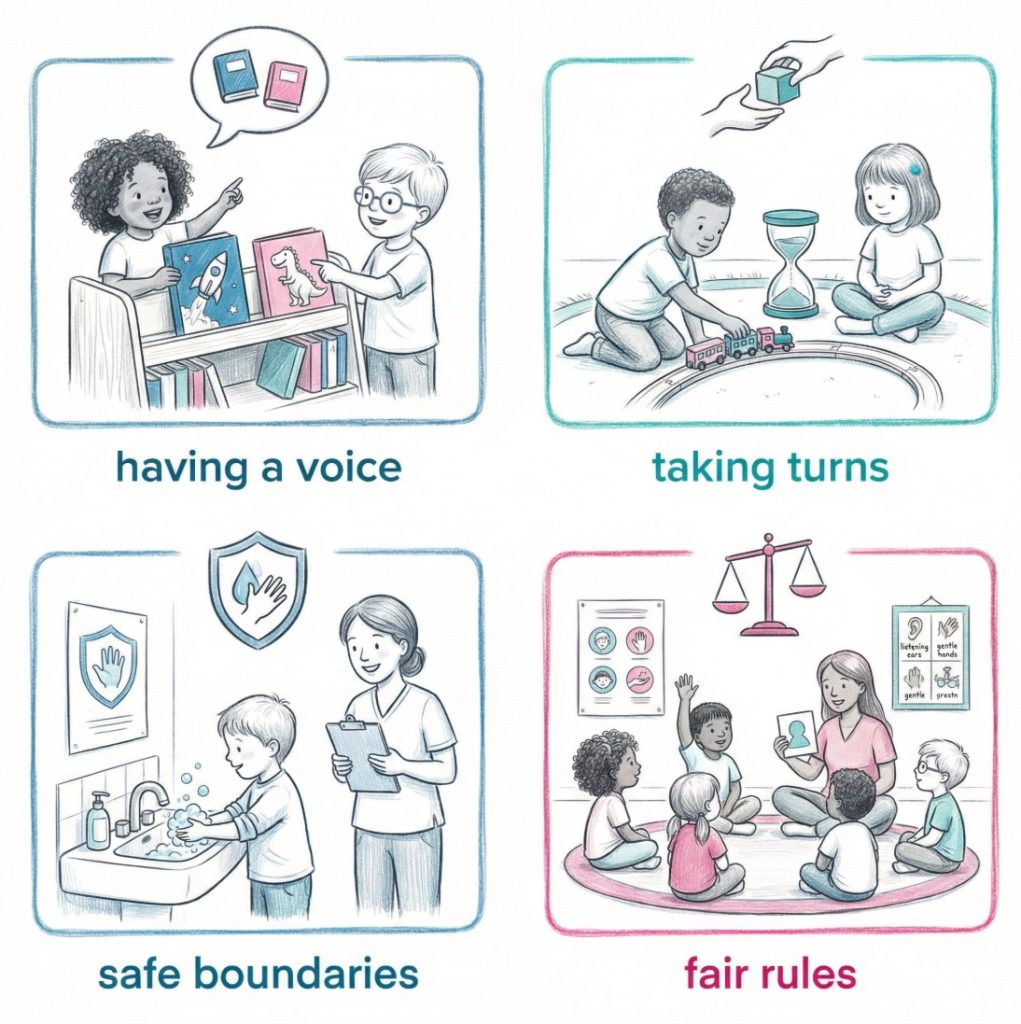
Democracy can look slightly different across settings:
- Nursery: Children choose whether to visit the water tray or the creative table first, and staff adjust the provision around those interests.
- Preschool: The group helps decide what should go in the home corner next week, perhaps a café, a clinic, or a bus station.
- Childminding setting: A childminder notices a strong interest in trains and reshapes tomorrow’s play around transport.
- Reception aged environment: Children help agree simple class rules such as kind hands, listening ears, and walking feet.
A mini case study makes this clearer. A group of children all want the same large construction pieces. Friction builds. Rather than imposing a quick adult solution, the practitioner gathers the group, hears what each child wants, and helps them agree on a fair plan for turns and shared building. The result is not perfect. It rarely is. Yet the children have practised being heard and seeing other people’s needs at the same time.
“Having a voice starts in small moments.”
Some adults worry that too much choice leads to disorder. That can happen if choices are wide open or poorly timed. A better approach is structured choice. Two or three clear options. A calm adult nearby. Real participation within safe limits.
How does the rule of law work in practice?
The rule of law in early years is about fair, consistent boundaries. Young children are still learning how to manage impulses, wait, cope with disappointment, and live alongside a group. They need adults to make the reasons for rules visible.
When a practitioner explains that we walk indoors so nobody gets hurt, or that we wash hands before snack to keep ourselves well, the child starts linking rules with safety and care. That link is far more useful than simple obedience.
Consistency is central here. If one adult ignores unsafe behaviour while another reacts sharply, children receive mixed signals. If the team responds steadily and explains expectations in simple language, children are more likely to feel secure. Security often comes before cooperation.
The rule of law can be seen in these ordinary features of the day:
- Clear routines: Children know what happens at arrival, snack, toileting, outdoor play, and home time.
- Simple expectations: Rules are short and positive, such as kind hands or walking feet.
- Steady responses: Adults respond in broadly the same way across the room or setting.
- Repair after conflict: Children are helped to put things right after upset or hurt, rather than simply being told off.
A realistic example might be a child who runs indoors after coming in from the garden. The practitioner stops beside them, explains the safety reason, and practises walking together back to the mat. The point is not just to stop the running. The child is learning what the boundary is for.
Meanwhile, this links closely with behaviour support. Early years practice should focus on teaching, co regulation, and predictable responses. It should not lean on shame or harshness. The EYFS statutory framework and Ofsted early years inspection information both sit behind that wider approach.
How does individual liberty work in practice?
Individual liberty in early years means children are supported to develop a sense of self. They can make age appropriate choices, express preferences, and try things for themselves within a safe framework.
This may involve choosing where to play, deciding whether to paint or build, selecting a comfort item for rest time, or saying no to a texture they dislike. These moments help children feel that they are people with thoughts, feelings, and preferences of their own.
Liberty is sometimes misunderstood as the absence of limits. That is not how it works in early years. Children need freedom and structure together. Open ended play, exploration, and child led activity sit best inside a secure environment with clear boundaries and attentive adults.
Examples of individual liberty include:
- Choice in play: A child chooses the block area, the book corner, or outdoor play according to interest.
- Choice in routine: A toddler chooses the blue cup or the green cup, or picks the song before lunch.
- Support for independence: Children are encouraged to wash hands, put on coats, and attempt simple self care tasks.
- Respect for identity: Adults use children’s names correctly, recognise family routines, and value home languages.
This value also connects strongly with inclusion. Some children need extra support to express choice. A child with speech, language, or communication needs may use visual cues. A child with SEND may need more time, adapted resources, or a familiar adult nearby. A child learning English as an additional language may show preference through play or gesture before speech.
That is why this topic links closely with the SEND code of practice and the setting’s wider responsibility to include every child. Liberty is not just for confident speakers. It should be available to everyone.
How do mutual respect and tolerance work in practice?
Mutual respect begins with the way adults treat children and one another. Children watch closely. They notice who gets listened to, who is interrupted, who is welcomed, and who is brushed aside.
If adults speak patiently, pronounce names with care, listen to parents, and handle disagreements without ridicule, children see respect in action. If adults are dismissive or careless, children absorb that too. The social climate of the room shapes a great deal.
Tolerance of those with different faiths and beliefs works best when difference is shown naturally and positively. This includes religion and belief, though it also reaches into language, family life, disability, skin colour, celebrations, and daily habits that children notice early.
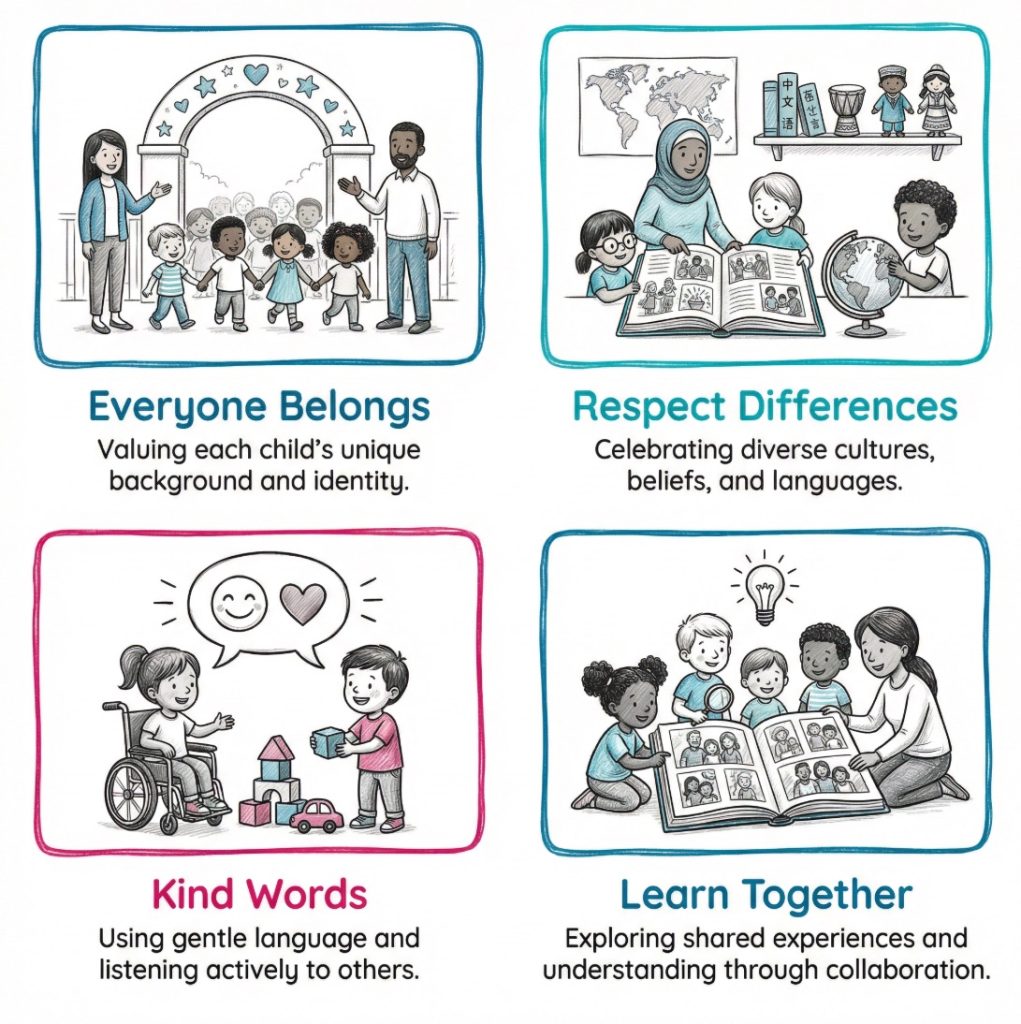
Useful ways to build this into provision include:
- Books and stories: Children see a range of families, communities, and traditions in ordinary reading time.
- Play resources: Dolls, figures, role play items, and images reflect a varied society.
- Respectful conversation: Adults respond calmly when children comment on difference and guide them towards better language.
- Family partnership: Parents and carers contribute their knowledge, routines, and experiences in ways that help the setting reflect real life.
A small example shows how this can work. A child says another child’s lunch looks strange. The practitioner does not ignore it or react with alarm. Instead, they respond calmly, explain that families eat different foods, and treat that difference as ordinary. The child learns that noticing difference is allowed, but mocking it is not.
“Respect is taught by how adults speak, listen, and respond.”
The Equality Act 2010 sits behind the wider expectation that people are treated fairly and not excluded because of protected characteristics. For early years settings, this should show up in practical choices. Books on shelves. Photos on walls. Dolls in baskets. Language in everyday use.
Where do British values appear in different early years settings?
British values appear across the whole early years sector, though they may look slightly different depending on the setting. The principles stay the same. The daily rhythm changes.
In a nursery, you often see them through room routines, group activities, and teamwork between several practitioners. In a preschool, there may be more scope for simple discussion, shared decisions, and group agreements. In a childminding setting, values may be especially visible in close home from home routines, mixed age play, and everyday contact with families. In a reception aged environment, they can connect more clearly with class routines and the wider school day while still staying suited to young children.
Here is how that can look in different places:
- Baby room: Respect is shown through responsive care, eye contact, warm communication, and careful attention to home routines.
- Toddler room: The rule of law appears through repeated boundaries, support with sharing, and help to use gentle hands.
- Preschool room: Democracy grows through helper roles, group choices, and adult support during disagreements.
- Childminder’s home: Tolerance and respect may be built through local outings, family style routines, and conversation about people in the community.
- Reception classroom: Individual liberty may show through supported choices, independent learning tasks, and simple class agreements.
Granted, the language used with staff may stay the same across these settings, but the way children meet the values should always reflect their age and development. A baby is not going to discuss liberty. A baby may, however, experience respectful care and responsive relationships. That is the early foundation.
The early education and childcare guidance, EYFS framework, and Ofsted guidance all support the view that this is setting wide work, not a narrow classroom topic.
How should practitioners, leaders, and key persons support British values?
Practitioners support British values first through their own conduct. Children learn from what adults do before they learn from what adults say. Tone counts. So does patience. So does how adults respond under pressure.
The key person has a particularly strong role. The EYFS places weight on positive relationships, and the key person helps children feel safe, known, and emotionally secure. A child who feels secure is usually better able to make choices, accept guidance, and build respectful relationships with others.
Leaders and managers shape the setting culture behind the scenes. They influence whether the values are actually lived or simply mentioned in policies. They also need to make sure staff know the relevant duties and standards. That includes the EYFS, safeguarding requirements, equality duties, SEND duties, and the wider context of the Prevent duty.
Useful responsibilities include:
- Model respect: Staff speak to children, parents, carers, and colleagues in calm, fair, professional ways.
- Plan inclusive provision: Resources and experiences reflect a range of families, communities, and needs.
- Keep boundaries steady: Expectations are clear, realistic, and broadly consistent across the team.
- Listen to children: Staff create genuine chances for children to express choice and preference.
- Work with families: Parents and carers are treated as partners whose knowledge is valuable.
- Reflect on bias: Teams consider whose voices are heard most easily and where provision may be excluding some children.
For the formal framework behind this, settings may draw on the Childcare Act 2006, the Equality Act 2010, the SEND code of practice, and the Prevent duty guidance.
How can a setting review its practice step by step?
A step by step review can help a setting move from broad policy language to what children actually experience. It does not need to be complicated. Nor should it become a paperwork exercise.
A useful review process could look like this:
- Start with the definition: Make sure staff can explain the five values in plain language and connect them to daily routines.
- Review the environment: Look at books, photos, displays, toys, and role play materials. Check whether children and families can see a range of lives and identities reflected there.
- Review routines: Look at arrival, snack, nappy changing, toileting, outdoor play, group time, and home time. Ask where children have a voice, where rules are clearest, and where independence can grow.
- Review adult interaction: Notice how staff respond to conflict, difference, distress, and children’s choices. Adult behaviour is often the clearest evidence.
- Review inclusion: Consider whether children with SEND, quieter children, and children learning English as an additional language can all access voice, choice, and belonging.
- Review family partnership: Ask whether parents and carers feel listened to and represented fairly in the setting.
- Review staff knowledge: Check that safeguarding, equality, and inclusion training support this work in practical ways.
This sort of review helps settings avoid token gestures. It shifts the focus back to the child. What do they see. What do they hear. What do they feel.
“If children feel safe, heard, and included, the values are already taking shape.”
A short practical checklist can help here:
- Children are offered real choices: Choices are simple, manageable, and suited to age.
- Rules are explained: Boundaries are linked to safety, fairness, or care for others.
- Resources reflect real life: Families and communities are shown in varied and respectful ways.
- Staff language is calm: Adults avoid shame and model respectful interaction.
- Families feel welcome: Parents and carers are included in conversations about children’s routines, identity, and needs.
- Inclusion is visible: Children who need extra support can still access choice and participation.
Which laws, standards, and bodies are relevant?
Several laws, standards, and public bodies connect to British values in early years in England. The starting point is the EYFS statutory framework because it sets the standards that providers must meet for learning, development, care, and safety.
The Childcare Act 2006 underpins the legal framework for early years provision and inspection. The Department for Education publishes the EYFS and related guidance. Ofsted inspects registered providers. The Equality Act 2010 supports fair treatment and protection from discrimination. The SEND code of practice supports settings in meeting children’s additional needs.
The Prevent duty guidance also sits in the background. This is statutory guidance linked to the Counter Terrorism and Security Act 2015. In early years, that does not mean children are taught security concepts. It means providers need to know the safeguarding context in which the phrase British values is sometimes used.
The main reference points include:
- Department for Education: Publishes the EYFS and early education guidance for England.
- Ofsted: Inspects registered early years settings and reports on quality, leadership, and safeguarding.
- Legislation.gov.uk: Holds the text of Acts such as the Childcare Act 2006 and the Equality Act 2010.
- Help for early years providers: Offers practical examples linked to areas of learning and inclusive provision.
- SEND code of practice: Supports settings in identifying and meeting special educational needs and disabilities.
Some readers feel this legal backdrop can make the topic seem heavier than it is. That reaction is understandable. The legal framework is there, but the daily reality remains simple. Young children need respectful relationships, clear boundaries, supported choice, and inclusive care.
What are common mistakes when explaining British values in early years?
One common mistake is treating British values as a separate lesson with a few themed activities. A one off vote about fruit, or a display with flags, does not show very much on its own. The deeper question is whether children are listened to every day and whether the setting is genuinely fair and inclusive.
Another mistake is keeping the language too abstract. Words such as liberty and tolerance can sound distant unless they are tied to things children actually experience, such as choice, kindness, safety, and belonging.
A third mistake is narrowing the topic too far. Some people reduce it to religion alone. Others reduce it to Prevent. Both miss the wider early years picture. The daily culture of the setting is the heart of the topic.
Common slips include:
- Token activities: A single themed task stands in for ongoing respectful practice.
- Inconsistent boundaries: Adults respond differently, so children do not get a steady message.
- Weak inclusion: Some children cannot access voice or choice because support is missing.
- Stereotyping: Cultures or faiths are reduced to festivals, clothes, or single images.
- Adult centred explanations: Staff use formal language without linking it to what young children live through.
There is a credible counter point here. Some practitioners feel the term British values can be unhelpful because it risks sounding nationalistic or narrow. That concern is not baseless. Yet in early years work, the term is usually handled through universal social experiences such as fairness, safety, respect, participation, and inclusion. Used that way, it becomes less about labels and more about the child’s day.
How might this look in a real early years scenario?
Imagine a preschool where several children argue over the bikes outside every day. Staff could treat it simply as poor behaviour. They could also see it as a useful moment to build British values through ordinary practice.
The practitioner gathers the children and keeps the language simple. Each child gets a turn to say what they want. The adult explains that everyone wants the bikes and the group needs a fair plan. Together, they agree to use a sand timer and put name cards in order. The adult stays close to support the system and remind the children why it is there.
Several values are active at once:
- Democracy: Children’s views are heard before a plan is made.
- The rule of law: A fair rule is agreed and used consistently.
- Individual liberty: Each child still gets a turn and keeps some control over their play.
- Mutual respect: Children are expected to listen and wait.
- Tolerance and inclusion: The adult checks that quieter children and children who need extra support are not pushed aside.
Conclusion and next steps
British values in early years are best seen in the daily life of the setting. They are there when children are heard, when rules are fair, when choices are offered, and when difference is treated with respect. In England, the formal language is democracy, the rule of law, individual liberty, mutual respect, and tolerance of those with different faiths and beliefs. In the room with children, those ideas become voice, safety, choice, kindness, and belonging.
This is why the topic sits so closely with the EYFS, safeguarding, inclusion, behaviour support, and positive relationships. It is not separate from strong early years work. It is one way of describing what strong early years work already looks like.
For anyone learning about the subject, a sensible next step is to look at ordinary parts of the day through this lens. Arrival. Snack. Group time. Outdoor play. Home time. Ask what children are actually experiencing in those moments. Often, that tells you far more than a policy statement ever will. Enough said.
Subscribe to Newsletter
Get the latest news and updates from Care Learning and be first to know about our free courses when they launch.