

Cultural capital in early years means the knowledge, language, experiences, routines, and social awareness that help a child take part in learning and everyday life. In simple terms, it is the background knowledge that helps children recognise what they see, hear, and do, and gives them more to build on as they grow.
In England, this sits most clearly within the Early Years Foundation Stage, usually shortened to EYFS. The EYFS is the statutory framework that sets the standards early years providers must meet so children learn and develop well, stay healthy and safe, and gain the knowledge and skills they need to start school. The legal basis for the EYFS comes through the Childcare Act 2006.
Cultural capital is not a separate lesson, a special display, or a list of costly outings. Instead, it runs through the life of a setting. It appears in stories, conversations, songs, play, visits, shared routines, and the way adults help children connect one experience to another.
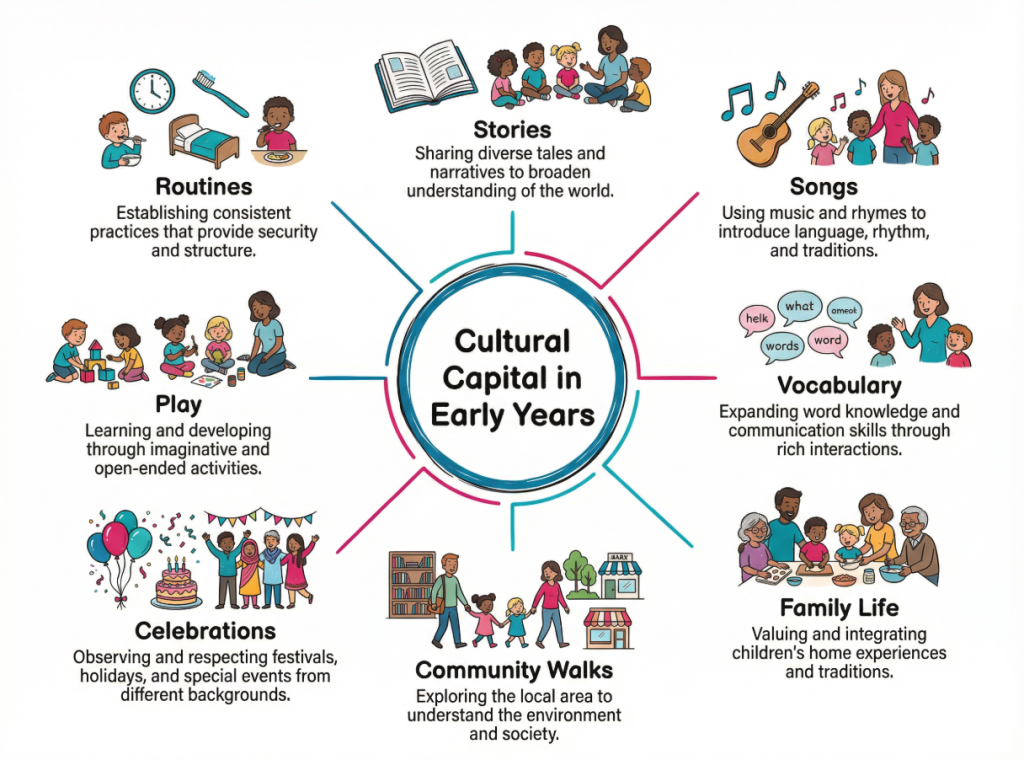
What is cultural capital in early years and why is it important?
Cultural capital in early years is the foundation of knowledge and experience that helps children make sense of the world. A child who has heard many stories, spoken with adults regularly, visited different places, noticed signs and symbols, sung songs, handled books, and talked about feelings often has more points of reference for later learning. That does not make the child better than anyone else. It means the child may have had more chances to build certain kinds of knowledge that education settings often draw on and extend.
This idea needs careful handling. Every child already brings culture from home. Family traditions, languages, routines, celebrations, foods, beliefs, and ways of communicating are all part of a child’s starting point. Good practice does not sort children into those who have culture and those who do not. Instead, it begins with what each child already knows and builds from there.
That is why cultural capital is linked to inclusion and curriculum design, rather than to money or social status. Used well, the term helps practitioners think carefully about what children experience, what they hear, and what they can talk about. Used badly, it can turn into a label that says more about adult assumptions than about children’s lives.
Its importance is strongest in early childhood because this is the stage when language, thinking, social awareness, and confidence grow quickly. The EYFS gives a central place to communication and language, personal, social and emotional development, and understanding the world. These areas are closely tied to the experiences that build cultural capital.
Language sits near the centre. Children do not only need activities. They need words for those activities, chances to hear rich speech, and time to take part in real conversation. A walk to look at puddles becomes far richer when an adult introduces words such as splash, reflection, shallow, weather, and slippery. Later, those same words can reappear in play and talk.
There is also a clear link to fairness. Some children may have been to libraries, farms, cafés, beaches, or places of worship. Others may not. Some may hear long, responsive conversations every day. Others may hear less language for many reasons outside their control. Good early years provision can reduce some of that unevenness by offering vocabulary, stories, routines, and experiences that broaden children’s horizons.
For children receiving care and education, this has direct effects. A child with broader vocabulary may find it easier to express feelings, join play, ask questions, and follow instructions. A child who has explored different people, places, and ideas may feel more secure when new learning appears. Cultural capital does not erase every gap. Still, it can help children get more from what the setting offers.
Some practitioners dislike the term because it can sound vague, or because it has sometimes been used in ways that undervalue family life. That concern is reasonable. The idea is still useful when it stays close to children’s real experiences and does not drift into class based assumptions.
How does cultural capital work in practice?
Cultural capital grows through everyday experiences that are planned, repeated, explained, and built on over time. It is rarely one large activity. More often, it is a thread running through the day. Children hear a story, act it out in role play, use some of its words in conversation, and connect it to something they noticed outside. That is how knowledge grows.
The strongest practice is usually deliberate. Adults have a clear reason for what they are offering. They know why a visit, a book, a conversation, or a routine is worth including. They think about what children already know, what they may not know yet, and how to help them make links. In this sense, cultural capital sits naturally within curriculum planning because it shapes which experiences and knowledge are introduced.
Adult interaction is a large part of this. A rich environment helps, but the adult often makes the difference by naming, modelling, explaining, recapping, and extending learning. Two settings can offer the same activity and get very different results. The difference often lies in the quality of talk.
A nursery reading a story about planting may then help children plant seeds, talk about soil and roots, notice change over time, and revisit the same words during outdoor play. A childminder visiting the local library each week may help children learn how books are chosen, borrowed, and returned. A Reception class exploring seasonal change may use stories, outdoor observation, art, and conversation to build language across a whole term.
Each example points to the same pattern. Experience on its own is not enough. Children gain more when adults connect the experience to language, memory, and shared reflection.
Cultural capital can appear in many everyday moments:
- Story and rhyme time: Repeated stories, songs, and rhymes help children build vocabulary, rhythm, memory, and shared references that support later literacy.
- Snack and mealtime talk: Conversations during routine parts of the day can help children learn turn taking, listening, and descriptive language in a calm and familiar context.
- Outdoor walks: A short walk can introduce transport, weather, buildings, signs, jobs, road safety, and local landmarks, all supported by adult talk.
- Role play areas: A café, post office, vet surgery, or bus station can help children meet new objects, routines, and social roles through play.
- Cooking and food activities: These can introduce measurement, texture, smell, sequence, and family traditions while giving children useful language for everyday life.
- Music and celebration: Songs, instruments, and shared events can broaden children’s awareness of community life and cultural expression.
These experiences do not need to be expensive. They need to be meaningful, repeated, and well supported. That is where the value sits.
What should practitioners, leaders, and key people do?
Cultural capital depends heavily on staff thinking and staff practice. In early years, the people with the strongest day to day influence are often the key person, room staff, childminder, nursery manager, Reception teacher, and, where relevant, the special educational needs co ordinator or SENCO. The EYFS requires providers to assign each child a key person, and that role is especially relevant here because the key person is often the adult who knows the child best.
Practitioners should begin with what children already bring. This includes home language, family routines, favourite stories, cultural traditions, interests, and previous experiences. The aim is not to replace those experiences. It is to recognise them and extend them. If a child loves buses, staff might build on that through books about transport, counting passengers in role play, discussion about road safety, or noticing timetables and signs on a local walk.
Leaders have a different but linked role. They shape the curriculum, choose resources, support staff development, and review whether children are receiving a broad range of experiences. Ofsted places strong weight on the quality of education and on the curriculum that leaders have in place. In early years, this means leaders should be able to explain what they want children to learn, why those experiences are worth including, and how knowledge builds over time.
Cultural capital should be open to all children, including children with SEND and children learning English as an additional language. Inclusion is part of the same work, not a separate task. The Equality Act 2010 and the SEND Code of Practice form part of the background here, because a broad curriculum should be available to every child in ways they can genuinely access.
Different roles often contribute in different ways:
- Key person: Builds a secure relationship, learns about the child’s starting point, and supports language and confidence through everyday interaction.
- Practitioner or educator: Plans experiences, models vocabulary, notices children’s responses, and helps connect one activity to another.
- Manager or leader: Shapes and reviews the curriculum, supports staff, and checks that experiences are broad, inclusive, and purposeful.
- SENCO: Helps staff think about access, participation, reasonable adjustments, and how to present experiences in ways that children with SEND can use.
- Parents and carers: Share valuable knowledge about the child’s interests, routines, language, and home experiences, which can help staff plan more effectively.
No one does this alone. It works best when staff are consistent and families are treated as partners.
Where does cultural capital show up in different early years settings?
Cultural capital can appear in every early years setting, but it may look slightly different depending on the type of provision. The principle stays the same. Children should gain broad knowledge, language, and experience through the curriculum and through the daily life of the setting. What changes is the context, the space, the routines, and the opportunities available.
In a day nursery, cultural capital often appears through planned themes, shared story work, outdoor learning, songs, meals, and group discussion. A nursery may have more staff and more children, which can allow for wider resources, visiting professionals, and carefully planned changes to areas of provision. A home corner might become a café, post office, or vet surgery so children learn about community roles, new objects, and new language.
In a childminding setting, the approach is often more flexible and closely tied to home and community life. Children may go to shops, parks, stay and play groups, libraries, and local events as part of the normal week. This can build real world knowledge because children experience routines in authentic contexts. The childminder can use these outings to extend language and introduce new ideas in a small group setting.
In a school nursery or Reception class, cultural capital may connect more directly to the wider school curriculum and to preparation for later learning. Staff may place a sharper focus on vocabulary, story structure, knowledge of the world, and routines that help children move confidently into Year 1. The EYFS still expects learning to be rooted in play, interaction, and developmentally appropriate practice rather than formal teaching alone.
Some realistic examples across settings include:
- Nursery example: A practitioner notices that several children are interested in a nearby building site. The setting introduces books about construction, toy tools, hard hats in role play, and words such as bricks, crane, digger, and architect.
- Childminder example: A market trip becomes a chance to talk about money, fruit names, weighing, queues, and polite social interaction in a real setting.
- Reception example: The class studies seasonal change in the school grounds, links it to stories and art, and uses vocabulary such as frost, blossom, shade, and harvest across the term.
- SEND example: Staff adapt resources, use visuals, repeat language, and build experiences more slowly so the child can access the same broad curriculum in a meaningful way.
A caveat here is that the setting itself does not guarantee quality. A small childminding environment can be rich in language and experience, while a larger nursery can still feel narrow if activities are poorly connected. The reverse is also true. What counts is the depth and consistency of the practice.
How can a setting build cultural capital step by step?
A step by step approach helps keep the idea focused and useful. Without that, cultural capital can become a vague phrase that sounds impressive but changes very little in daily work. The strongest approach is usually simple, consistent, and closely linked to the curriculum.
A realistic sequence could look like this:
- Start with the child’s current experiences: Gather what is known about the child’s interests, family life, language, routines, and previous experiences so planning begins from a realistic starting point.
- Identify useful next knowledge and language: Think about what the child could benefit from learning through stories, play, outdoor experiences, community links, and conversation.
- Plan experiences that are meaningful: Choose activities and routines that genuinely broaden knowledge. These do not need to be expensive. Repeated books, cooking, planting, music, and local walks can all work well.
- Add deliberate vocabulary and explanation: Name objects, describe actions, explain events, and model new words in context so language stays closely tied to what children are doing.
- Revisit and connect learning: Bring ideas back in different parts of the day and over several weeks through stories, role play, small world resources, art, singing, and discussion.
- Review access and inclusion: Check whether every child can take part in a real way. Where needed, adapt the experience, use visual support, simplify language, or work closely with the SENCO and families.
- Notice what children now know and can say: The aim is not a tick box exercise. It is to see whether children have gained vocabulary, confidence, curiosity, and stronger connections between experiences.
On second thought, “step by step” can sound more rigid than it needs to be. Settings often move back and forth between these stages. That is normal. What counts is that children’s experiences are widened with purpose rather than left to chance.
A short scenario shows this clearly. A setting notices that many children enjoy watching refuse lorries outside. Staff turn this into a short topic about the local community. They read books about people who help us, invite children to sort materials in play, introduce words such as recycle and rubbish, talk about where waste goes, and look for bins and lorries on walks. Over time, children gain new vocabulary, learn more about community roles, and connect home life with learning in the setting.
When should cultural capital be considered and what can go wrong?
Cultural capital should be considered from the start of a child’s time in the setting and then revisited regularly. It is most useful when it informs the curriculum from the beginning rather than being added later. At the settling in stage, staff often gather information from parents and carers about family life, language, routines, interests, and previous experiences. This can help the key person build a more accurate picture of the child’s starting point.
It should also be considered whenever adults plan changes to provision. A setting might ask whether children are hearing rich stories, seeing diverse representation, gaining knowledge of their local area, or developing vocabulary beyond immediate routines. Questions like these help move planning beyond busy activities and towards purposeful learning.
Assessment is another point where the idea needs careful handling. Cultural capital should not become a label placed on children or families, and it should not be turned into a score. Staff can instead reflect on whether the curriculum is giving children access to a widening range of vocabulary, experiences, and knowledge, and whether all children are benefiting from that range.
Common mistakes can weaken the whole approach. Some are obvious. Others are less so.
- Using the term too vaguely: Staff may use the phrase often but struggle to explain what children are actually gaining from the curriculum.
- Focusing on trips over talk: Memorable events may be planned, but adults do not build vocabulary or revisit the learning afterwards.
- Ignoring children’s starting points: Planning may reflect adult assumptions rather than the experiences, interests, and language children already bring.
- Overlooking inclusion: Children with SEND, children learning English as an additional language, or children from minority backgrounds may not access the full breadth of learning unless staff adapt thoughtfully.
- Treating it as inspection language only: The concept may appear in policies and conversations with inspectors without truly shaping children’s daily experiences.
- Assuming some families have no cultural capital: This is a serious error because every child comes with a cultural background, even if it differs from what the setting expects.
There is another risk. Some settings become so focused on offering new experiences that they forget the value of repetition. Yet repeated stories, familiar songs, and recurring routines often give children the security they need to absorb new knowledge. Newness has a place. So does return.
What legislation, standards, and bodies are relevant?
Several important laws, frameworks, and organisations shape how cultural capital is discussed in early years, although the term itself appears more often in curriculum and inspection language than in legislation. The main statutory framework is the EYFS. This sets the standards early years providers in England must meet for learning, development, assessment, safeguarding, and welfare. It is underpinned by the Childcare Act 2006.
Ofsted is also highly relevant. Ofsted inspects registered early years settings in England and looks closely at the quality of education, including the curriculum. Cultural capital became more widely discussed in early years because of inspection conversations about what children know, experience, and can draw on, and how the curriculum broadens those opportunities.
Inclusion law and guidance are relevant too. The Equality Act 2010 applies to early years settings and supports fair access, protection from discrimination, and reasonable adjustments where needed. The SEND Code of Practice is also relevant because broad experiences should be available to children with SEND, not reserved for children who can access learning in more straightforward ways.
Key frameworks and bodies include:
- Early Years Foundation Stage: The main statutory framework for early years provision in England.
- Childcare Act 2006: The legal basis that underpins the EYFS and wider early years duties.
- Ofsted: The inspectorate that reviews the quality of early years provision, including curriculum quality.
- Department for Education: The body that publishes the EYFS, Development Matters, and wider support materials for providers.
- SEND Code of Practice: Guidance that supports early identification, inclusion, and a graduated approach for children with SEND.
- Equality Act 2010: The legislation that supports fair treatment, protection from discrimination, and reasonable adjustments.
This article focuses mainly on England because the EYFS, Ofsted framework, and Childcare Act 2006 are England specific. Other parts of the UK have different early years systems and guidance. The wider principle is familiar across early childhood education. Children benefit when adults widen experience, strengthen language, and value the knowledge children already bring.
Useful further reading includes Early years foundation stage statutory framework, Development Matters, Help for early years providers: communication and language, Help for early years providers: diverse world, and SEND code of practice: 0 to 25 years.
Closing thoughts
Cultural capital in early years is the widening of children’s knowledge, language, experiences, and social awareness so they can take part more fully in learning and in the world around them. In England, it makes the most sense when seen through the EYFS, good curriculum design, inclusive practice, and high quality adult interaction. It is not a separate subject, and it is not about appearing impressive.
For someone learning about the topic, the main idea is simple. Cultural capital works best when it stays practical. It should help practitioners think more clearly about the experiences they offer, the vocabulary they model, the backgrounds they value, and the way the curriculum expands opportunity for every child. That includes children in nurseries, childminding settings, pre schools, and Reception classes, and it includes children who may need extra support to access the same broad range of experiences.
When the idea is used well, children benefit because they gain more language, more knowledge, more confidence, and more ways to connect one experience to another. Staff benefit too, because the concept gives a clearer reason for planning beyond surface level activities. It keeps attention on children’s real learning. Where it belongs.
Subscribe to Newsletter
Get the latest news and updates from Care Learning and be first to know about our free courses when they launch.


