
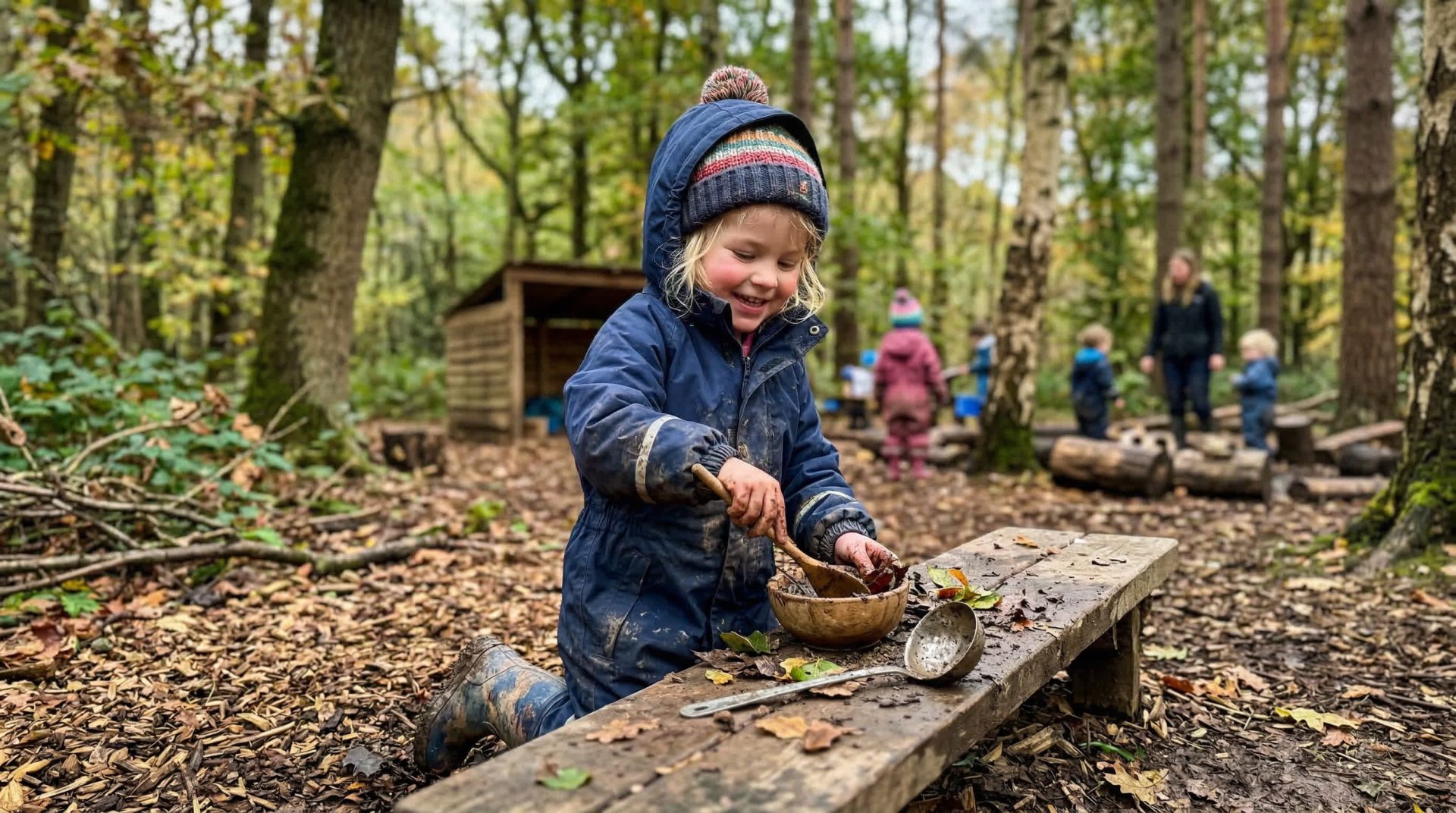
Forest School is a long-term approach to outdoor learning in a natural environment. It uses regular sessions, child-led exploration and reflective practice to support the whole child. In Early Years settings, Forest School can sit alongside the EYFS by promoting learning, development, wellbeing, inclusion and safe practice through meaningful outdoor experiences.
This free forest school online course introduces Forest School in the context of UK Early Years practice. It explains what Forest School is, how it differs from one-off outdoor activities, and how regular, play-based sessions in a natural environment can support children’s development, confidence, independence and wellbeing.
Why Take This eLearning Course?
Forest School offers a thoughtful and child-centred way of supporting learning outdoors. It helps children build confidence, communication, physical skills, resilience and a sense of belonging, while also encouraging safe risk-taking, curiosity and care for the natural environment. For practitioners, it provides a clear framework for planning, observation, safeguarding and reflective practice.
This free course will help you to:
- Understand what Forest School means and how it differs from one-off outdoor activities.
- Recognise the common principles used by UK Forest School training providers.
- Understand how Forest School fits within Early Years practice and the EYFS.
- Explore the links between outdoor, play-based learning and child development.
- Recognise common wellbeing benefits associated with Forest School practice.
- Understand how Forest School can support self-regulation, resilience and independence in children aged 2 to 5.
- Learn how to structure regular Forest School sessions and plan them effectively.
- Recognise how children may show progression over time through repeated outdoor experiences.
- Understand hazard, risk and risk-benefit assessment in outdoor learning.
- Identify common Early Years outdoor risks and typical control measures.
- Explore safeguarding considerations in outdoor practice.
- Learn about common Forest School activities, including how tool and fire culture may be introduced appropriately.
- Understand how to teach simple outdoor living skills in a developmentally appropriate way.
- Recognise barriers to participation and explore inclusive strategies.
- Learn how to support behaviour through relationships, routines and the environment.
- Understand how to observe learning outdoors and link observations to the EYFS without over-formalising play.
- Recognise what information should be shared with parents, carers and colleagues.
- Explore environmental responsibility, including leave no trace style practice.
- Identify what good practice looks like in a UK Forest School programme.
- Reflect on next steps for developing Forest School practice in your setting.
Learning Outcomes
By the end of this course, you will be able to:
- Define Forest School and describe how it differs from one-off outdoor activities.
- Identify the common Forest School principles used by UK training providers.
- Explain where Forest School fits within UK Early Years practice and provision expectations.
- Describe the links between outdoor, play-based learning and Early Years development.
- Explain common wellbeing benefits reported in UK Forest School practice.
- Give examples of how Forest School can support self-regulation, resilience and independence in 2 to 5 year olds.
- Outline how to structure regular Forest School sessions.
- Identify what to include in session planning.
- Give examples of progression over time.
- Define hazard, risk and risk-benefit assessment, and explain why this approach is used in Forest School.
- Identify common Early Years outdoor risks and outline typical control measures.
- Explain safeguarding considerations outdoors.
- List common Early Years Forest School activities.
- Give examples of how tool and fire culture may be introduced appropriately.
- Describe how to teach basic woodland or outdoor living skills in a developmentally appropriate way.
- Identify barriers to participation.
- Explain common inclusive strategies used in Forest School.
- Give examples of supporting behaviour through environment and relationships.
- Describe ways to observe learning outdoors.
- Outline how to link observations to EYFS learning and development without over-formalising play.
- Identify what to share with parents, carers and colleagues.
- Explain leave no trace style practice and how to model care for the natural environment.
- Identify what good practice looks like in a UK Forest School programme.
- Outline appropriate next steps for developing Forest School practice.
Forest School in Early Years Course Outline
Module 1: Understanding Forest School and Its Place in Early Years Practice
Learners will explore what is meant by Forest School and how it differs from one-off outdoor activities. This module explains Forest School as a long-term approach to outdoor learning in a natural environment, using regular sessions, child-led exploration, and reflective practice to support the whole child. Learners will examine the common principles used by UK training providers, including regular long-term practice, learner-centred experiences, holistic development, supported risk-taking, and the use of natural spaces. The module also explains where Forest School fits within UK Early Years practice, showing how it can sit alongside the EYFS and complement wider provision through play-based, observation-led, and inclusive outdoor learning.
Module 2: Outdoor Play, Development, and Wellbeing
This module focuses on the links between outdoor, play-based learning and Early Years development. Learners will examine how Forest School supports physical development, communication and language, personal, social and emotional development, thinking and problem-solving, and sensory learning through real experiences in a natural setting. The module also explores common wellbeing benefits reported in UK Forest School practice, including increased confidence, stronger engagement, enjoyment of learning, emotional release, and a sense of belonging. Learners will consider how repeated outdoor experiences can also support self-regulation, resilience, and independence in children aged 2 to 5 through warm relationships, manageable challenge, predictable routines, and opportunities to make simple decisions and recover from setbacks.
Module 3: Planning, Structure, and Progression Over Time
Learners will explore how regular Forest School sessions can be planned and structured to support both security and child-led exploration. This module explains the value of familiar routines such as arrival, boundary reminders, opening circles, exploration time, focused invitations, snack or rest points, and reflection at the end of sessions. Learners will also examine what to include in session planning, such as aims for learning and wellbeing, resources, site checks, adaptations for individual children, contingency plans, and safeguarding or supervision points. The module also considers how progression can be recognised over time, including changes in confidence, independence, collaborative play, practical skills, and children’s relationships with the site, adults, and peers.
Module 4: Risk, Safety, and Safeguarding Outdoors
This module focuses on how risk is understood and managed within Forest School practice. Learners will examine the meaning of hazard, risk, and risk-benefit assessment, and will explore why this approach is used to balance safety with the educational value of challenge. The module explains common Early Years outdoor risks, including weather, boundaries, plants, fires, tools, uneven ground, and hidden hazards, alongside typical control measures that support safe participation without removing all uncertainty. Learners will also explore safeguarding considerations outdoors, including supervision, site security, toileting and personal care, ratios, staff deployment, communication systems, emergency arrangements, and the need to reflect the setting’s wider safeguarding policy in all outdoor practice.
Module 5: Activities, Skills, Tools, and Fire Culture
Learners will explore the types of activities commonly used in Early Years Forest School and how these can be introduced in developmentally appropriate ways. This module explains how nature play, storytelling, sensory experiences, building, and making activities can support play, language, movement, imagination, and sensory development while remaining open-ended and responsive to children’s interests. The module also covers the respectful introduction of tool and fire culture, showing how routines, modelling, close supervision, safe zones, and developmentally suitable tasks help children learn responsibility and managed challenge over time. Learners will also examine how basic woodland or outdoor living skills can be taught through simple routines, weather awareness, observation, site care, and shared practical experiences that help children become capable and confident outdoors.
Module 6: Inclusion, Behaviour Support, and Participation
This module focuses on inclusive Forest School practice and the steps needed to support participation for all children. Learners will examine common barriers to participation, including sensory needs, limited mobility, communication differences, anxiety, delayed self-help skills, trauma, English as an additional language, lack of suitable clothing, transport issues, family confidence, and site access challenges. The module also explains common inclusive strategies such as offering choice, using visual routines, keeping sessions predictable, using smaller groups, creating quiet or sheltered spaces, adapting communication, and providing practical clothing support. Learners will explore how behaviour can be supported through environment and relationships, including co-regulation, clear boundaries, consistent routines, predictable spaces, trusted adults, and suitable challenge, with behaviour understood as communication rather than simply as misbehaviour.
Module 7: Observation, Assessment, and Communication with Others
Learners will explore how to observe children’s learning outdoors in ways that are purposeful but not intrusive. This module explains how narrative observations, photographs, learning stories, child voice, and adult reflection can be used to understand process, relationships, language, wellbeing, and development in a natural environment. Learners will also examine how to link observations to EYFS learning and development without over-formalising play, focusing on broad learning, meaningful examples, and proportionate assessment rather than checklist-driven recording. The module also covers what should be shared with parents, carers, and colleagues, including progress in confidence and participation, wellbeing, examples of learning, safety approaches, next steps, practical information, and any concerns or support needs in line with safeguarding procedures.
Module 8: Environmental Responsibility, Good Practice, and Next Steps
In the final module, learners will explore how care for the natural environment is embedded within Forest School practice. This module explains leave no trace style practice, including removing litter, avoiding unnecessary damage, using resources thoughtfully, respecting wildlife, caring for equipment and fire areas, and modelling thoughtful language and behaviour towards the site. Learners will also examine what good practice looks like in a UK Forest School programme, including regularity, trained leadership, child-centred delivery, reflection, appropriate boundaries, inclusion, family communication, and respect for the site. The module concludes by encouraging learners to consider next steps in their own development, such as reviewing current provision, identifying where regular sessions could fit, improving sites and resources, building staff confidence, planning further training, and creating manageable improvement goals for future practice.
Target Audience
This course is suitable for:
- Early Years practitioners.
- Nursery and preschool staff.
- Childminders and childminding assistants.
- Reception staff and teaching assistants.
- Forest School leaders and those preparing to introduce Forest School.
- Managers and supervisors in Early Years settings.
- Anyone involved in outdoor learning with young children.
No previous specialist knowledge of Forest School is required.
FAQ
Is this course relevant to Early Years practice in the UK?
Yes. The course is designed for UK Early Years practice and explains how Forest School can complement the EYFS through play-based, child-centred and inclusive outdoor provision.
Does the course explain how Forest School is different from outdoor play?
Yes. It explains that Forest School is a long-term, regular and reflective approach to outdoor learning, rather than a one-off activity or general outdoor play session.
Will this course help with planning and running sessions?
Yes. It covers session structure, planning, progression, risk-benefit thinking, safeguarding and practical activities suitable for young children.
Does it include observation and assessment?
Yes. The course explains how to observe learning outdoors and link this to EYFS learning and development without turning play into an overly formal assessment process.
Does the course cover inclusion and behaviour support?
Yes. It includes barriers to participation, inclusive strategies, and ways to support behaviour through routines, relationships and the outdoor environment.
Is environmental responsibility included?
Yes. The course covers leave no trace style practice, respect for living things, thoughtful use of resources and modelling care for the natural environment.
How long does the course take?
The course is self-paced and typically takes 1 hour to complete.
Will I receive a certificate?
Yes. A certificate is issued after successful completion.
Is the course CPD accredited?
Courses are not currently CPD accredited, but accreditation is planned.
Forest School offers children time, space and repeated opportunities to explore, connect and grow in a natural environment. By understanding its principles and applying them thoughtfully in Early Years practice, practitioners can support learning, wellbeing, inclusion and safe, meaningful outdoor experiences.
Enrol now to build your understanding of Forest School in Early Years practice.
You must log in and have started this course to submit a review.

