
Information, Advice and Guidance (IAG) plays an essential role in helping people understand their options, make informed decisions, and access appropriate support. In health, social care, and community settings, staff are often the first point of contact and need the skills to provide accurate information, appropriate advice, and effective guidance—while working within clear professional boundaries.
This free information, advice and guidance course provides a clear and practical introduction to IAG. It focuses on communication skills, ethical practice, confidentiality, and knowing when and how to signpost or refer individuals to specialist services.
Why Take This eLearning Course?
Providing IAG requires more than good intentions. It demands clarity about roles, strong communication skills, and an understanding of legal and ethical responsibilities.
This free IAG course will help you to:
- Understand IAG clearly: Learn the differences between information, advice, and guidance, and when each should be used.
- Communicate effectively: Develop questioning, listening, and non-verbal communication skills.
- Work within boundaries: Understand professional limits and when to refer or signpost.
- Support fair access: Recognise and challenge barriers and discriminatory practices.
- Work ethically: Apply confidentiality, data protection, and ethical decision-making.
- Improve service quality: Use accurate record-keeping and information management to support individuals effectively.
Learning Outcomes
By the end of this course, you will be able to:
- Define information, advice, and guidance and explain the differences between them.
- Identify the key principles and boundaries of IAG practice.
- Use effective questioning and active listening techniques.
- Recognise how personal values, beliefs, and attitudes can influence interactions.
- Understand signposting and referral processes and when to use them.
- Apply IAG appropriately across different contexts and client groups.
- Identify and address barriers and discriminatory practices in IAG.
- Maintain confidentiality and ethical standards when handling information.
- Keep accurate and lawful records in line with professional requirements.
Information, Advice and Guidance (IAG) Training Course Outline
Module 1: Understanding the Basics of Information, Advice and Guidance (IAG)
Learners will be introduced to the core concepts of information, advice, and guidance and how these differ in practice. This module explains the purpose of IAG within health, social care, and community settings. Learners will explore the key principles, boundaries, and limitations of IAG, helping them understand what can and cannot be provided within their role.
Module 2: Developing Interaction Skills for IAG
This module focuses on the communication skills required to deliver effective IAG. Learners will develop an understanding of effective questioning techniques, active listening, and non-verbal communication. The module also explores how personal values, beliefs, and attitudes can influence interactions with individuals and how to remain professional, respectful, and unbiased.
Module 3: Understanding Signposting and Referrals
Learners will explore what signposting and referrals mean within IAG practice and when each should be used. This module outlines good practice for making referrals and signposting individuals to appropriate services and support. Practical examples are used to help learners recognise situations where signposting or referrals are necessary to meet an individual’s needs.
Module 4: Applying IAG in Different Contexts
This module examines how IAG is applied across different settings and with diverse client groups. Learners will identify common barriers to providing effective IAG, such as access issues or discrimination. The module also explores ways to challenge and overcome discriminatory practices to ensure fair, inclusive, and accessible IAG for all individuals.
Module 5: Developing Skills for Advice Providers
Learners will explore the purpose and structure of advice interviews and how to conduct them effectively. This module explains the importance of confidentiality in advice work and introduces the role of social policy in shaping advice provision. Learners will gain an understanding of how wider policy and systems influence the advice given to individuals.
Module 6: Record Keeping and Information Management in IAG
This module focuses on the legal and professional responsibilities linked to record keeping in IAG. Learners will explore requirements for storing, managing, and retrieving client information securely. The importance of accurate, clear, and timely records is highlighted, along with how good information management supports continuity, accountability, and safe practice.
Module 7: Confidentiality and Ethics in IAG Practice
In the final module, learners will explore ethical principles that underpin IAG work. This includes maintaining confidentiality, handling sensitive information appropriately, and working within clear professional boundaries. Learners will understand how ethical practice protects both individuals and practitioners and supports trust in IAG services.
Target Audience
This course is suitable for:
- Health and social care workers providing frontline support.
- Community workers, support workers, and advisers.
- Volunteers and staff in advice, guidance, and signposting roles.
- Team leaders and managers overseeing IAG provision.
- Learners preparing for roles involving client support and guidance.
No previous IAG training is required. The course is accessible, practical, and relevant across a wide range of settings.
FAQ
What does the course cover?
The course covers IAG principles, communication skills, signposting, referrals, confidentiality, ethics, and record-keeping.
Is this course relevant to UK practice?
Yes. The content reflects UK legislation, ethical standards, and professional expectations.
Can I apply what I learn straight away?
Yes. The course provides practical tools and examples for immediate use.
How long does the course take?
The course is self-paced and typically takes 1 hour to complete.
Will I receive a certificate?
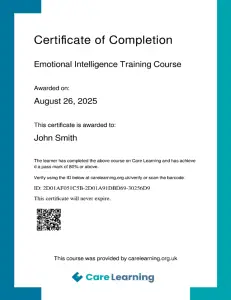
Yes. A certificate is provided on successful completion.
Is this course CPD accredited?
Courses are not currently CPD accredited, but accreditation is planned.
Effective Information, Advice and Guidance empowers people to make informed choices and access the right support at the right time. By strengthening your IAG skills, you can provide clearer, fairer, and more ethical support.
Join this course today and build your confidence in delivering Information, Advice and Guidance.
You must log in and have started this course to submit a review.
Information, Advice and Guidance (IAG) Training Course CPD Accredited and Government Funding
We’re working on getting this Information, Advice and Guidance (IAG) Training Course CPD accredited, and any course that’s approved will be clearly labelled as CPD accredited on the site. Not every health and social care course has to be accredited to help you meet CQC expectations – what matters is that staff are competent, confident and properly trained for their roles under Regulation 18. Our courses are built to support those requirements, and because they’re not government funded there are no eligibility checks or ID needed – you can enrol and start learning straight away.