
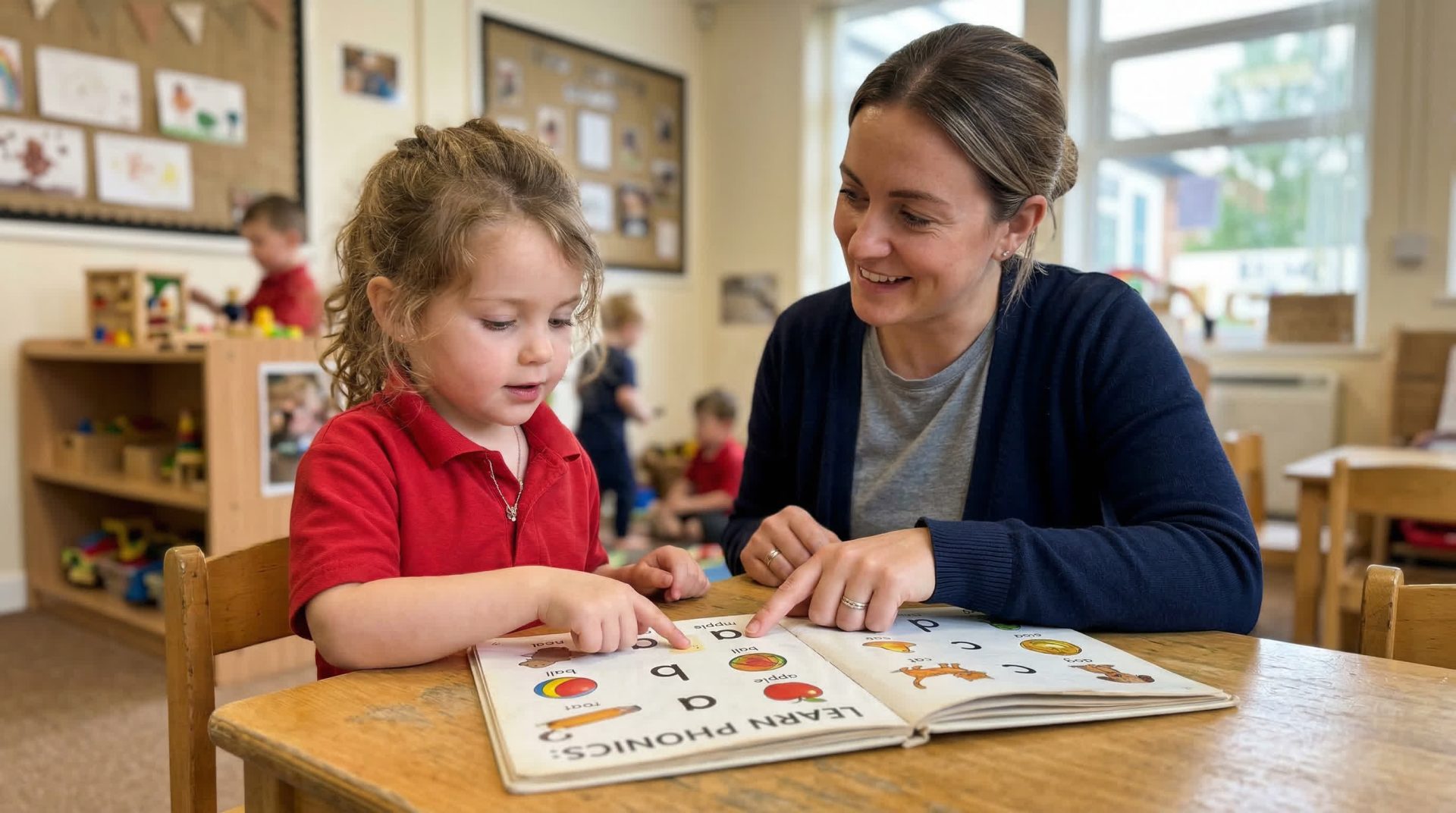
Phonics is a method of teaching that links speech sounds to written letters and letter groups. It supports early reading by helping children work out unfamiliar words, and it supports early writing by helping children choose letters for the sounds they hear. In early years practice, phonics sits alongside talk, stories, songs, mark-making and shared reading to build strong foundations for literacy.
This free phonics online course introduces phonics in the context of Early Years practice in England. It explains what phonics is, why it matters in the EYFS, and how children develop key skills such as sound awareness, blending and segmenting. It also explores play-based teaching, inclusive approaches, assessment and the role of parents and carers in supporting early reading and writing.
Why Take This eLearning Course?
Phonics is a key part of early literacy development. When it is taught in a clear, playful and developmentally appropriate way, it helps children connect spoken language to print, build confidence with words, and begin to read and write with increasing independence. For practitioners, a good understanding of phonics supports better planning, observation and communication with families.
This free course will help you to:
- Understand what phonics means and its purpose in early reading and writing.
- Recognise the importance of phonics within the Early Years Foundation Stage.
- Understand how phonics supports communication, language and literacy development.
- Learn key phonics terminology, including phoneme, grapheme and digraph.
- Understand blending and segmenting and how they support reading and spelling.
- Recognise the difference between letter names and letter sounds.
- Explore the typical phases of phonics used in early years settings.
- Understand what children usually learn at each phase.
- Recognise age-appropriate expectations for early phonics learning.
- Learn how phonics can be taught through play-based learning.
- Explore examples of adult-led and child-initiated phonics activities.
- Understand the role of repetition, songs and stories in phonics teaching.
- Learn how to create a phonics-friendly learning environment.
- Recognise how resources, displays and daily routines can support phonics learning.
- Understand how to support children at different stages of development.
- Explore inclusive approaches for children with additional needs or English as an additional language.
- Learn why assessment is important in phonics learning and how it informs next steps.
- Understand the importance of parental involvement and how settings can support phonics at home.
Learning Outcomes
By the end of this course, you will be able to:
- Define phonics and explain its purpose in early reading and writing.
- Describe the importance of phonics in the Early Years Foundation Stage (EYFS).
- Outline how phonics supports communication, language and literacy development.
- Define phoneme, grapheme and digraph.
- Explain blending and segmenting.
- Identify the difference between letter names and letter sounds.
- Outline the typical phases of phonics used in early years settings.
- Describe what children learn at each phase.
- Identify age-appropriate expectations for early phonics learning.
- Describe how phonics is taught through play-based learning.
- Give examples of adult-led and child-initiated phonics activities.
- Explain the role of repetition, songs and stories.
- Identify features of a phonics-friendly learning environment.
- Describe how resources and displays support phonics learning.
- Outline ways to embed phonics into daily routines.
- Explain how to support children at different stages of development.
- Identify signs a child may need additional support.
- Describe inclusive approaches for children with additional needs or EAL.
- Outline why assessment is important in phonics learning.
- Describe simple observation methods used in early years.
- Explain how assessment informs next steps in learning.
- Explain the importance of parental involvement in phonics.
- Give examples of how settings can support phonics at home.
- Identify simple phonics activities parents can use with their child.
Phonics in Early Years Course Outline
Module 1: Understanding Phonics and Its Purpose in Early Literacy
Learners will explore what phonics is and why it is important in early reading and writing. This module explains phonics as a method of teaching that links speech sounds to written letters and letter groups, helping children connect spoken language with print. Learners will examine how phonics supports early reading through decoding unfamiliar words and supports early writing through selecting letters for the sounds children hear in words. The module also explains the place of phonics within the Early Years Foundation Stage, showing how it contributes to literacy development alongside shared reading, vocabulary growth, mark-making, and rich language experiences. The links between phonics, communication, language, and literacy are also explored, including listening skills, sound awareness, vocabulary development, decoding, encoding, and growing confidence with print.
Module 2: Key Phonics Terminology and Core Skills
This module focuses on the main terms and skills used in early phonics teaching. Learners will examine what is meant by phoneme, grapheme, and digraph, and how these terms help adults describe sounds and letters consistently within early years practice. The module also explains the difference between blending and segmenting, showing how blending supports reading by combining phonemes into words and how segmenting supports writing by breaking words into sounds for spelling. Learners will also explore the difference between letter names and letter sounds, understanding why letter sounds are used more often in early phonics teaching and how clear, consistent adult language helps reduce confusion and build children’s confidence.
Module 3: Progression and Development in Early Phonics Learning
Learners will explore how phonics teaching is often organised through a phased approach in early years settings. This module explains the typical progression from listening and attention, to sound discrimination, to learning simple grapheme–phoneme correspondences, and then to blending, segmenting, digraphs, and more complex spellings. Learners will examine what children usually learn at different phases and how each stage builds on earlier sound awareness, rhyme, alliteration, and oral language experiences. The module also considers age-appropriate expectations for phonics learning, showing how phonics development begins with playful listening and sound awareness in the nursery years and becomes more systematic in Reception, while still remaining flexible and responsive to children’s individual development.
Module 4: Teaching Phonics Through Play and Everyday Practice
This module focuses on how phonics can be taught in ways that are meaningful, engaging, and appropriate for young children. Learners will examine how phonics can be woven into play-based learning through sound-rich talk, role play, labels, signs, games, mark-making, and outdoor learning. The module also explores examples of adult-led and child-initiated phonics activities, showing how short small-group sessions, sound sorting, sound hunts, role play writing, and construction captions can all help children revisit and apply early phonics knowledge. The role of repetition, songs, and stories is also covered, highlighting how regular revisiting, rhythm, rhyme, and shared reading help children remember sounds, notice word patterns, and connect phonics learning with enjoyment of books and spoken language.
Module 5: Creating a Phonics-Friendly Learning Environment
Learners will explore the features of an environment that supports phonics learning naturally across the day. This module explains how a phonics-friendly environment includes clear print, accessible mark-making materials, sound-focused resources, comfortable book spaces, adult modelling areas, and opportunities for phonics indoors and outdoors. Learners will examine how resources and displays can support phonics when they are purposeful, current, and closely linked to adult interaction and the phonics content being taught. The module also explains how phonics can be embedded into daily routines through registration, transitions, tidy-up times, snack routines, self-registration, labels, and familiar print, helping phonics become part of the setting’s everyday culture rather than a separate activity only.
Module 6: Inclusion, Developmental Stages, and Additional Support
This module focuses on how phonics teaching can be adapted to meet the needs of children at different stages of development. Learners will examine how support can begin with rhythm, rhyme, and listening games for children at an earlier developmental stage, and move towards more structured grapheme–phoneme learning, blending, and segmenting for children who are ready. The module also explains signs that a child may need additional support, including limited attention to sounds, difficulty hearing phonemes, slow progress with correspondences, challenges with blending or segmenting, and spoken language difficulties that affect phonics learning. Learners will also explore inclusive approaches for children with additional needs or English as an additional language, including small predictable steps, multi-sensory teaching, clear modelling, vocabulary support, and valuing children’s home language while developing English phonics knowledge.
Module 7: Observation, Assessment, and Planning Next Steps
Learners will explore why assessment is important in phonics learning and how it helps adults understand children’s current knowledge and next steps. This module explains how phonics assessment in early years is often ongoing, proportionate, and linked closely to observation in play, routines, reading, and writing. Learners will examine simple observation methods such as focused small-group notes, spontaneous observations, quick checks, annotated writing samples, reading behaviour notes, listening observations, and conversations with parents and carers. The module also explains how assessment informs next steps by helping adults group children appropriately, revisit or introduce grapheme–phoneme correspondences, target blending and segmenting, choose suitable texts, and adjust support strategies so learning remains responsive and achievable.
Module 8: Working with Parents and Supporting Phonics at Home
In the final module, learners will explore the importance of parental involvement in supporting early phonics development. This module explains how consistency between home and the setting can strengthen children’s confidence, memory, and willingness to apply phonics skills in different contexts. Learners will examine how settings can support phonics at home by sharing information about the approach used, explaining key terms, modelling sound pronunciation, offering workshops or leaflets, and suggesting practical home learning ideas that fit into everyday family life. The module also explores simple home activities such as rhyme time, sound hunts, oral blending games, segmenting in talk, shared reading, and noticing everyday print, showing how these playful experiences can reinforce phonics learning while also building vocabulary, talk, and enjoyment of reading.
Target Audience
This course is suitable for:
- Early years practitioners.
- Nursery and preschool staff.
- Childminders and childminding assistants.
- Reception staff and teaching assistants.
- Literacy leads and phonics leads in early years settings.
- Managers and supervisors.
- Anyone involved in supporting early reading and writing in young children.
No previous specialist knowledge of phonics is required.
FAQ
Is this course relevant to Early Years practice in England?
Yes. The course is designed for Early Years practice in England and reflects EYFS expectations around communication, language, literacy and play-based learning.
Does the course explain key phonics terminology?
Yes. It explains core terms such as phoneme, grapheme, digraph, blending, segmenting, letter names and letter sounds in clear and practical language.
Will this course help with teaching phonics through play?
Yes. The course includes play-based approaches, adult-led and child-initiated activities, and ways to embed phonics into everyday routines and environments.
Does it cover different stages of development?
Yes. It explains how to support children at different stages of phonics development and how to recognise when a child may need additional support.
Is inclusion covered?
Yes. The course includes inclusive approaches for children with additional needs and for children with English as an additional language, with a focus on practical adjustments and accessible teaching.
Does the course include assessment?
Yes. It explains why assessment is important, describes simple observation methods used in early years, and shows how assessment can inform next steps in phonics learning.
Does it include support for parents and carers?
Yes. The course explores the importance of parental involvement, how settings can support phonics at home, and simple activities families can use with their child.
How long does the course take?
The course is self-paced and typically takes 1 hour to complete.
Will I receive a certificate?
Yes. A certificate is issued after successful completion.
Is the course CPD accredited?
Courses are not currently CPD accredited, but accreditation is planned.
A strong understanding of phonics helps early years practitioners support children’s reading and writing in ways that are clear, playful and meaningful. By linking sound, talk, print and real experiences, practitioners can help children build the confidence and skills they need for later literacy success.
Enrol now to build your understanding of phonics in Early Years practice.
You must log in and have started this course to submit a review.

