
Maintaining professional boundaries is essential to providing safe, ethical, and effective care. In health and social care, clear boundaries help to build trust, protect both workers and the people they support, and ensure that professional relationships remain respectful and appropriate.
This free professional boundaries online course explores what boundaries in health and social care are, why they matter, and how to maintain them in everyday practice. You’ll learn how to recognise when boundaries may be at risk, apply professional codes of conduct, and respond appropriately to challenging situations.
Why Take This eLearning Course?
Professional boundaries are at the heart of ethical care practice. They protect individuals receiving support and ensure that care workers act with integrity, respect, and accountability. This course is designed to strengthen your understanding of boundaries and help you make confident, professional decisions.
Here’s why this course is valuable:
- Promote safe practice: Learn how to identify and manage situations where professional boundaries might blur.
- Improve self-awareness: Reflect on your own values, attitudes, and behaviours, and how they influence your relationships at work.
- Strengthen professional confidence: Gain practical tools and communication strategies to uphold boundaries in complex situations.
- Understand your responsibilities: Explore the legal, ethical, and organisational frameworks that govern professional behaviour in care.
Professional Boundaries in Health and Social Care – Course Content Outline
Module 1: Introduction to Professional Boundaries
Learners will explore the concept of professional boundaries within health and social care. The module defines what boundaries are, why they are essential for maintaining professionalism and trust, and how they protect both workers and service users. Learners will also review the potential consequences of poor boundary management, including ethical, legal, and professional risks.
Module 2: Understanding Core Standards and Codes of Conduct
This module introduces the key professional standards that guide behaviour and practice in social care. Learners will study the principles within the relevant codes of conduct (such as those from Skills for Care and the Health and Care Professions Council) and understand how local policies support safe and ethical boundary management.
Module 3: Identifying and Managing Boundaries
Learners will identify common examples of clear and unclear boundaries within their roles. The module explores the distinction between personal and professional relationships, strategies to establish healthy boundaries, and how to manage “grey areas” where lines may become blurred. Realistic case examples and reflection activities help reinforce learning and self-awareness.
Module 4: Practical Application of Professional Boundaries
This module focuses on everyday practice and explores how to maintain boundaries in real situations. Learners will understand how to manage physical contact appropriately, follow rules around giving and receiving gifts, maintain confidentiality and financial boundaries, and avoid inappropriate connections with service users on social media.
Module 5: Professional Boundaries and the Law
Learners will examine the legal implications of breaching professional boundaries and the role of safeguarding in maintaining professional integrity. The module includes how to recognise, report, and respond to boundary violations in accordance with organisational and statutory requirements.
Module 6: Supporting Workers to Maintain Boundaries
This module highlights the importance of support mechanisms such as supervision, appraisal, and reflective practice. Learners will explore how managers and organisations can help staff uphold boundaries through ongoing training, development, and open communication. It reinforces how reflective practice enhances self-awareness and professional growth.
Module 7: Self-Care and Emotional Well-Being
Learners will understand how maintaining personal well-being supports professional judgement and boundary management. The module explores self-care strategies, stress management techniques, and emotional resilience to reduce the risk of burnout or over-involvement in care relationships.
Module 8: Scenario-Based Learning
This final module provides real-life case scenarios that challenge learners to identify boundary crossings and decide how to respond appropriately. Learners will apply the principles and frameworks learned throughout the course to evaluate situations and make ethical, informed decisions.
Learning Outcomes
By the end of this course, you will be able to:
- Define professional boundaries and explain their importance in a social care context.
- Describe how codes of conduct, policies, and procedures support safe and professional practice.
- Identify examples of clear and unclear boundaries, and apply strategies to maintain professional relationships.
- Understand how to manage physical contact, gift-giving, and financial or personal information appropriately.
- Recognise the risks of boundary crossings through social media and personal communication.
- Explain the legal and safeguarding implications of boundary breaches and how to report them correctly.
- Use supervision, reflection, and training to strengthen boundary management skills.
- Apply self-care and emotional wellbeing strategies to reduce the risk of compassion fatigue and professional burnout.
- Demonstrate appropriate responses to real-world scenarios involving boundary dilemmas.
Target Audience
This course is suitable for:
- Health and social care workers
- Support workers, care assistants, and keyworkers
- Team leaders and registered managers
- Students and new entrants to the care sector
- Volunteers and anyone supporting vulnerable individuals
No prior knowledge is required. This course is designed for all levels, from those new to care to experienced professionals seeking to refresh their knowledge.
FAQ
How long does the course take?
This course typically takes 1-2 hours to complete, depending on your pace and reflection activities.
Do I need any previous training?
No. The course is suitable for beginners and experienced staff alike.
Is the course aligned with UK standards?
Yes. The content is mapped to the Skills for Care standards, CQC regulations, and relevant UK safeguarding guidance.
Will I receive a certificate?
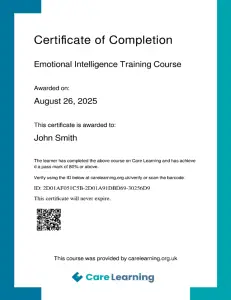
Yes. You’ll receive a certificate of completion, which can be added to your CPD record or used for compliance evidence.
Can I study in my own time?
Yes. The course is self-paced, so you can complete it whenever it suits you.
In health and social care, professional boundaries safeguard both the worker and the individual receiving care. They ensure that relationships remain appropriate, respectful, and focused on the person’s wellbeing. When boundaries are crossed, trust can be broken, professionalism can be questioned, and harm may occur.
This course equips you with the knowledge and skills to manage these challenges confidently—helping you maintain the integrity and trust that define excellent care practice.
Enrol in the Professional Boundaries in Health and Social Care Training Course today.
Learn how to protect yourself, your organisation, and the people you support through strong, ethical, and professional boundaries.
You must log in and have started this course to submit a review.