
A strengths based approach focuses on what people can do, rather than what they cannot. It recognises abilities, resilience, relationships, and community resources, and uses these as the foundation for care and support planning.
In health and social care, this approach promotes independence, confidence, and wellbeing. It shifts practice away from deficit-focused models and towards partnership, empowerment, and shared decision-making.
This free strengths based approach online course provides a clear, practical guide to understanding and applying strengths based approaches in everyday professional practice.
Why Take This eLearning Course?
Traditional care models often focus on needs, risks, and problems. While these are important, they can unintentionally reduce autonomy and confidence. A strengths based approach encourages professionals to see the whole person and work collaboratively to achieve meaningful outcomes.
This free course will help you to:
- Understand strengths based practice: Learn its principles and how it differs from deficit models.
- Identify strengths effectively: Recognise individual, family, and community assets.
- Use practical tools: Apply strength mapping, the ROPES model, and positive risk-taking approaches.
- Work collaboratively: Encourage co-production and shared decision-making.
- Use motivational interviewing techniques: Support empowerment and goal setting.
- Embed strengths based thinking: Promote a positive culture within teams and organisations.
- Evaluate impact: Reflect on outcomes and continuous improvement.
Learning Outcomes
By the end of this course, you will be able to:
- Define a strengths based approach within health and social care.
- Explain the key principles underpinning strengths based practice.
- Identify methods for recognising individual, family, and community strengths.
- Apply tools such as strength mapping and the ROPES model.
- Use motivational interviewing techniques to support change and empowerment.
- Encourage collaborative planning and co-production.
- Integrate strengths based thinking into daily professional practice.
- Evaluate the effectiveness of strengths based interventions.
Strengths Based Approach Course Outline
Module 1: Understanding Strengths Based Approaches
This module introduces the strengths based approach within health and social care. It explains the core principles, including empowerment, collaboration, and focusing on abilities rather than deficits. Learners will explore the benefits of recognising strengths to improve confidence, resilience, and wellbeing.
Module 2: Identifying and Building on Strengths
Learners will explore practical methods for identifying strengths at individual, family, and community levels. This includes strength mapping, positive risk-taking, and supportive conversations that help people recognise and use their own abilities and resources.
Module 3: Collaborative Practice
This module focuses on partnership working. Learners will understand the importance of co-production, shared decision-making, and respectful communication. It also explores common barriers to collaboration and practical strategies to overcome them.
Module 4: The ROPES Model and Strengths Mapping
Learners will be introduced to the ROPES model (Resources, Options, Possibilities, Exceptions, Solutions) and how it supports strengths based assessment and planning. The module explains how to create strengths maps and apply the model in real-world care situations.
Module 5: Motivational Interviewing and Planning
This module explains motivational interviewing and its role in supporting empowerment and positive change. Learners will explore key techniques, collaborative goal setting, and the development and review of action plans that promote independence and build on existing strengths.
Module 6: Embedding Strengths Based Approaches in Practice
Learners will examine how to integrate strengths based working into daily practice. The module considers organisational culture, teamwork, and the value of linking with community resources and networks to enhance outcomes.
Module 7: Case Studies and Action Planning
The final module provides real-world examples of strengths based practice. Learners will develop an action plan for applying the approach in their own setting and explore ways to evaluate its impact on individuals, teams, and services.
Target Audience
This course is suitable for:
- Health and social care workers.
- Social workers and support workers.
- Managers and team leaders.
- Community workers and care coordinators.
- Anyone involved in assessment, care planning, or support provision.
No prior knowledge of strengths based practice is required.
FAQ
Is this course relevant to UK health and social care?
Yes. The course reflects UK legislation, policy expectations, and person-centred practice standards.
Is this course practical?
Yes. It includes practical tools, examples, and case studies that can be applied immediately.
How long does the course take?
The course is self-paced and typically takes 1 hour to complete.
Will I receive a certificate?
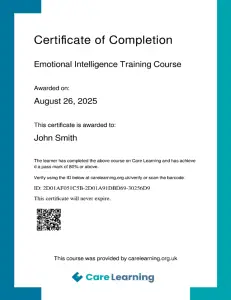
Yes. A certificate is provided upon successful completion.
Is this course CPD accredited?
Courses are not currently CPD accredited, but accreditation is planned.
A strengths based approach promotes dignity, independence, and resilience. By completing this course, you will develop the confidence and practical skills to apply strengths based principles consistently in your professional role.
Enrol now to strengthen your practice and promote empowering, person-centred care.
Strengths Based Approach Training Course CPD Accredited and Government Funding
We’re working on getting this Strengths Based Approach Training Course CPD accredited, and any course that’s approved will be clearly labelled as CPD accredited on the site. Not every health and social care course has to be accredited to help you meet CQC expectations – what matters is that staff are competent, confident and properly trained for their roles under Regulation 18. Our courses are built to support those requirements, and because they’re not government funded there are no eligibility checks or ID needed – you can enrol and start learning straight away.