
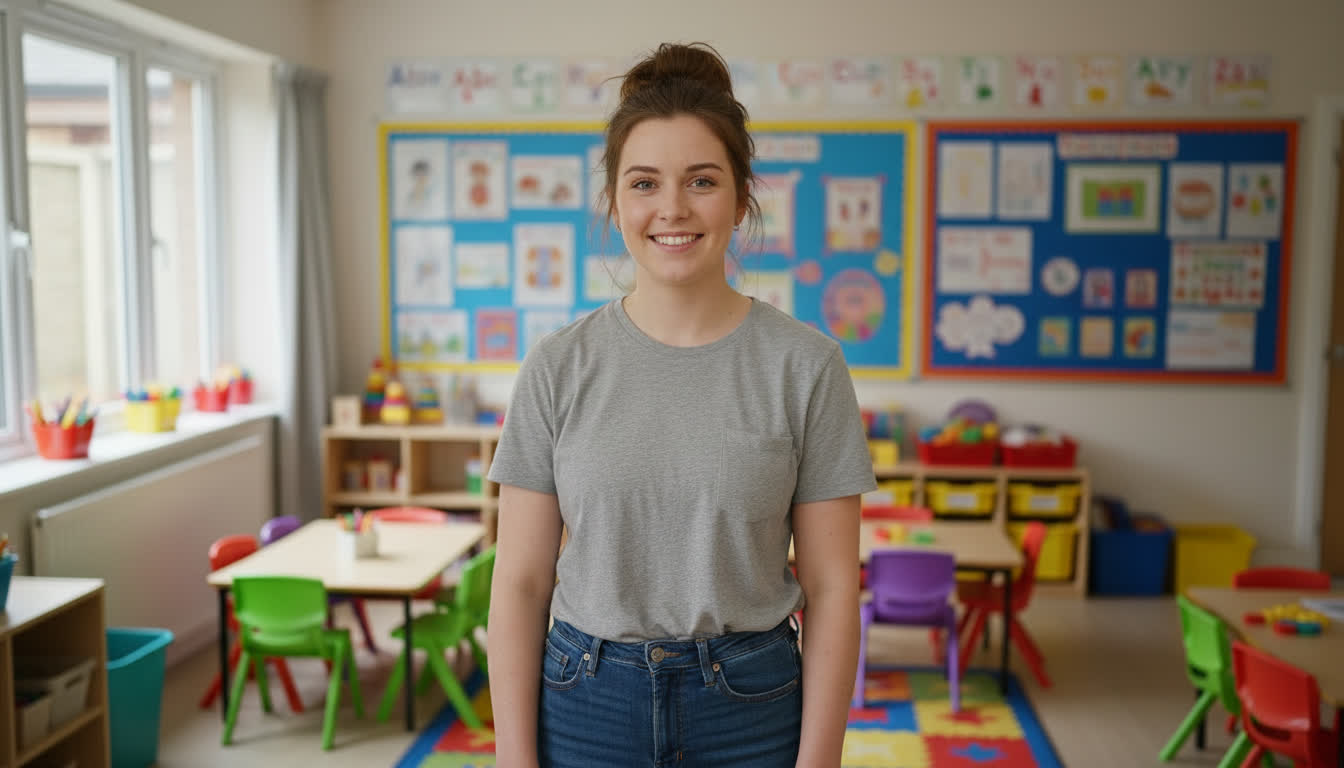
A calm corner is a small, planned space in an early years setting where a baby or young child can feel safer, quieter, and more settled with support from a trusted adult. It is there to help with emotional regulation, co regulation, sensory overload, and recovery after stress. It is not a punishment space, and it should not be used to isolate a child for doing something wrong.
In England, this sits comfortably alongside the EYFS statutory framework, which expects settings to support children’s personal, social and emotional development, wellbeing, safety, and individual needs. It also links with the SEND Code of Practice, which sets out how early years settings should identify needs early and put support in place.
A calm corner can look simple. A rug, a couple of cushions, a few carefully chosen resources, and an adult who knows how to use the space well may be enough. When it is planned properly, it can change the feel of a room.
Young children often show stress through their bodies and behaviour before they have the words to explain it. A child may cover their ears, cry hard, throw toys, run away, freeze, cling, or lash out. Those moments are easy to read as poor behaviour. More often, they point to overload, frustration, tiredness, fear, or a strong need for comfort.
A calm corner gives staff a steady way to respond. It helps adults slow things down, protect the child’s dignity, and keep the relationship intact. It also helps children learn that strong feelings do not push adults away.
“A calm corner should feel like support, not removal.”
This article looks at what a calm corner is, why it helps, how it differs from time out, what to include, how to introduce it, what it may look like in different settings, and which mistakes can weaken it. It also links the practice to the Department for Education guidance on mental health for early years children, the guidance on emotions in the early years, and the NICE guidance on social and emotional wellbeing in the early years.
What is a calm corner and what is it for?
A calm corner is a support space. Its job is to help a child move from stress, upset, or overload towards a steadier state where they can reconnect, think, and join in again. It is not there to make children sit still or stay quiet for adult convenience.
The purpose is practical. A child may need the space after a disagreement, before a noisy transition, during a difficult separation from a parent or carer, or when the room feels too busy. In a baby room, the space may be used mostly with an adult for cuddles, rocking, or a short pause from noise and activity. In a preschool or Reception room, some children may begin to use parts of it more independently, though adult support still does most of the work.
Language helps shape how children see the space. If the team calls it the calm corner, calm space, or quiet space, that name should stay the same. The wording around it should also stay calm and neutral. Children need to hear that the space is there to help, not to remove them or correct them.
This is especially useful for children with communication needs, sensory differences, attachment needs, or wider developmental needs. A child who cannot explain “this is too loud” may show it through behaviour. A child who feels unsure after a change in routine may need a familiar place and a familiar adult. A calm corner gives adults a place to respond quickly and kindly.
“Children do not need a perfect corner. They need a predictable response.”
Parents and carers often notice the difference too. When a setting uses a calm corner well, it shows that behaviour is being read as communication. It shows that emotional support is built into everyday care. That fits well with the broad aims of the Early Years Foundation Stage and with person centred practice across early years work.
Why does a calm corner support emotional regulation?
Emotional regulation is the gradual ability to notice feelings, manage body responses, and recover after stress. Young children are still learning how to do that. They are not born knowing how to calm themselves after disappointment, noise, change, or frustration.
This is where co regulation comes in. Co regulation means a child uses the adult’s calm voice, steady presence, routine, and relationship as support while their own regulation skills are still developing. It is one of the clearest reasons a calm corner can help. The space lowers demands, but the adult makes it work.
A quieter area can reduce noise, visual busyness, social pressure, and choice overload. That does not solve everything. It does give the child a better chance of settling. Once the child feels safer, they are more likely to listen, use language, accept comfort, and return to play or learning.
The adult response sits at the centre of this. A practitioner may crouch down, soften their voice, offer one simple choice, or sit nearby without rushing the child. Small actions. Big difference. Over time, repeated experiences like this can help children notice what settling feels like and which tools support them.
Some people worry that a calm corner might encourage dependence on adults. There is a fair point there. Children do need chances to build their own coping skills. Yet that growth usually starts with shared regulation, not instant independence. On second thought, that is often where teams need the clearest shift in thinking. The calm corner is not a shortcut to self control. It is a place where self regulation starts to take shape through repeated, supported experiences.
The wider picture supports this approach. The government guidance for early years providers on mental health places strong emphasis on warm relationships and responsive adult support. The NICE early years wellbeing guidance also points towards early support for social and emotional development.
What is the difference between a calm corner and time out?
The difference is not about furniture. It is about purpose, tone, and adult behaviour. A calm corner is there for support. Time out is usually used to withdraw a child after behaviour adults want to stop.
Children tend to feel that difference very quickly. If a child is sent to the calm corner with a sharp voice, kept there until an adult decides they are ready, or taken there mainly after conflict, the space stops being a support. It becomes a sanction with soft cushions.
That shift can happen easily. A setting may begin with good intentions, but children soon learn what the space means by how adults use it. If they only go there when adults are cross, they will read it as a place for being in trouble. Once that happens, the calm corner loses its value.
A calm corner should stay relational. An adult may sit nearby, offer one or two regulating tools, name what they notice, and keep the child connected. A baby or toddler may need full adult support there. An older child may manage short periods with a familiar routine and nearby supervision. The level of independence should match the child, not adult preference.
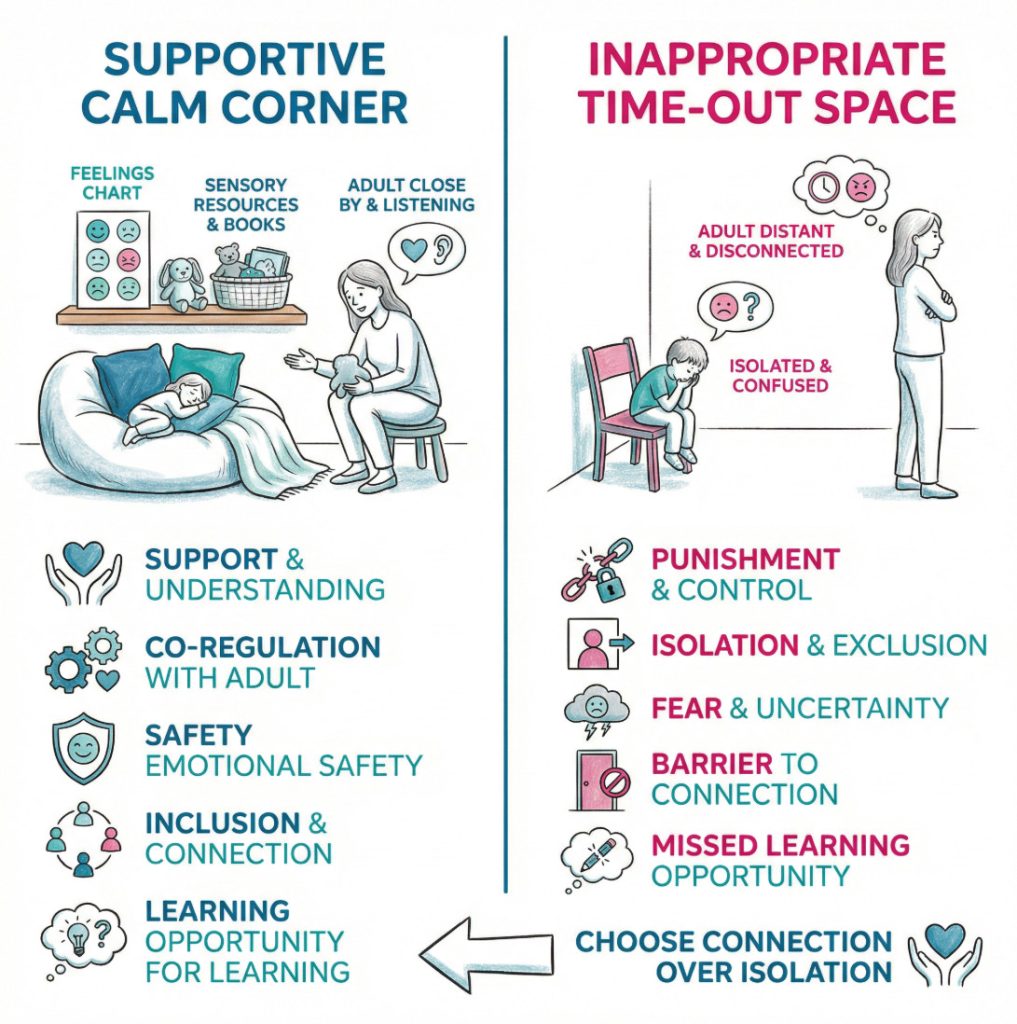
A simple comparison can help.
| Calm corner | Time out space |
|---|---|
| Used to help a child settle | Used to withdraw a child after behaviour |
| Adult stays emotionally available | Adult often steps back or removes attention |
| Child keeps dignity and connection | Child may feel shame or rejection |
| Resources are chosen to support regulation | Resources are absent or not central |
| Can be used before distress grows | Usually used after a problem |
“If the space feels like punishment, children will treat it like punishment.”
This distinction also links to safeguarding, inclusion, and equal access. The Equality Act 2010 guidance and the SEND Code of Practice both support the need for reasonable adjustments and thoughtful responses to individual needs. A calm corner can be part of that response. It should never become a place where children are pushed out of ordinary experiences because they need more support.
What should you include in a calm corner?
The best calm corners are simple, uncluttered, and easy to read. Too many items can make the space busy and confusing. Fewer, well chosen resources usually work better.
The resources should support comfort, sensory regulation, communication, or emotional recognition. They are not there to entertain children or fill the area with colourful objects. They are there to help a child settle.
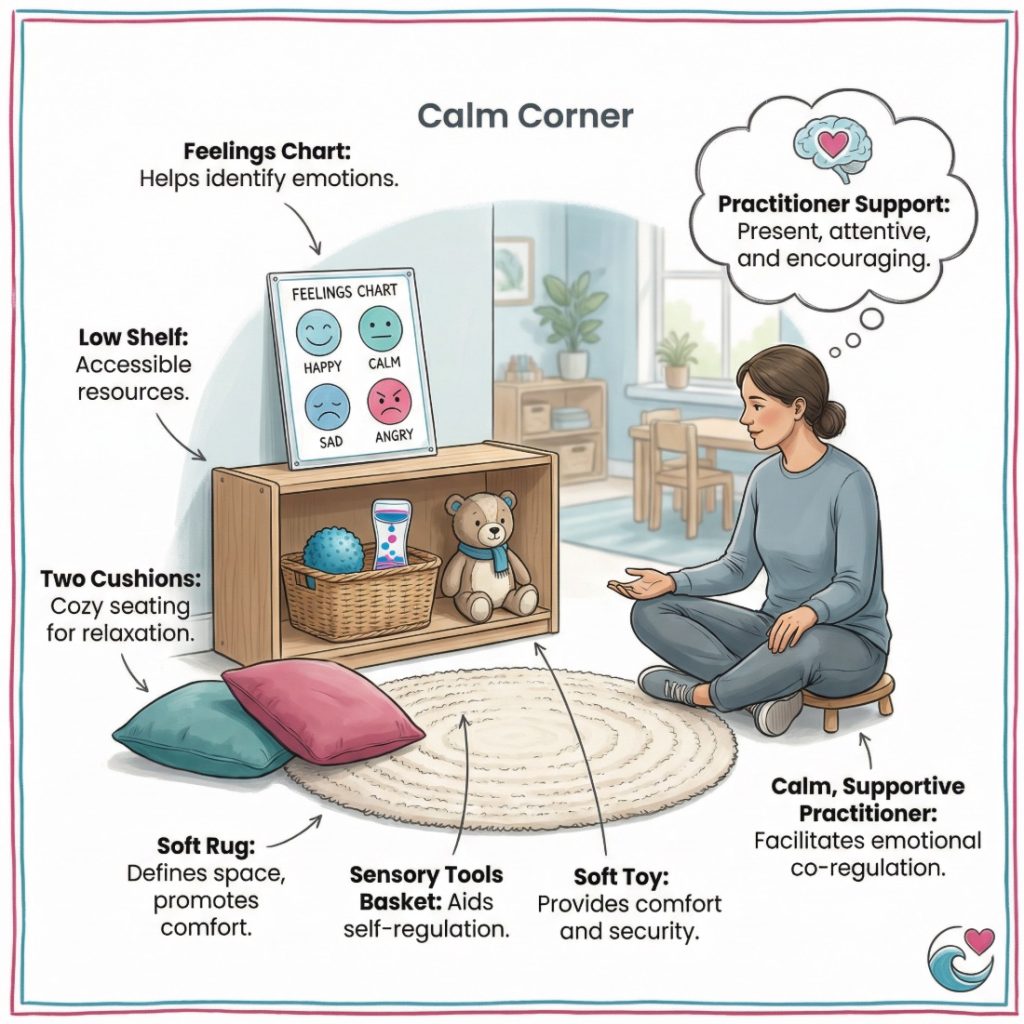
- Comfort objects: Soft cushions, a washable blanket, a small rug, or one or two soft toys can help the space feel safe and familiar. These should be calm items rather than exciting ones.
- Sensory tools: A stress ball, textured fabric, a simple fidget, or ear defenders may help some children settle. These tools should be chosen carefully and reviewed to see whether they actually help.
- Visual supports: Feelings cards, simple picture cues, a now and next board, or a visual prompt for quiet breathing can support children who find spoken language hard when upset.
- Comforting books or photo cards: A few calm books about feelings, routines, or reassurance may help. Some children also respond well to a small set of family photo cards.
- Low stimulation storage: A basket or low shelf keeps resources easy to reach and easy to tidy. That helps the space stay predictable.
It is worth being selective. Fairy lights, busy posters, glitter bottles, noisy toys, or lots of bright plastic items can look appealing to adults but feel overwhelming to children. A pop up tent may help one child feel contained, but it may not suit your supervision arrangements or the needs of the wider group.
Different settings will shape the space in different ways.
- Nursery baby room: A quiet nook with a soft mat, two comfort objects, and a familiar adult nearby may be enough.
- Preschool room: A low shelf, a feelings chart, a basket of calming tools, and enough open space for an adult to sit alongside the child often works well.
- Childminding setting: A corner near the sofa with a cushion, a photo book, and a small calming basket can be very effective.
- Reception class: A defined quiet area with simple visuals and one or two agreed tools may support children during transitions or after a busy group session.
The early years guidance on emotions is useful here because it links emotional support to everyday routines rather than separate behaviour systems.
Where should the calm corner go and how should it look?
Location shapes how well the space works. A calm corner needs to reduce stimulation, but it also needs to remain visible and safe. It should not be hidden away from adult oversight.
A corner near the book area often works well because that part of the room is already quieter. Some teams place it near the key person base so support is close by. Others use low shelving to define the space without cutting it off from the room. What usually works less well is placing it near the entrance, beside the loudest area, or next to the place where children queue and wait.
The look of the space should be calm and predictable. Soft colours, tidy storage, simple visuals, and limited wall display all help. Children should be able to see what is there and what it is for. If there are too many choices, the space can become another source of overload.
Accessibility should be considered from the start. A child with physical disabilities should be able to enter and use the area comfortably. A child with sensory differences may need a quieter position, softer colours, or fewer resources. A child with communication needs may need clear pictures and consistent language. A child with visual impairment may need resources placed in a very specific way. The environment should be shaped around real children, not around a generic idea of what a calm corner looks like online.
The Equality Act guidance is relevant here because settings may need to make reasonable adjustments for disabled children. The SEND Code of Practice is relevant too, especially where the calm corner forms part of a wider plan of support.
“A calm corner should be easy to reach, easy to read, and easy to use.”
How do you introduce a calm corner to children?
A calm corner should be introduced before it is needed. If children only hear about it in the middle of a difficult moment, they may link it with getting into trouble. A calmer introduction helps children see it as a normal part of the room.
Start by showing the space during ordinary times. Let children look around with an adult. Name the area clearly. Use simple language and the same terminology each time. Practitioners can model what the resources are for by sitting there briefly, holding a cushion, naming feelings, or using a visual prompt in a natural way.
A short step by step approach often works well.
- Step 1: Introduce the space when the room is calm and children are regulated enough to take it in.
- Step 2: Show a few resources and explain them with simple, familiar language.
- Step 3: Model the space through everyday use, not just after conflict or upset.
- Step 4: Link the space to body cues such as tired eyes, tight hands, loud noise, or feeling cross.
- Step 5: Practise using one or two tools with adult support so children know what to expect.
- Step 6: Keep reviewing what children actually use and what they ignore.
Stories and routine language can help. A book about feelings, a visual timetable, or a familiar phrase from a key person may make the space easier to trust. This is especially helpful for children who rely on repetition and predictability.
A realistic example is a three year old who becomes distressed before tidy up every day. The practitioner notices the pattern, introduces the calm corner during free play, and practises sitting there for a short moment with a soft toy and a picture card. A few days later, the child is offered the space before tidy up noise builds. The transition becomes smoother because the child already knows the routine.
Family knowledge can strengthen this process. A parent or carer may know that a child settles best with a certain phrase, a familiar object, or a picture of home. The What to expect in the EYFS guide for parents is useful background here because it helps place emotional development within the wider early years picture.
When should children use a calm corner, and how might it work in practice?
Children may use a calm corner before, during, or after a stressful moment. It can prevent escalation, not just respond to it. That is often where it becomes most useful.
A child may need the space before group time after a difficult drop off. Another may need it during a noisy transition. Another may use it after a conflict once the immediate safety issue has been managed. Not every upset child will want the calm corner, and not every situation calls for it. The space should be offered when it genuinely helps regulation.
Examples from different settings make this clearer.
- Baby room example: A baby becomes fretful after a busy arrival period. The key person takes them to the calm corner, reduces stimulation, and uses a familiar phrase while holding them close. The space supports co regulation rather than independent calming.
- Preschool example: A four year old becomes distressed after losing a turn with a favourite toy. The practitioner first keeps everyone safe, then offers the calm corner, sits nearby, and uses a visual to show “my turn later”.
- Childminding example: A child arrives unsettled after leaving a parent. The childminder uses a small quiet space with a cushion, photo cards, and calm talk before the child rejoins snack.
- Reception example: A child who finds transitions difficult uses the calm space for a short period before carpet time with a visual routine card and one familiar sensory tool.
These examples show the same principle in different forms. The space helps because adults use it early, calmly, and consistently.
It also helps teams notice patterns. If one child needs the calm corner several times a day, or only during certain parts of the routine, that information is useful. It may point to sensory overload, communication difficulty, fatigue, anxiety, a need for more predictable routines, or a broader SEND profile. The calm corner may help in the moment, but repeated use should lead to reflection, observation, and discussion with the child’s family and relevant staff.
How does a calm corner link to co regulation, the key person role, and the evidence base?
A calm corner only works well when adults know how to co regulate. Co regulation means the child borrows calm from the adult. Voice, posture, pace, facial expression, and relationship all shape that process.
That is why the key person role is so important. A familiar adult often makes the difference between a child settling and a child feeling pushed away. The EYFS framework places clear value on the key person approach, attachment, confidence, and wellbeing. A calm corner fits that approach when it is used as part of responsive care rather than as a separate behaviour system.
The evidence base needs careful wording. There is support for emotionally responsive practice, for co regulation, and for early support with social and emotional development. There is also support for approaches that build self regulation over time. What the evidence does not show is that a beanbag or sensory toy on its own changes children’s development. The room setup helps, but the quality of adult response does most of the work.
That is why a calm corner should sit inside a wider culture of emotionally informed practice. Staff need a shared view of what distress looks like, how behaviour communicates need, and how adult tone can either settle or escalate a situation. Room leaders, SENCOs, DSLs, managers, and key persons may all play a part here.
- Key person: Builds trust, knows the child’s cues, and offers familiar support.
- SENCO: Reviews whether the calm corner is meeting a child’s needs and whether wider adjustments are needed.
- DSL: Keeps an eye on repeated distress where safeguarding concerns may sit in the background.
- Leader or manager: Checks that the space is used consistently and that staff training matches the setting’s approach.
A counter point does come up from time to time. Some practitioners worry that giving children a special calm area may single them out or make them avoid ordinary frustrations. That risk exists if the space is used poorly or offered in a way that feels exceptional. Used well, though, it does the opposite. It gives children a safe route back into the group.
What legislation, standards, and guidance are relevant?
A calm corner is not a named legal requirement. It does, however, connect closely with early years duties around wellbeing, inclusion, safeguarding, development, and meeting individual needs.
The main frameworks and organisations linked to this topic are worth keeping in view.
- EYFS statutory framework: Sets the standards for learning, development, safeguarding, and welfare for children from birth to five in England.
- SEND Code of Practice: Covers early identification, the graduated approach, and support for children with SEND in early years settings.
- Equality Act 2010: Supports non discrimination and reasonable adjustments for disabled children.
- Childcare Act 2006: Sits behind the regulation of early years provision in England.
- NICE: Provides guidance on social and emotional wellbeing in the early years.
- Ofsted: Inspects registered early years provision and looks at how settings support children’s development, behaviour, personal development, and leadership.
- Department for Education guidance: Offers practical early years material on emotions, mental health, routines, and personal, social and emotional development.
These frameworks are most relevant in England. Scotland, Wales, and Northern Ireland have different arrangements, although the broad ideas around emotional support, inclusion, and child centred practice remain familiar.
For leaders and practitioners, a calm corner is best viewed as one part of a thoughtful environment. It can support a setting’s wider duties, but it does not replace observation, planning, partnership with families, staff training, or proper SEND processes. The Ofsted inspection information for early years is useful for the broader context, and the NHS mental health pages can also help adults reflect on how stress affects wellbeing more generally.
What are the most common mistakes to avoid?
Many calm corners fail because the idea is sound but the daily use becomes confused. The setup may look attractive, but children do not experience it as safe or supportive.
The most common mistakes are usually practical.
- Using it as punishment: If children are sent there after “bad behaviour”, the space quickly becomes a softer version of the naughty corner.
- Adding too many resources: Lots of bright, noisy, or exciting items can increase stimulation instead of reducing it.
- Expecting independence too soon: Many babies and young children still need strong adult support to use the space well.
- Putting it in the wrong place: A corner beside the busiest area, doorway, or queueing point is unlikely to help children settle.
- Using mixed language: If one adult uses it for support and another uses it as a sanction, children receive two messages at once.
- Failing to review patterns: Frequent use by one child may point to unmet needs, SEND concerns, or environmental triggers.
- Leaving families out: Parents and carers often know what soothes a child, what unsettles them, and which routines work best.
A short checklist can help staff review the space.
- Purpose: Is the calm corner clearly used for support rather than sanction?
- Adult role: Do adults stay emotionally available when children use it?
- Resources: Are the items simple, calm, and genuinely useful?
- Location: Is the space quiet, visible, and easy to supervise?
- Consistency: Does the whole team use the same language and approach?
- Inclusion: Can children with different needs access and use the space?
- Review: Does the team notice patterns and adapt the provision when needed?
A realistic case shows how easily things can slip. A preschool creates a lovely calm corner with fairy lights, glitter bottles, and many sensory toys. Staff then begin sending children there after arguments. Within a few weeks, children are calling it the naughty corner. The problem is not the corner itself. The problem is how adults are using it.
“A calm corner works best when adults change their response as well as the room.”
Conclusion and next step
A calm corner can be a very useful part of an early years setting when it is built around safety, co regulation, and respectful relationships. The space helps, but the adult response carries most of the weight. Children learn to settle through repeated experiences of being helped to settle.
The strongest calm corners are simple, predictable, and thoughtfully used. They do not shame children. They do not replace careful observation or wider SEND support. They do not solve every behaviour concern. What they can do is give babies and young children a safe place to recover from stress and return to play, learning, and relationships with support.
For anyone building or reviewing a calm corner, the next sensible step is to look closely at the daily routine around it. Not the cushions. Not the labels. The adult language, the timing, the location, and the consistency across the team. That is where the real quality shows.
Subscribe to Newsletter
Get the latest news and updates from Care Learning and be first to know about our free courses when they launch.


