
Symbolic play is when a baby or young child uses one thing to stand for something else during play. An object, action, word, sound or role takes on a new meaning. A block becomes a phone. A child becomes a parent. A handful of leaves becomes soup. EYFS statutory framework, Play skills guidance from Bolton NHS Foundation Trust
In early years, symbolic play sits alongside pretend play, imaginative play and role play. These terms overlap, but they are not identical. Symbolic play is the broader idea underneath them. The child is representing something in the mind, then showing that idea through objects, actions, language or stories. Development Matters and the Department for Education’s imagination and creativity guidance both place this kind of imaginative, play based learning within early development in England.
This is one of the clearest signs that thinking is becoming more flexible. The child is no longer responding only to what is directly in front of them. They are remembering, copying, changing and combining experiences. That links symbolic play with communication, social development, emotional expression and the wider EYFS picture of learning through play, adult modelling and adult guided activity.
“Symbolic play shows that a child can hold an idea in mind and act on it. That small shift opens the door to language, stories, memory and shared play.”
A short comparison helps here.
| Term | What it usually looks like | What makes it different |
|---|---|---|
| Imitation | Copying a real action such as stirring or sweeping | The child copies what they have seen |
| Symbolic play | Using one thing to stand for another | Meaning is transferred from one object, action or role to another |
| Role play | Acting as a person or character | The child takes on a role within the play |
| Small world play | Using figures, animals, vehicles or props in a scene | The child may create symbolic stories on a smaller scale |
Why does symbolic play help children learn?
Symbolic play brings several areas of development together at once. A child pretending to give medicine to a teddy may be drawing on memory, vocabulary, care giving routines and emotional expression in one short sequence. The same moment can include turn taking, problem solving and early storytelling. The EYFS statutory framework states that children learn and develop through play, adult modelling, observing each other and guided learning, which is exactly where symbolic play often sits.
Language often grows quickly in pretend play. Children have a reason to speak. They name roles, repeat familiar phrases, explain what is happening and experiment with new words. The Department for Education’s exploring language guidance says children extend language through pretend play and acting out stories, and that props, small world resources and open ended materials can deepen this learning.
Symbolic play also supports flexible thinking. A stick is still a stick, but in the play it may become a spoon, a wand or a pen. That shift is not trivial. It gives children repeated practice in representation, and representation sits behind reading, writing, drawing and mathematics. Development Matters links children’s play with representing ideas, creating storylines and building on previous learning.
The emotional side is just as important. Children often replay routines and events that feel powerful, puzzling or familiar. Bedtime. Hospital visits. New babies. Cooking. Going on a bus. Through play, they can revisit those experiences with a sense of control. The Department for Education’s interactions guidance and Best Start in Life review both stress the role of warm, responsive interaction in helping children communicate, play and build relationships.
“A child stirring an empty bowl is not ‘just pretending’. They may be rehearsing language, replaying a routine and building a story all at once.”
A common counter point is that symbolic play can be overpraised, while movement play, sensory play or construction play may show equally rich thinking. That is a fair point. Children do not all grow in the same pattern. Symbolic play is important, but it is one strand of development rather than the only sign of good learning. Development Matters presents play as broad, varied and interconnected.
When does symbolic play begin and how does it develop?
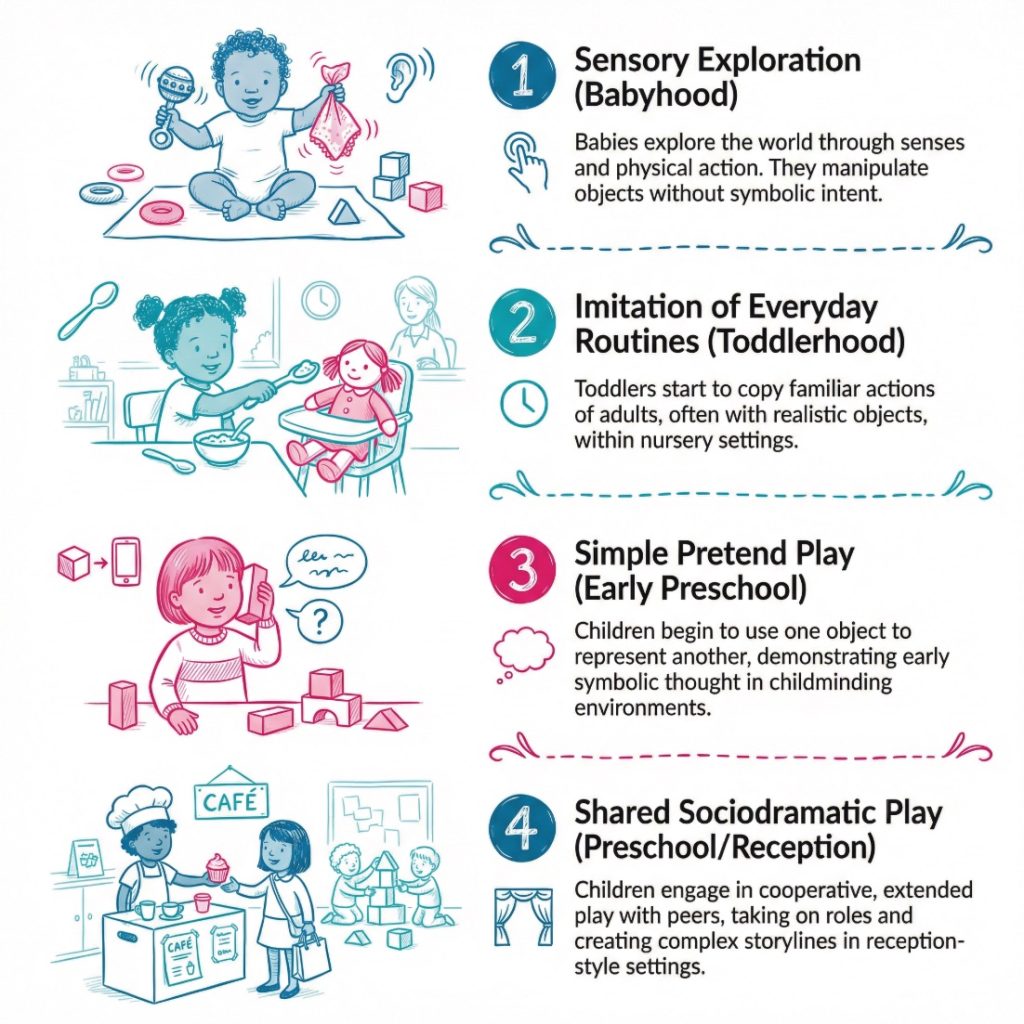
Symbolic play usually grows out of earlier play. Babies begin with sensory and exploratory play. They look, reach, mouth, drop, shake and repeat actions. Those repeated experiences help them learn what objects feel like, how they move and what other people do with them. Development Matters places repetition, exploration and connection making at the centre of early development.
The first signs are often simple. A toddler may pretend to drink from an empty cup, pat a doll to sleep or hold a block to the ear like a phone. The Bolton NHS play skills page describes symbolic play as using one object to represent another, and gives the example of a child pretending a block is a phone. Development Matters also notes simple pretend play such as using an object like a brush to pretend to brush hair or drinking from a pretend cup.
Later, the play often becomes more flexible and more connected. The child moves from single actions to short sequences. They may cook a meal, serve it, tidy up and put the baby to bed. They may start using objects that do not closely resemble the real item. A caveat here is that development is uneven. Some children show this early. Others stay longer with transport play, sensory play or construction play before symbolic elements become clear.
By the preschool years, children often begin to build shared imaginary scenes with other children. Development Matters says children aged 3 and 4 are learning to take part in simple pretend play, and that adults should provide flexible, open ended resources, help children negotiate roles and support children who are not joining pretend play. It also states that children in Reception will be learning to develop storylines in their pretend play.
A realistic nursery example shows the pattern well. A two year old watches snack being prepared each day. Soon she stirs an empty bowl in the home area. Later, she adds pinecones as “pasta”, serves it to a doll and warns that it is “hot”. A few weeks after that, she insists everyone sits down, then whispers because “the baby is sleeping”. Same theme. More depth.
Where does symbolic play appear in different early years settings?
Symbolic play can appear almost anywhere. It does not depend on a home corner. It may happen with crates outdoors, blocks on the carpet, toy animals in a tray, or a scarf tied around the shoulders as a cape. The Department for Education guidance on exploring language specifically points to pretend play, acting out stories, small world resources, blocks and loose parts as useful for language and imaginative development.
In a nursery room for babies and toddlers, symbolic play may be brief and easy to miss. A child may feed a teddy, rock a doll, answer a toy phone or cover a bear with a blanket. These are short actions, but they show that the child is attaching meaning to what they do. In a preschool room, the play often becomes longer and more social. Children may create a café, a hospital, a bus, a family home or a rescue centre. They may argue about roles, assign jobs, invent problems and return to the same scene the next day.
A childminding setting often supports symbolic play in a slightly different way. Daily routines are closer to home life, so children may copy cooking, tidying, shopping, washing dolls or getting ready to go out. The EYFS framework has separate documents for childminders and for group or school based providers, but both sit under the same statutory EYFS framework for England.
In Reception, symbolic play may blend with mark making, story work and themed provision. A post office role play area can include signs, lists, labels and parcels. A woodland tray may become the setting for retelling a story. A vet surgery may include clipboards, waiting lists and toy animals. The strongest examples still feel like play rather than a disguised worksheet.
Useful examples across settings include:
- Object substitution: A block becomes a mobile phone or a stick becomes a spoon.
- Care play: A child feeds, dresses, comforts or settles a doll.
- Role adoption: A child becomes a doctor, bus driver, builder, parent or animal.
- Small world storytelling: Figures, vehicles and animals become part of a scene with a clear storyline.
- Story acting: A child acts out a familiar story or invents a new ending.
“Symbolic play is not tied to one corner of the room. It follows the child’s ideas, not the label on the shelf.”
How can practitioners support symbolic play well?
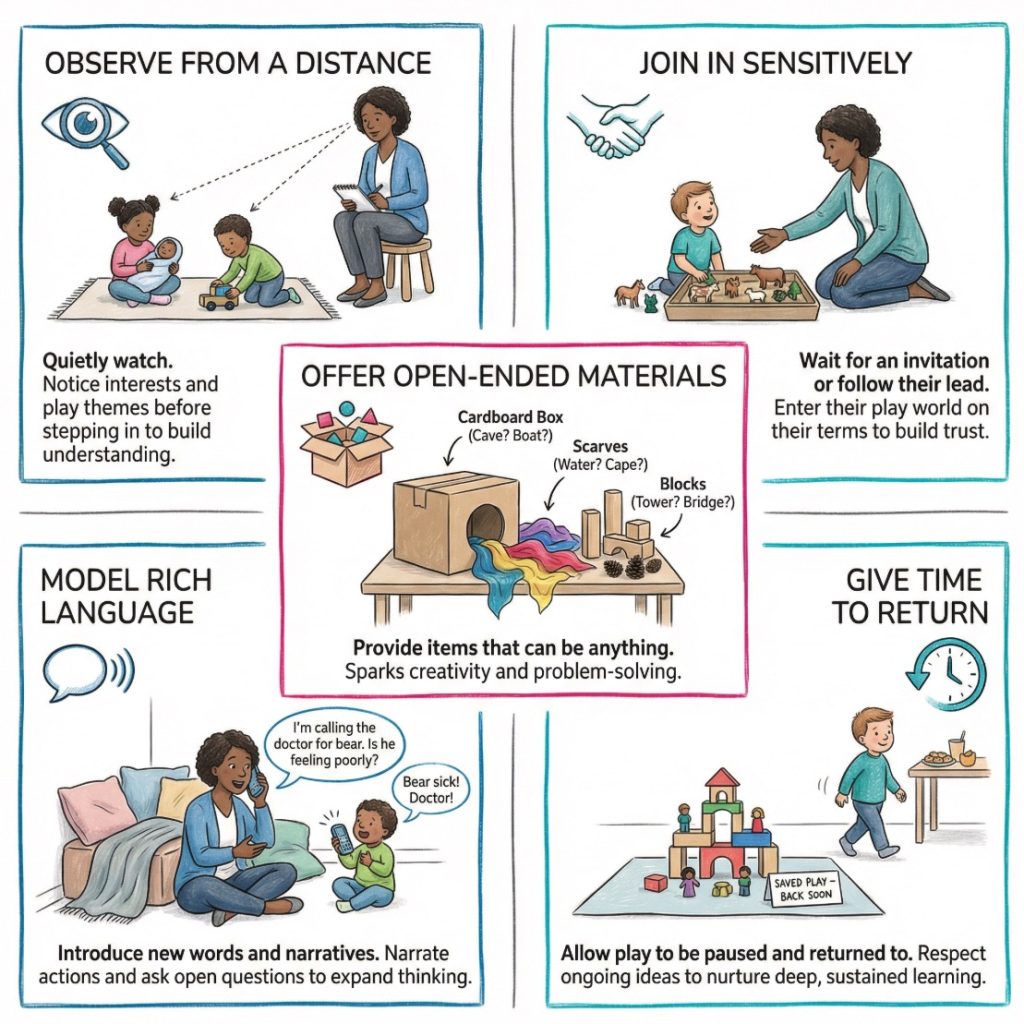
Practitioners usually support symbolic play best by noticing first and adding carefully. Too much adult control can flatten the play. Too little interest can leave it thin or short lived. The Department for Education interactions guidance promotes responsive interaction, careful modelling and adding language in ways that connect with what children are already doing. Development Matters takes a similar line.
A simple sequence helps.
- Notice the theme: Watch for repeated routines, favourite objects, familiar roles and early pretend actions.
- Choose flexible resources: Boxes, fabric, baskets, dolls, blocks, figures, clipboards and loose parts usually give children more room to think than fixed themed toys.
- Follow the child’s meaning: If the tube is a telescope, treat it as a telescope within the play.
- Add language lightly: A short comment or one new word often works better than a stream of questions.
- Extend with care: One extra prop or one fresh idea is often enough.
- Leave room for repetition: Rich play usually builds over time.
- Share observations: Parents, carers and colleagues may spot the real life link behind a play theme.
A realistic example makes this clearer. A practitioner notices a toddler stirring leaves in a bowl. The adult says, “You’re making soup.” The child replies, “Hot.” The adult places a teddy nearby and says, “Teddy looks hungry.” The child serves the soup, blows on it, then tucks Teddy into bed. The adult has not taken over. The adult has helped the play breathe.
There is also a place for direct modelling. A child who rarely joins symbolic play may benefit from seeing a short pretend sequence first. The adult might feed a doll, wipe its face and say, “Baby’s tired now.” Then the doll is handed over and the child decides what happens next. First a model. Then choice.
How does symbolic play connect with parents, carers and the key person?
Symbolic play often grows out of ordinary family life. Cooking, getting ready to go out, caring for babies, shopping, travelling on a bus, visiting the doctor, hearing the same bedtime story night after night. These repeated experiences give children the material they later reuse in play. The EYFS statutory framework places strong emphasis on partnership with parents and carers and on the key person relationship.
The key person is especially important here. A practitioner who knows the child well is more likely to notice what a recurring play theme may be linked to. A child who keeps putting dolls to bed may have a new sibling at home. A child who packs bags and says goodbye may be replaying a recent journey. A child who keeps making tea may simply be absorbed by a familiar part of family routine.
That kind of shared knowledge can sharpen observation.
- Family routines: These often appear in symbolic play before children can talk about them clearly.
- Favourite stories: Repeated books and rhymes often turn up as characters, scenes or catchphrases in play.
- Recent events: New babies, journeys, parties, illness or changes in routine may reappear in pretend scenes.
- Cultural routines: Food, celebrations, occupations and home language all shape the content of play.
The Best Start in Life review notes that around 1 in 5 children in English schools are learning English as an additional language, and that communication, play and relationships develop alongside home language and English. That is useful context when play seems more expressive than spoken English.
For families and practitioners, the value of sharing observations is practical rather than formal. It helps adults see the child’s play as meaningful, connected and rooted in real experience.
What standards, roles and guidance in England relate to symbolic play?
Symbolic play is not listed as a separate legal duty, but it sits firmly within the framework that governs early years provision in England. The EYFS statutory framework sets the standards providers must meet for learning, development and care from birth to 5, and it applies in England. The page was last updated on 1 September 2025. The framework states that children learn and develop through play, adult modelling, observing others and guided learning.
The wider legal background comes from the Childcare Act 2006. Non statutory guidance also shapes day to day practice, especially Development Matters and the Department for Education’s Help for early years providers materials. Together, these support play based learning, rich interaction, enabling environments and inclusive provision.
The SEND and equality framework is also relevant. The Early Years Guide to the SEND Code of Practice explains that children with SEN may also be covered by disability legislation and that reasonable adjustments should be considered as part of planning and review. It also states that early years providers have duties under the Equality Act 2010 and must make reasonable adjustments, including auxiliary aids and services, to prevent disabled children being put at a substantial disadvantage.
Ofsted sits in the background too. The Ofsted requirements page for early years register providers explains its role in registration, regulation and inspection of early years childcare providers in England. Symbolic play is not something settings perform for inspection, yet rich symbolic play can reflect strong provision, thoughtful interaction and an enabling environment.
Relevant roles include:
- Key person: Builds security, notices recurring themes and links play with the child’s wider experience.
- Early years practitioner: Provides resources, models language, observes carefully and extends play with care.
- SENCO: Helps identify barriers to access and considers adjustments where symbolic play is hard to join.
- Childminder: Often supports symbolic play through close, home based routines and long term knowledge of the child.
- Speech and language therapist: May look at play skills, including symbolic play, when considering communication and interaction. The NHS play skills guidance is useful here.
What are the common mistakes adults make with symbolic play?
One common mistake is taking over too quickly. An adult joins the play, asks a rush of questions, redirects the scene or turns it into a teaching task. The play then starts to belong to the adult rather than the child. Development Matters supports a lighter touch, with adults helping children elaborate play rather than controlling it.
Another mistake is relying too heavily on fixed themed resources. A beautifully set up area can look impressive, but it may leave little room for invention if every object has only one obvious purpose. The Department for Education’s exploring language guidance points instead to props, small world resources and open ended materials such as blocks and loose parts.
A third mistake is missing the quieter forms of symbolic play. Not every child wants to join a busy role play area. Some children show symbolic thinking through one to one play, small world scenes or repeated short routines. Others may be communicating more through action than through speech.
Watch for these pitfalls:
- Too many questions: The flow of play breaks when every moment becomes a test.
- Too much novelty: Frequent changes to provision can stop children returning to deepen a familiar theme.
- One narrow model of play: Loud social role play is not the only form symbolic play can take.
- Quick judgements: A child who does not join pretend play on one day may still show symbolic thinking elsewhere.
- Weak continuity: Good ideas fade when there is no space, time or storage to return to them.
“When adults rush in, symbolic play can shrink. When adults watch well and join lightly, it often grows.”
How can strong symbolic play be recognised?
Strong symbolic play rarely looks polished. It often looks absorbed, purposeful and alive. Children return to an idea, assign meaning to objects, repeat language linked to the play and add new details as the scene develops. Development Matters refers to children developing storylines in pretend play, using flexible resources and building on previous learning.
Useful signs include:
- Clear pretend meaning: An object, action or role stands for something else.
- A sequence: The play has a beginning, a middle or at least a sense of “what happens next”.
- Repeated themes: The child comes back to similar scenes because they still have something to work through or develop.
- Growing language: Words and phrases begin to fit the storyline more closely.
- Shared roles: Children negotiate jobs, places and problems within the imaginary scene.
- Adult support that fits: The adult adds depth without taking ownership.
A mini case study shows this well. Four preschool children build an ice cream shop outside with crates and planks. One child makes tickets. Another collects leaves for “mint”. A third says the freezer is broken. A fourth becomes the mechanic. The adult listens, adds a clipboard when orders begin and introduces the word “customer”. Then she steps back. The play stays child led, but the language and complexity rise.
A short checklist can help identify strong provision around symbolic play.
- Flexible resources are available: Children can combine, move and redefine materials.
- Adults know the children well: Play is read in context, not in isolation.
- Time is protected: Children can return to a play theme over several sessions.
- Noise levels are considered: Quiet children can access symbolic play as well as confident talkers.
- Family knowledge is used: Links between home life and play are noticed and valued.
Conclusion and next step
Symbolic play shows a child using objects, actions, roles and words to represent something beyond the here and now. That shift supports language, emotional expression, memory, social connection and flexible thinking. It also gives adults a clear view of what a child has noticed, absorbed and is trying to work out.
For early years settings in England, the picture is straightforward. Good symbolic play grows where there are secure relationships, flexible resources, enough time and adults who can join without taking over. The statutory framework, supporting guidance, SEND duties and equality duties all point in that direction.
The next step is simple. Look closely at the play that is already happening. A child may be showing far more through a pretend cup of tea, a line of toy animals or a cardboard box bus than first appears.
Subscribe to Newsletter
Get the latest news and updates from Care Learning and be first to know about our free courses when they launch.