
Loose parts play is open ended play using objects that children can move, carry, combine, line up, stack, sort, fill, empty, take apart, redesign and use in many different ways.
In early years, loose parts are resources without one fixed purpose. A cardboard tube can become a telescope, tunnel, trumpet, ramp, chimney or rocket. A scarf can become a blanket, river, cape, picnic rug, bandage or curtain. A crate can become a boat, shop counter, stage, bridge, den or bus.
This idea is often linked to Simon Nicholson’s writing on the theory of loose parts, which explored how flexible environments can support children’s creativity.
Loose parts play gives children ownership. They decide what the materials are, what they mean, how they work and what happens next. It supports creativity, problem solving, communication, physical development, emotional wellbeing and social learning.
It can look ordinary at first glance. A child may move stones from one basket to another, wrap fabric around a chair, or balance planks on crates. Yet those moments can involve careful thinking about weight, space, pattern, cause and effect, role play, safety, connection or control.
Loose parts play can happen indoors or outdoors, in nurseries, preschools, childminding settings, baby rooms, toddler rooms and reception classes. It can be calm and sensory, large and physical, imaginative and social, or quiet and reflective.
Adults shape the quality of the play. Practitioners choose suitable materials, assess risks, observe closely, support language, encourage inclusion and help children manage safe challenge.
“Once we stopped showing children what to make, we heard much more talk between them. They started explaining their own ideas.”
Why Loose Parts Play Supports Early Learning
Young children learn through movement, repetition, curiosity, communication and hands on exploration. Loose parts fit this well because children can investigate the materials freely. They are not limited by a toy’s fixed use.
A toy phone usually stays a phone. A puzzle usually has one correct solution. A wooden block behaves differently in children’s hands. It might become a phone, cake, bridge, wall, parcel, seat, ticket, boat or stepping stone.
This kind of play supports flexible thinking. When a tower falls, children might try a wider base. When a tube does not reach, they might add another one. When a den collapses, they may move the crate or change how the fabric hangs.
Creativity grows because children are not trying to copy an adult model. They are not all making the same craft. They are making decisions, testing ideas and adapting their plans. Over time, this can help children see their own thinking take shape.
The Early Years Foundation Stage statutory framework sets standards in England so early years providers support children’s learning, development, health and safety. There are separate versions for childminders and for group and school-based providers.
One play episode can touch many areas of learning. Children may explain ideas, negotiate, lift, pour, balance, persist, share, count, compare, retell stories and invent symbols.
A child building a pretend shop with stones, boxes and fabric may be doing far more than role play. They may count “money”, write signs, decide who works at the till, take turns with customers and change the layout when more children join.
The learning grows through the child’s choices, the environment, the adult response and the time given for play to develop.
What Counts as Loose Parts in Early Years?
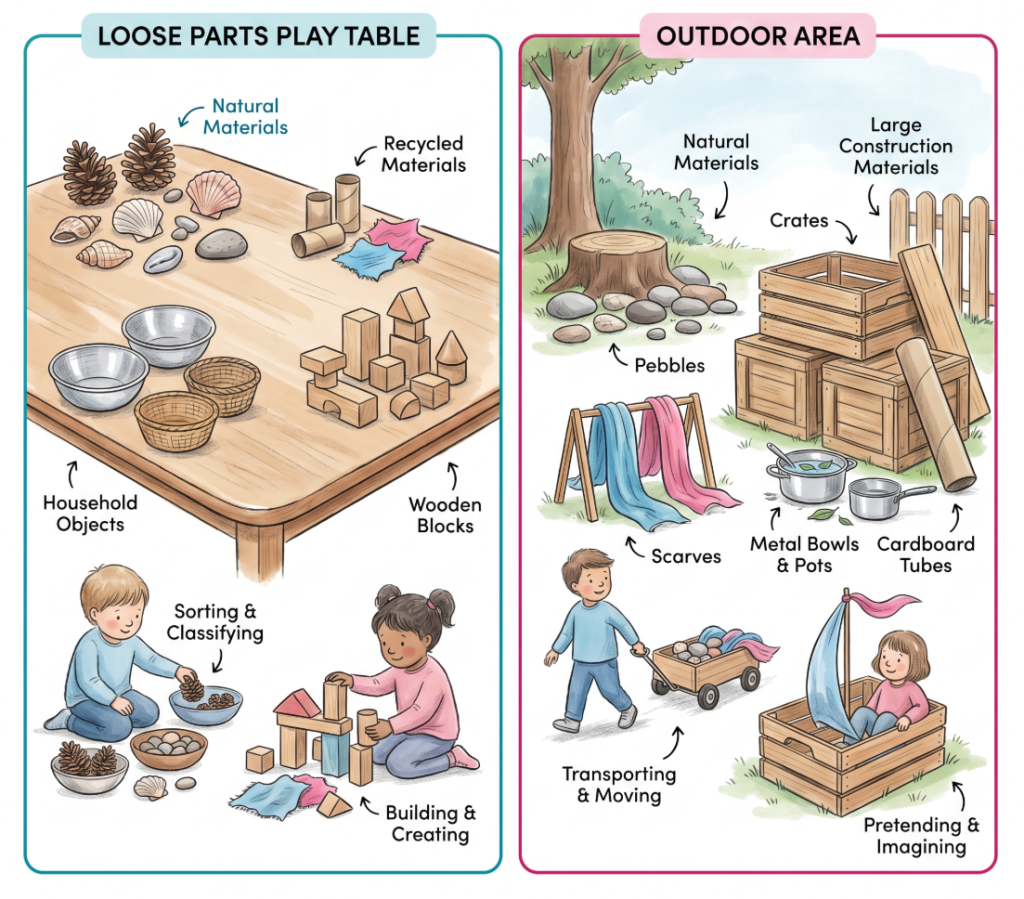
Loose parts can be natural, recycled, everyday or manufactured objects. They should be safe, suitable, interesting and open to more than one use.
A pine cone might become food in a mud kitchen, a tree in small world play, treasure in a pirate game, or a counting object in a maths activity. A piece of fabric might be a superhero cape in the morning and a river in the afternoon.
Loose parts can include:
- Natural materials: Pine cones, shells, stones, sticks, bark, leaves, seed pods, feathers and flowers can support sensory play, sorting, counting, pattern making and storytelling.
- Recycled materials: Cardboard tubes, boxes, lids, clean containers and packaging can support construction, pretend play, transporting, problem solving and design.
- Household objects: Wooden spoons, metal bowls, sieves, baskets, pegs, curtain rings and fabric can support filling, emptying, sound play, role play and fine motor skills.
- Large construction materials: Crates, tyres, planks, logs, guttering, buckets and cable reels can support den building, climbing, balancing, teamwork and large physical play.
- Creative loose parts: Corks, buttons, ribbons, scarves, tiles, wooden discs and bottle tops can support temporary art, pattern making and imaginative representation.
Temporary art means artwork made from loose materials that children can move, rearrange and take apart. The value sits in the creating, changing and thinking, rather than a finished picture to take home.
Suitability depends on the children using the materials. Babies and toddlers need larger, washable objects because they may mouth resources. Small objects can create a choking risk. The NHS guidance on choking shows why adults need to think carefully about small objects around babies and young children.
Older children may be ready for smaller, more complex materials. They still need supervision. Good loose parts are not always expensive. Many are natural, recycled or donated, but they should never be dirty, sharp, broken, rusty, toxic or unsafe.
Simple can be powerful.
How Loose Parts Play Supports Child Development
Loose parts play brings many areas of learning together. One episode may include movement, communication, imagination, maths, investigation, problem solving, cooperation and emotional regulation.
Three children might use crates, planks and fabric to build a bus. They lift and move large objects, which supports physical development. They negotiate roles such as driver, passenger and mechanic, which supports social development. They count seats, create tickets and discuss the route, which supports maths and language.
Small loose parts can support fine motor development. Children may pick up shells, thread curtain rings, peg fabric, place stones carefully, stack corks or sort buttons. These actions build hand strength, coordination and control.
Large loose parts support gross motor development. Children may drag tyres, carry buckets, crawl through boxes, balance along planks or climb over logs. Through these movements, they develop body awareness, strength, balance and coordination.
Early maths appears naturally. Children count, match, sort, compare, order, measure and create patterns. They explore full and empty, heavy and light, tall and short, more and fewer, long and short, near and far.
Loose parts may support development in these ways:
- Communication and language: Children describe ideas, negotiate roles, listen to others and learn words linked to what they are doing.
- Physical development: Lifting, carrying, pouring, stacking, gripping, balancing, crawling and climbing all give children chances to move with increasing control.
- Personal, social and emotional development: Children make choices, cope with frustration, cooperate, share resources and build confidence.
- Mathematics: Sorting, counting, comparing, measuring, ordering and pattern making arise naturally during play.
- Knowledge of the world: Children test materials, explore natural objects, notice change and investigate cause and effect.
- Expressive arts and design: Children imagine, design, create, perform, represent ideas and use objects symbolically.
Loose parts play should not be dismissed as children playing with bits and pieces. With skilled adult support, it can offer rich learning across the whole early years curriculum.
How Loose Parts Play Supports Communication and Language
Loose parts play can be especially useful for communication and language because children often need to explain the meaning of their play. The objects do not tell the story by themselves. The child gives them meaning through words, gestures, actions and shared attention.
A stone may be a coin, cake, egg, button, wheel or treasure. Another child will not always know that straight away. The first child may need to explain, point, show, negotiate or repeat the idea.
This gives children a real reason to communicate. The language grows from the play rather than from an adult led speaking task.
Practitioners can support this by commenting on what children are doing. For example, “You balanced the shell on top”, “The tube is pointing downwards”, or “You wrapped the fabric around the basket”. These comments give children words for their actions.
New vocabulary can be added gently. During loose parts play, children may hear and use words such as balance, steep, shallow, smooth, rough, narrow, wide, heavier, lighter, full, empty, through, between, beside, above and underneath.
Loose parts can also support children who are not yet using many spoken words. A child may communicate through pointing, offering objects, moving materials, copying another child or leading an adult to something. These are meaningful forms of communication.
For children learning English as an additional language, loose parts offer shared experiences where meaning is visible. A child can join in by building, carrying, sorting or pretending while spoken English develops.
Useful adult responses include:
- Commenting instead of testing: Saying “You made a long road” often supports language better than repeated questions such as “What colour is this?”
- Repeating and extending: If a child says “big tower”, the adult might say, “Yes, a tall tower with three blocks”.
- Modelling useful words: Adults can introduce words linked to the child’s play, such as balance, tunnel, edge, corner, bridge or pattern.
- Allowing thinking time: Children may need time to plan, respond or show their idea through action.
Loose parts play creates meaningful conversations because children care about what they are making. This makes language more purposeful and easier to remember.
How Loose Parts Play Supports Emotional Wellbeing and Behaviour
Loose parts play can support emotional wellbeing because it gives children choice, control and freedom to explore. Young children spend much of their day within adult routines. Open ended play gives them a safe space to make decisions.
Children may use loose parts to express feelings or make sense of experiences. A child may build a hospital after visiting one. Another may wrap dolls in fabric after caring for a new baby at home. Another may build a den when they need a cosy, protected space.
Repeated actions can be calming. Filling, emptying, lining up, wrapping, carrying or posting may help some children settle into play. Large movement, such as dragging crates or carrying buckets, can help children use energy with purpose.
Behaviour is often communication. If a child is running, grabbing or knocking things over, adults can look at what the child may be seeking. They may need movement, attention, sensory input, clearer boundaries, connection or a more meaningful role in the play.
The NICE guidance on social and emotional wellbeing in early years focuses on support for vulnerable children under 5 through home visiting, childcare and early education. Loose parts play is not named as a specific intervention, but it can sit within a wider setting approach that values relationships, routines, play and emotional security.
Loose parts play can support behaviour when:
- Children are deeply involved: Purposeful play can reduce aimless movement and help children focus.
- Children have choices: Choice can support confidence and reduce frustration.
- Children can move: Carrying, building and lifting can help some children regulate their bodies.
- Adults support conflict: Practitioners can help children solve problems when they want the same resource.
- Expectations are clear: Children need to know how to carry, build, tidy and use materials safely.
Loose parts can create conflict when several children want the same resource. Good adult support can turn this into learning. Two children who both want a crate can be helped to find another crate, use it together, take turns or change their plan.
Loose parts should not be used as a reward or removed as a punishment unless there is a clear safety reason. They belong within meaningful provision that supports learning, wellbeing and relationships.
“A parent once described the loose parts area as ‘just boxes and bits’. After seeing the photos, they noticed the planning, counting and teamwork.”
Where Loose Parts Play Can Happen
Loose parts play can happen across the early years environment. It is not limited to a construction area or outdoor space. It can support role play, small world play, sensory play, maths, storytelling, art, mark making and physical play.
Indoors, loose parts may be arranged in baskets, trays, shelves or small play invitations. A practitioner might set out shells, stones and fabric near small world animals. Children may build beaches, caves, homes or rescue centres.
In a role play area, loose parts can make play more flexible. Instead of a fixed shop with plastic food, children might use stones as money, wooden discs as cakes, leaves as herbs, fabric as bags and boxes as tills. This encourages imagination and negotiation.
Outdoors, loose parts often support larger movement. Crates, planks, tyres, pipes, buckets and fabric can become dens, vehicles, stages, obstacle routes or water systems. Outdoor play gives children space to test bigger ideas.
Loose parts can work well in:
- Baby rooms: Large washable objects, fabric, metal bowls, sensory baskets and wooden rings can support touch, sound and early exploration.
- Toddler rooms: Buckets, bags, baskets, tubes and large blocks can support transporting, filling, emptying and early pretend play.
- Nursery rooms: Children may build dens, sort natural objects, create role play scenes and work together on larger constructions.
- Preschool rooms: Loose parts can support storytelling, maths, creative design, social play and problem solving.
- Childminding settings: Everyday and natural materials can support small group play, home like routines and learning from walks.
- Reception classes: Loose parts can support child initiated play, story retelling, early design, maths investigations and collaborative projects.
The space does not need to be perfect. Children need safe access, enough room, visible materials and time to return to their ideas.
When Loose Parts Play Works Best
Loose parts play can be part of everyday provision. It does not need to be saved for occasional sessions. Children benefit when they can return to materials repeatedly and develop ideas over time.
At first, children may tip, scatter, carry or explore the materials. This can be part of the process. They are learning what the materials do. Later, their play may become more focused, imaginative or collaborative.
Loose parts work well during child initiated play. This means children choose what to play, how to play and who to play with. Adults still observe and support, but they do not control the direction.
Practitioners can also use loose parts to extend current interests. A transport interest might lead to boxes, tubes, wheels, crates, maps and steering wheel shapes. An animal interest might lead to bark, leaves, stones, fabric and small world figures.
Seasonal changes offer useful possibilities. In autumn, children may explore leaves, pine cones and conkers. In spring, they may use petals, seed packets, pots and soil. In summer, water play with guttering, buckets, funnels and tubes can support investigation.
Useful times include:
- Free flow play: Children can choose materials indoors and outdoors and move between spaces.
- After a story: Loose parts can help children retell, adapt or extend story ideas.
- Small group play: Adults can support language, maths or problem solving without making the play too formal.
- Outdoor sessions: Large materials can support movement, teamwork and construction.
- Following children’s interests: Loose parts can deepen play linked to homes, vehicles, babies, shops, animals, journeys or building.
Loose parts play should not be rushed. Children need time to explore, repeat, return and refine. A construction that looks unfinished may be part of a developing idea.
Leave room for return visits. That is often where the deeper thinking appears.
How Loose Parts Play Works Day to Day
Loose parts play works best when the environment offers freedom within clear boundaries. Children need permission to explore. They also need adults to support safety, respect and care for resources.
A setting may start with a small selection of materials. For example, a preschool might offer baskets, cardboard tubes, wooden blocks, fabric and shells. Adults can observe what children do before adding more.
Children often show what the provision needs next. If they build ramps, practitioners might add guttering, balls or planks. If they create homes, adults might add pegs, blankets, cushions or small figures. If they sort objects, adults might add bowls, trays, number cards or tweezers.
Presentation affects how children use loose parts. A mixed box of clutter may lead to tipping and walking away. Sorted baskets or trays can help children see possibilities. Low shelves and picture labels can support independence.
A simple comparison can help teams decide how to present resources.
| Approach | What children may do | What adults may notice |
|---|---|---|
| Mixed box of many objects | Tip, scatter and move on quickly | Too much choice may reduce focus |
| Small baskets of sorted objects | Choose, compare, sort and combine | Children may play with more purpose |
| Fixed adult model | Copy the adult’s idea | Creativity may narrow |
| Open ended invitation | Create their own idea | Children may show deeper thinking |
| No clear boundaries | Materials may be thrown or misused | Safety expectations may need support |
| Clear shared routines | Children carry, build and tidy with care | Play can stay freer for longer |
Loose parts play may look messy. Children may spread fabric across the floor, move crates across the garden or fill several baskets with objects. Adults need to look at what the children are doing, saying and testing.
A practitioner might notice:
- The child’s intention: The child may be building, hiding, sorting, carrying, connecting or pretending.
- The idea being tested: The child may be exploring balance, size, movement, weight, pattern or cause and effect.
- The language being used: The child may be naming objects, giving roles, explaining plans or negotiating.
- The social level of play: The child may be playing alone, alongside others, or with others.
- The level of safety: The play may need more space, clearer boundaries or closer adult support.
If children are building a bridge and it keeps falling, the adult might say, “It falls when the plank is near the edge. What could make it steadier?” This keeps the thinking with the children.
Routines still help. Children can learn how to carry long objects, where to build, how to tidy and how to ask for help. Good routines make open ended play safer and more purposeful.
How to Introduce Loose Parts Play Step by Step
A clear approach helps practitioners introduce loose parts play with confidence. This can be useful for new staff, childminders, or settings improving their provision.
Step 1, decide the purpose: A setting may introduce loose parts to support creativity, communication, physical play, problem solving, sensory exploration, inclusion or child led learning.
Step 2, start with the children: Adults look at children’s ages, stages, interests and needs. Babies, toddlers, preschool children and reception aged children will need different resources and levels of support.
Step 3, choose safe materials: Objects should be clean, suitable and in good condition. Sharp edges, splinters, rust, broken plastic, toxic materials and small items for children who mouth objects are unsuitable.
Step 4, begin with a small collection: A manageable number of resources helps children focus. Too many materials at once can overwhelm children and make supervision harder.
Step 5, organise materials clearly: Baskets, trays, shelves or labelled boxes help children see what is available. Picture labels can support younger children and children who benefit from visual prompts.
Step 6, introduce expectations: Children may need support to carry, build, use space, tidy and care for materials. Expectations work best when they are simple and consistent.
Step 7, observe before leading: Adults watch what children do first. They may notice sorting, building, transporting, wrapping, lining up, pretending or combining materials.
Step 8, add language and ideas gently: Practitioners can use comments and open questions. The aim is to support children’s thinking, not give them adult answers.
Step 9, reflect with the team: Staff can discuss what children used, what learning happened, what risks appeared and what might be changed.
Step 10, share the learning with families: Photos, displays and short explanations can help parents and carers see the value of loose parts play, where this fits the setting’s permissions, policies and data protection arrangements.
This gradual approach helps loose parts play become part of high quality provision rather than a one off activity.
What Adults Do During Loose Parts Play
The adult role in loose parts play is thoughtful and active. Practitioners are not passive observers, but they should avoid taking over children’s ideas.
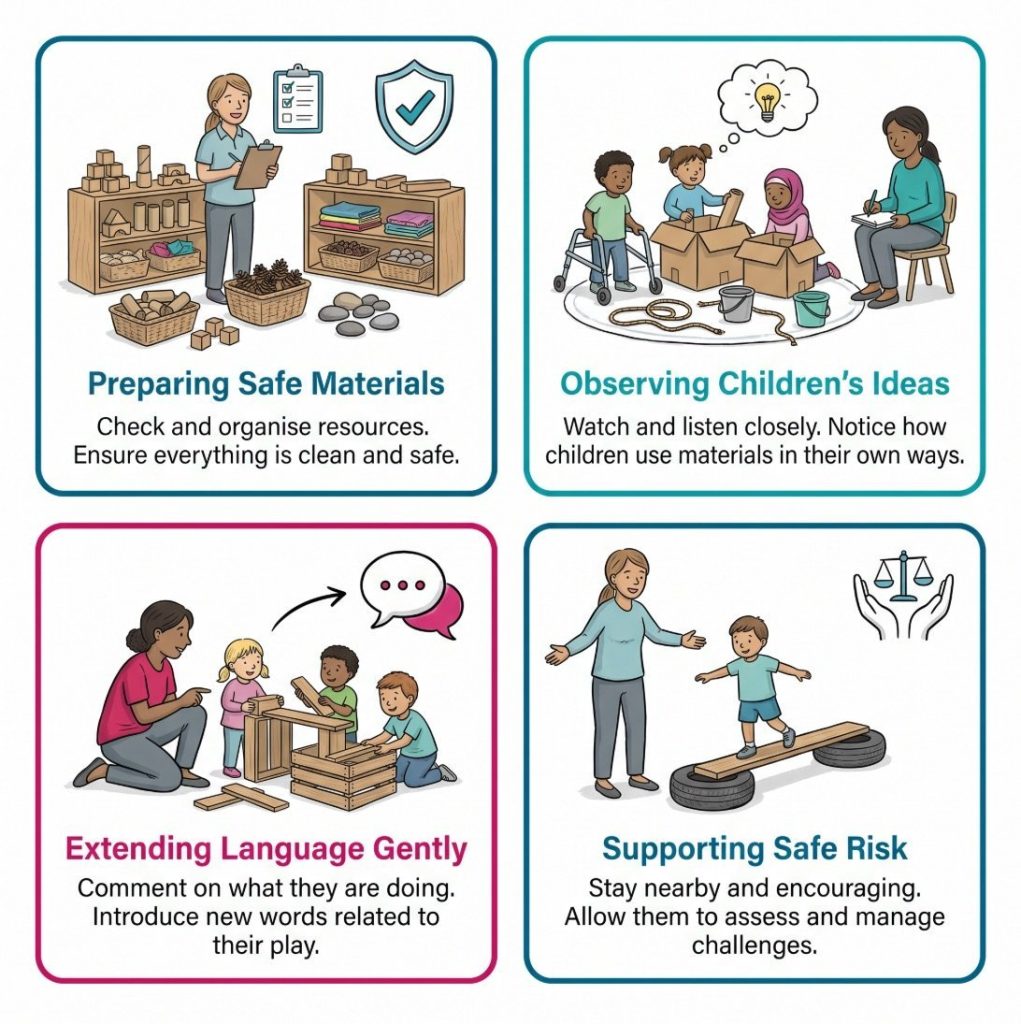
Adults prepare the space, choose materials, check safety, support inclusion and observe children’s learning. They also help children develop language, solve social problems and manage safe risk.
A practitioner may notice that a child repeatedly carries objects from one place to another. This may show a transporting schema. A schema is a repeated pattern of behaviour that helps children explore how the world works. Other schemas include connecting, enclosing, rotating, positioning, enveloping and trajectory.
The adult can support the transporting schema by adding bags, baskets, trolleys or buckets. There is no need to stop the child simply because the play looks repetitive. Repetition is often how young children learn.
Adults can support loose parts play by:
- Preparing the environment: Practitioners choose suitable materials, organise storage, check safety and think about supervision.
- Observing children’s thinking: Adults notice what children are exploring, such as balance, connection, movement, order or enclosure.
- Extending language: Practitioners add words linked to children’s actions, such as heavier, balance, tunnel, pattern, smooth or steep.
- Supporting social play: Adults help children negotiate, share resources, solve problems and listen to each other.
- Promoting inclusion: Practitioners adapt resources and access so all children can take part meaningfully.
- Managing risk: Adults allow appropriate challenge while reducing hazards children cannot judge for themselves.
A useful adult response might be, “You used the long tube to make the water travel further”. This shows the adult has noticed the child’s thinking. It also introduces useful language without interrupting the play.
The adult role is to protect the quality of the play. Control is not the goal.
How Loose Parts Play Links to Safety, Risk and Safeguarding
Loose parts play needs a balanced approach to safety. Children need opportunities to test ideas, move materials and experience manageable challenge. They also need adults who can identify and reduce real hazards.
The Health and Safety Executive’s statement on children’s play and leisure supports a risk benefit approach. Play providers should think about the benefits of challenge as well as the risks that need control.
Risk and hazard are different. A risk might be a manageable challenge, such as balancing on a low plank. A hazard is something more likely to cause harm, such as broken glass, sharp metal, loose nails or a heavy unstable object.
Loose parts safety should include:
- Age suitability: Small objects may not be suitable for babies or toddlers who mouth resources.
- Condition checks: Materials should be checked for sharp edges, splinters, cracks, rust, dirt and breakage.
- Cleaning and hygiene: Recycled and natural materials may need washing, drying or replacing.
- Safe movement: Children may need guidance on carrying long, large or heavy objects.
- Clear boundaries: Adults should explain where materials can be used and how to keep others safe.
- Supervision: Some materials, such as planks, tyres, water channels or small objects, need closer adult attention.
Safeguarding also connects to loose parts play. Practitioners should consider supervision, emotional safety, behaviour, hygiene, allergies, safe storage, intimate care needs and children’s individual vulnerabilities.
The current Working Together to Safeguard Children guidance applies in England and is for organisations and agencies with functions relating to children, including education providers and childcare settings. The NSPCC early years safeguarding resources also provide useful information for early years practice.
Settings should follow their own safeguarding policy, risk assessment procedures, health and safety policy and behaviour policy. The designated safeguarding lead may support staff if any concern arises about a child’s safety or welfare.
Loose parts play should offer challenge, not danger. Good practice means careful selection, close observation and changes when children need more support.
What Legislation, Standards and Bodies Are Relevant?
Loose parts play is not usually named directly in legislation, but it links to several early years responsibilities. These responsibilities cover learning, welfare, safeguarding, inclusion and safety.
In England, the EYFS is the main statutory framework for registered early years providers. It includes requirements for learning and development, safeguarding and welfare. Loose parts play can support EYFS learning when it is well planned, safely supervised and linked to children’s interests and development.
Ofsted inspects and regulates many early years providers in England. The Ofsted early years inspection guidance and resources explain how inspection looks at early years practice. Practitioners may need to explain how loose parts play supports children’s learning, safety, behaviour, personal development and wellbeing.
The Health and Safety at Work etc. Act 1974 is described by HSE as the primary occupational health and safety legislation in Great Britain. In an early years setting, it connects to safe premises, suitable resources, safe systems and sensible risk management.
The Management of Health and Safety at Work Regulations 1999 are also relevant because they support the need for risk assessment. For loose parts play, this means thinking about likely risks and reasonable ways to manage them.
The Equality Act 2010 duty to make reasonable adjustments is relevant to inclusion. Early years settings should consider reasonable adjustments so disabled children are not placed at a disadvantage. This could mean adapting access, changing materials, offering quieter play spaces, using visual supports, or providing adult support for participation.
The SEND code of practice: 0 to 25 years applies to England and is relevant where children have special educational needs or disabilities. Loose parts play can be adapted so children can join in through movement, touch, gesture, sound, eye gaze, words, symbols or adult support.
Important roles and bodies include:
- Department for Education: This government department is responsible for early years policy and the EYFS in England.
- Ofsted: Ofsted inspects and regulates many early years services in England.
- Health and Safety Executive: This body provides guidance on health and safety, including a balanced approach to play.
- Local safeguarding partners: These partners set local safeguarding arrangements that settings should know and follow.
- Designated safeguarding lead: This person leads safeguarding practice and supports staff with concerns.
- SENCO: The special educational needs coordinator supports provision for children with special educational needs and disabilities, where this role applies.
- Key person: The key person builds a close relationship with the child and family, and notices development, interests and wellbeing.
In Scotland, Wales and Northern Ireland, early years settings follow their own curriculum, inspection and regulatory arrangements. The principles of open ended, safe and inclusive play can still apply, but settings use the framework that fits their nation and service.
How Loose Parts Play Can Look in Different Settings
Loose parts play changes with the children, space, staffing and routines. This flexibility is one of its strengths.
In a baby room, loose parts play may be quiet and sensory. A practitioner might offer large wooden rings, fabric squares, metal bowls and soft brushes in a low basket. A baby may bang, mouth, drop, rub and pass objects between hands. The adult stays close, responds warmly and names what the baby is doing.
In a toddler room, the play may involve lots of transporting. Toddlers often enjoy filling bags, pushing baskets and moving objects from one place to another. A practitioner might offer buckets, large corks, fabric, tubes and cardboard boxes. Repeated filling and emptying may lead the adult to provide more containers.
In a nursery room, children might use crates, tyres and fabric to create a bus. They may make tickets from leaves, use stones as money and place chairs in rows. The adult can support language, turn taking, counting and role play.
Preschool play may grow into longer projects. A group might build a veterinary surgery using boxes, fabric, soft animals, tubes, clipboards and bottle tops. Children may create waiting areas, beds, medicine bottles and signs. This supports mark making, empathy, communication and organisation.
In a childminding setting, loose parts may come from everyday life. After a walk, children may collect leaves, sticks and pine cones. They may sort them, create patterns, make homes for toy animals or use them in mud kitchen play.
In a reception class, loose parts can support story retelling. After reading a traditional tale, children might use blocks, planks, stones, fabric and small figures to build a bridge, forest or house. Some children may focus on construction while others develop dialogue and story sequence.
A group of preschool children used guttering, crates, buckets and stones to make a water channel. The water kept spilling at one join. One child placed a stone under the guttering to lift it. Another child fetched a shorter tube. The practitioner commented on the slope, the flow and the join. The children tested the route again and cheered when the water reached the bucket.
This single play episode supported teamwork, language, problem solving, physical movement and early science. No worksheet was needed.
How to Observe and Assess Learning Through Loose Parts Play
Loose parts play gives practitioners rich opportunities to observe children’s learning. Because children lead the play, their actions often show genuine interests, skills and thinking.
Observation does not need to interrupt the play. Adults can watch, listen, take brief notes, record key phrases or take photographs where this fits the setting’s policy and parental permissions.
The most useful observations focus on what the child is doing and what this may show. A child who repeatedly connects tubes may be exploring joining, direction and cause and effect. A child who lines up stones may be exploring order, pattern or positioning.
Practitioners can observe:
- Interests: Adults notice which materials, themes or actions the child returns to.
- Schemas: Adults notice repeated actions such as transporting, enclosing, rotating or connecting.
- Language: Adults listen for words, gestures, signs, sounds and shared attention.
- Social interaction: Adults notice whether the child plays alone, alongside others or with others.
- Physical skills: Adults watch how the child lifts, grips, places, balances, pours, climbs or carries.
- Thinking skills: Adults notice testing, comparing, predicting, problem solving and changes of plan.
Assessment should stay useful and proportionate. Loose parts play should not become a paperwork exercise. Observation helps adults know the child better and improve provision.
For example, a key person may notice that a child often wraps objects in fabric. The practitioner may offer more scarves, pegs, bags and boxes to support this enveloping schema. They may also talk with parents about whether the child enjoys wrapping, hiding or carrying objects at home.
Good observation helps adults respond to children’s actual play rather than planning activities based only on adult assumptions.
How Loose Parts Play Supports Inclusion
Loose parts play can be inclusive because there is no single correct way to take part. Children can enter the play at different levels, using different skills and interests.
A child with limited spoken language may join by carrying, placing, pointing or copying. A child who prefers quiet play may arrange shells on a mat. A child who enjoys movement may carry crates outdoors. A child who likes pretend play may turn fabric and boxes into a home.
Inclusion needs thought. Practitioners need to think about access, communication, sensory needs, confidence and physical comfort.
Inclusive practice may include:
- Offering different sizes and weights: Lighter resources can support children who find heavy materials difficult, while larger objects may be easier for some children to grasp.
- Using visual labels: Photos and symbols can help children see where resources are and where they belong.
- Creating quieter spaces: Some children may engage better away from noise, crowding and fast movement.
- Adapting height and reach: Materials should be accessible to children who play seated or use mobility aids.
- Supporting communication: Adults can use words, gestures, signs, objects and visuals to help children express ideas.
- Respecting sensory preferences: Some children may avoid rough, sticky, noisy or strong smelling materials.
In settings where a SENCO role applies, the SENCO can help staff adapt loose parts play for children with special educational needs and disabilities. The key person can share knowledge of the child’s interests, routines and emotional needs.
Inclusion also means valuing different forms of play. A child who lines up stones is not playing incorrectly. A child who repeatedly carries objects may be exploring an important schema. Adults should observe carefully before redirecting.
How to Share Loose Parts Play With Parents and Carers
Parents and carers may not always recognise the learning in loose parts play straight away. They may see children playing with cardboard boxes, sticks or stones and wonder where the usual toys are. Practitioners can help by making the learning visible.
A photo with a short explanation can be powerful. Instead of writing, “Mia played with tubes”, a practitioner might write, “Mia joined three tubes together and tested whether the ball would roll through. She changed the angle when the ball got stuck and used the words fast, stuck and again”.
This shows parents that the play involved thinking, problem solving, language and persistence.
Settings can share loose parts learning through:
- Displays: Photos and short notes can show the process, not just the finished result.
- Learning journals: Observations can link children’s play to development and interests.
- Conversations: Staff can share one meaningful example at collection time.
- Parent workshops: Families can see examples of loose parts and hear how adults support play.
- Home ideas: Practitioners can suggest safe everyday objects, such as boxes, fabric, spoons, bowls or cardboard tubes.
It is also useful to explain safety. Families may worry when children use planks, crates, sticks or stones. Practitioners can explain that resources are checked, supervised and chosen carefully.
Parents and carers can share useful information too. They may say that their child loves collecting stones, building dens, posting objects or wrapping toys at home. This helps practitioners build a fuller picture of the child.
Good communication builds trust. It helps families see loose parts play as meaningful learning, not just mess.
Common Mistakes in Loose Parts Play
Loose parts play is simple in principle, but it can become weaker when adults misunderstand it. The aim is not to fill a room with random objects. The aim is to provide safe, flexible materials that support rich play.
Too much choice can work against children. When there are too many materials, children may tip everything out and struggle to focus. A smaller, carefully chosen selection is often better.
Another common problem is adult control. Adults may want to show children what to build or how to use the materials. This can reduce creativity. Children need time to test their own ideas.
Common mistakes include:
- Using unsafe materials: Objects should be checked for choking risks, sharp edges, splinters, rust, dirt and breakage.
- Offering too many resources: Too much choice can overwhelm children and make the space chaotic.
- Expecting a finished product: Loose parts play is often about the process, not the final result.
- Turning play into a lesson too quickly: Adults should avoid testing children with too many questions.
- Ignoring schemas: Repeated actions such as carrying, lining up or wrapping may show important learning.
- Forgetting inclusion: Some children may need adapted resources, quieter spaces or adult support.
- Not explaining the value to families: Parents may misunderstand the play if the learning is not shared clearly.
- Removing all risk: Children need manageable challenge to build confidence and judgement.
A useful staff question is, “What learning is this material making possible?” If the answer is unclear, the material may need changing, removing or presenting differently.
What Good Loose Parts Provision Looks Like
Good loose parts provision is thoughtful, safe, flexible and responsive. It does not need to look perfect. It should show that children can make choices, explore ideas and use materials in different ways.
Strong provision usually starts small. Practitioners choose a manageable selection of resources, observe how children use them and then adjust. Adding more materials without purpose rarely improves the play.
Good storage helps children use resources well. Baskets, trays, low shelves and picture labels make materials visible and accessible. Children can choose what they need and help return items afterwards.
Good provision includes:
- Open ended resources: Materials can be used in many ways, not just one.
- Safe organisation: Items are checked, cleaned, stored and replaced when needed.
- Enough time: Children can return to ideas and develop their play.
- Enough space: Children can spread out, build, move and collaborate.
- Adult observation: Practitioners notice learning and support without taking over.
- Inclusive access: All children can take part in ways that suit their development and needs.
- Reflective practice: Staff review what is working and what needs to change.
The Loose Parts Play Toolkit offers practical play guidance for adults developing loose parts play in education, care and play settings.
Good provision also includes staff confidence. Adults need to know why loose parts play may look messy, repetitive or unusual. They need to see the thinking beneath the action.
A child carrying stones from one side of the garden to another may be developing strength, coordination, purpose, memory and schema play. A child lining up corks may be exploring order, pattern and control. A child wrapping fabric around a box may be creating meaning, comfort or enclosure.
When adults recognise this, they can support children more effectively.
Practical Takeaways and Loose Parts Play Checklist
Loose parts play works best when it is simple, safe and purposeful. Expensive resources are not needed. Children need flexible materials, enough time, sensitive adults and clear routines.
A useful starting point is a small collection of well chosen materials. A setting might begin with baskets, fabric, tubes, wooden blocks, shells and boxes. Staff can then watch how children use them and adjust the provision.
Practical takeaways include:
- Start small: A limited collection helps children focus and helps adults observe clearly.
- Choose flexible materials: The best loose parts can be used in many ways.
- Match resources to age and stage: Babies and toddlers need larger, washable objects and close supervision.
- Use clear storage: Baskets, trays and picture labels help children choose and return materials.
- Watch before adding: Children’s actions show what they need next.
- Support language naturally: Comments and useful words often work better than repeated questioning.
- Keep safety active: Materials need regular checks, cleaning and replacement.
- Share the learning: Families often value loose parts play more when they can see the thinking behind it.
A simple checklist can help teams review provision.
- Are the materials open ended?: Each item should offer several possible uses.
- Are the materials safe and suitable?: Adults should check size, condition, cleanliness and likely use.
- Can children reach the resources?: Low storage and clear labels support independence.
- Is there enough space?: Children need room to carry, build, sort and collaborate.
- Are adults observing closely?: Practitioners should notice learning, risk, language and social interaction.
- Can every child join in?: Materials, layout and adult support should allow meaningful access.
- Are families included?: Photos, notes and conversations can make the learning visible.
- Is the provision reviewed?: Staff discussion helps keep loose parts play safe, fresh and purposeful.
Small improvements can make a big difference. A basket of well chosen objects can lead to richer play than a cupboard full of toys with fixed uses.
Conclusion and Next Step
Loose parts play gives children materials full of possibility. It respects them as thinkers, makers, explorers and communicators.
It supports the whole child. Through loose parts play, children can move, talk, imagine, build, sort, count, compare, negotiate, test, pretend and try again. They can also express feelings, build confidence and develop friendships.
For practitioners, loose parts play involves skill. Adults choose suitable materials, check safety, observe carefully, support language, include every child and manage risk sensibly. The adult role is not to control the play, but to protect and extend its quality.
For parents and carers, loose parts play may look simple at first. A pile of boxes, tubes, fabric and stones may not look like a planned learning experience. Yet these materials can become a bus, bridge, home, shop, story, pattern, investigation or problem solving project.
The strongest setting practice begins with purpose. Materials are chosen carefully. They are presented clearly. Adults watch what children do. Teams review what happens. Families see the learning through clear examples.
Loose parts play does not need expensive resources. It needs thoughtful adults, safe materials and time for children to explore. Its strength lies in freedom. A child can look at a tube, shell, scarf or crate and decide what it might become.
That freedom supports creativity, confidence and deep learning in ways that fixed resources often cannot.
A useful next step is to review one area of provision and choose five safe, flexible loose parts that could extend children’s current interests. Start there.