
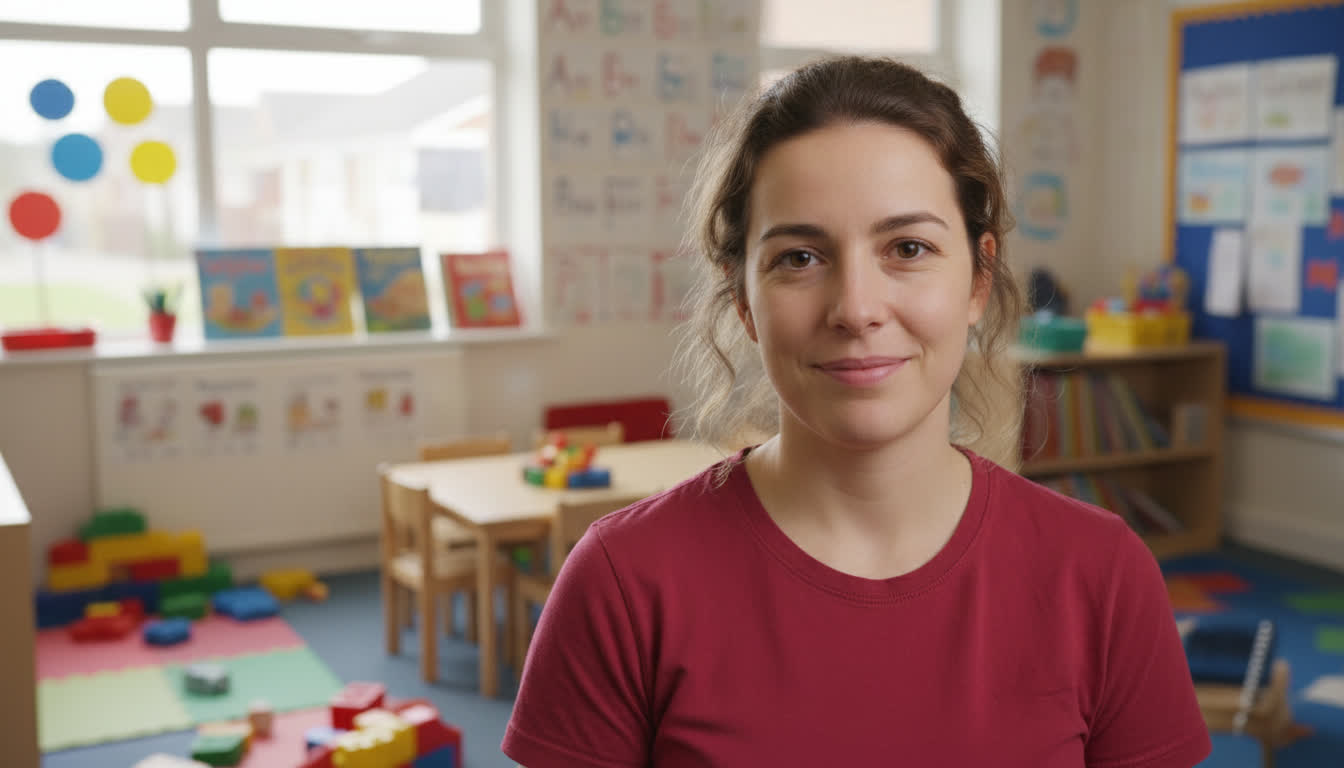
Socio-dramatic play is shared pretend play built around roles, relationships and a simple storyline. Children act out familiar situations together. In early years settings, those situations often include feeding a baby, getting ready for bed, going shopping, visiting the doctor, running a café, helping at home, or looking after a doll.
The social part comes from working with other people. Children agree roles, respond to one another, and keep the play going through talk, gesture and action. The dramatic part comes from pretending. A block becomes a phone. A scarf becomes a sling. A child becomes the parent, baby, shopkeeper, teacher or receptionist.
This is more than simple make believe. A child feeding a teddy alone is using pretend play. A group deciding who is the parent, who is the baby, and who is the shopkeeper is using socio-dramatic play. The shared storyline changes the quality of the play. It brings in negotiation, turn taking, empathy and language.
An early years lens makes that difference easier to see. Children are not only copying routines. They are exploring what home life looks like, how adults and children relate to one another, and what comfort, fairness or responsibility may mean in everyday life. Within the Early Years Foundation Stage, this sits closely with communication and language, personal, social and emotional development, and expressive arts and design.
“Socio-dramatic play shows children trying out everyday life, not just copying it.”
Useful signs of socio-dramatic play include:
- Shared roles: Children decide who will be the parent, baby, teacher, helper or shopkeeper. This shows social awareness and a growing ability to cooperate.
- Pretend objects: A child uses one object to stand for another, such as a spoon for a thermometer. This shows symbolic thinking.
- Story building: The play has a loose sequence, such as someone getting ready, going out, and coming home again. This supports memory and sequencing.
- Everyday language: Children use words linked to routines, feelings, food, sleep, helping or waiting. This supports spoken language in a meaningful setting.
- Repeated themes: The same scene appears often, such as bedtime, mealtimes or shopping. This may reflect interest, familiarity or emotional processing.
Why does socio-dramatic play support development?
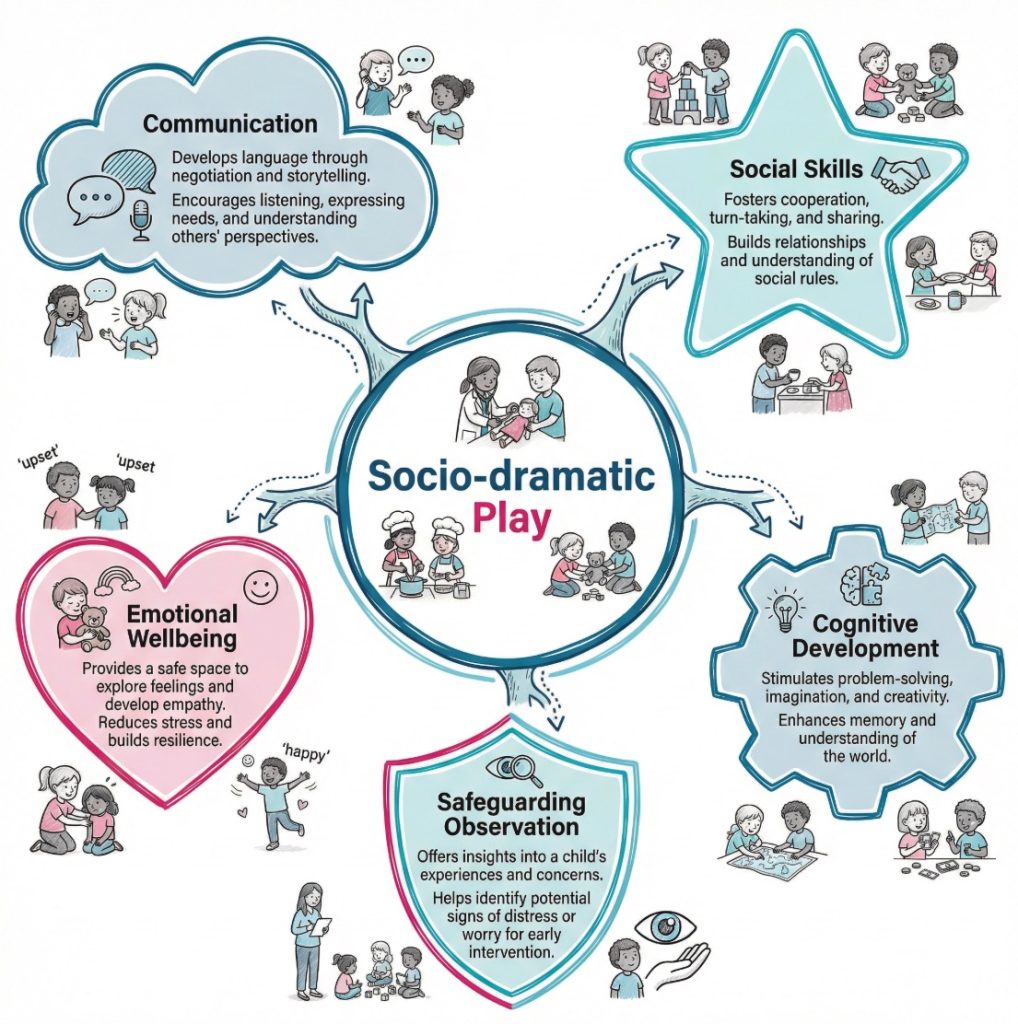
Socio-dramatic play supports several areas of development at once. Children speak, listen, move, negotiate, imagine and regulate their feelings during one shared activity. That mix is one reason role play remains such a strong part of early years provision.
Language grows through real use. Children ask for help, explain what is wrong, tell someone to wait, or reassure a crying baby. Those exchanges are short, but they are rich. Play links closely with speech, language and wider development, and that connection is easy to see in socio-dramatic play. The NHS guidance on play and learning and the Department for Education’s early years child development training both reflect that link.
Emotional development grows too. Children often return to scenes that feel important in their lives. A child may act out a nursery drop off after finding separation difficult. Another may keep coming back to feeding and settling a doll after a new sibling arrives. The play offers a safe frame for feelings that may still be taking shape. Brief, but powerful.
There is a social side as well. Children have to read one another’s cues, accept changes in the storyline, repair small disagreements and make room for different ideas. These are early relationship skills. They also help children settle into group life in nursery, preschool and reception. The NICE guidance on social and emotional wellbeing in the early years is useful here because it places emotional wellbeing at the centre of healthy early development.
A fair counterpoint is that not every pretend scene carries deep emotional meaning. Sometimes children choose doctor play because the props are attractive or the role feels exciting. That is true. Still, repeated patterns, strong feelings and consistent role choices can give practitioners useful clues when they are read alongside the wider picture of the child.
“Children often speak most clearly through the roles they choose and repeat.”
Socio-dramatic play may support:
- Communication: Children practise vocabulary, listening, questioning and turn taking within a shared scene.
- Emotional expression: Children can show fear, care, comfort, frustration or relief through role and story.
- Social learning: Children negotiate roles, take turns and respond to the needs of others.
- Thinking skills: Children sequence events, solve simple problems and use one object to represent another.
- Inclusion: Children bring home routines, community experiences and family relationships into the setting.
What does socio-dramatic play look like in different early years settings?
In a nursery, socio-dramatic play may begin with a home corner, baby care area or small role play set up. One child wraps a doll in a blanket. Another writes notes on a clipboard. A third says the baby needs milk and sleep. The scene may stay simple, yet it already shows shared roles, care language and a clear social purpose.
In preschool, the play often becomes more organised. Children may create a waiting room, decide who is first, give out appointment slips, or argue about who gets to use the toy stethoscope. Those moments are useful, because the learning sits in the interaction as much as in the theme itself. Children are building a shared world and trying to manage it together.
A childminding setting may look quieter and more familiar. The play may grow from everyday routines rather than a dedicated role play area. A child may copy nappy changing, bottle feeding, snack preparation or comforting a baby after a bump. In a smaller group, the adult often sees the detail more clearly and can notice what the child repeats over time.
A reception class may extend the same play through mark making, labelling, stories and wider topic work. A role play area may include signs, lists, booking forms and named roles. That does not make the play less imaginative. It widens it. The non statutory Development Matters guidance supports this kind of rich, connected early learning.
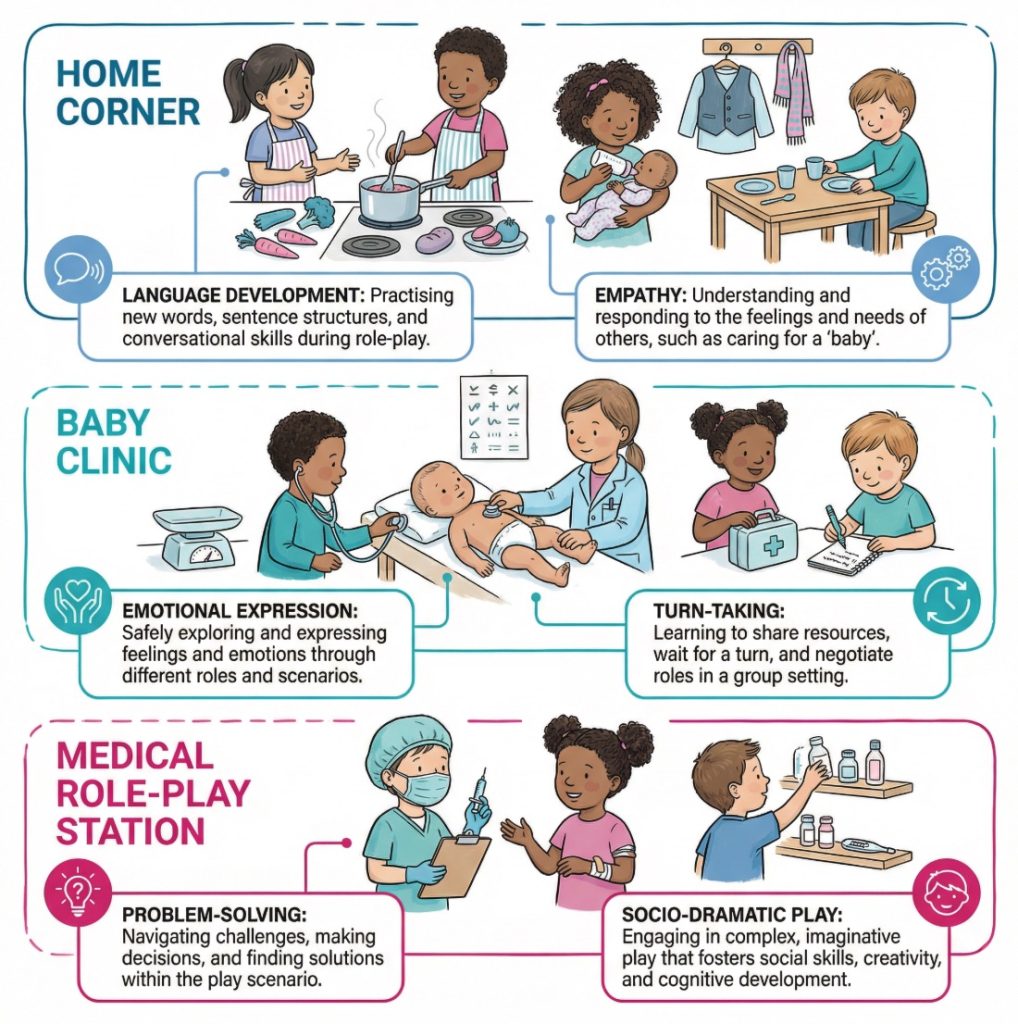
Examples across settings may include:
- Nursery: A home corner with dolls, telephones, blankets and chairs. Children act out meals, bedtime, comfort and going out.
- Preschool: A family flat or small vet or café set up. Children play out shopping, cooking, caring and serving.
- Childminding: A small basket with bottles, blankets and soft toys. Children copy close daily routines in a familiar space.
- Reception class: A post office, classroom, home or travel scene with signs and simple forms. Children combine role play, talk and early writing.
“The strongest role play usually grows from ordinary life, not from expensive equipment.”
A realistic mini scenario makes this clearer. A four year old who recently started nursery sets up a register area with two friends. One child becomes the teacher. Another says the baby is late and needs help hanging up a coat. The child leading the play insists that everyone must sit on the carpet before snack. That detail may look small, yet it shows recall, social structure and a wish to recreate the event accurately enough for it to make sense.
How does socio-dramatic play connect with early years development?
Early years practice is built around relationships, communication, routine and play. Socio-dramatic play gives children a way to explore those things through action. They can try out what happens when someone is hungry, tired, upset, left out or waiting for a turn.
That makes everyday life visible. A child who says, “She needs a drink first”, is showing an idea about comfort and priority. A child who tells another to sit down and wait may be replaying the structure of a familiar routine. A child who rocks a doll and speaks softly is showing a picture of nurture. These scenes are small, but they reveal how children are piecing together social life.
The link with emotional wellbeing is especially strong. Young children often revisit events before they can talk about them in a neat, adult way. Pretend routines can help them organise memory, reduce uncertainty and feel more in control. The NHS play and learning page and NICE early years guidance both sit comfortably alongside that view of play.
There is also a safeguarding dimension. Practitioners may notice repeated themes such as fear, separation, harsh language or exclusion. Those themes should not be treated as proof of a problem. They do, however, deserve thoughtful observation as part of the wider picture of the child’s development, behaviour and sense of safety. The current Working Together to Safeguard Children guidance underpins that professional responsibility.
This does not turn every role play scene into evidence. Far from it. It simply recognises that shared pretend play can form part of the wider picture of a child’s development, relationships and emotional security.
When should adults join in, and when should they step back?
Adults have an important role, but not the starring role. Children usually gain most when the play stays child led and the adult response stays light, timely and relevant. That balance takes judgement.
Joining in can help when a child is struggling to enter the play, when language is thin, or when one repeated action is stopping the scene from developing. A brief prompt may be enough. A practitioner might add a question such as, “Who is helping the baby now?” or place a notebook nearby so the play widens into lists, bookings or messages.
Stepping back is just as valuable. When children are negotiating well, holding roles, adapting the storyline and solving small disputes, adult interruption can flatten the scene. Observation tells more than constant talk. Meanwhile, careful watching helps practitioners notice who leads, who hangs back, who repeats routines and who may need extra support.
A caveat here is that stepping back should not mean drifting away. If the play becomes unsafe, persistently excluding or clearly distressing for one child, adult involvement becomes necessary. That sits within the wider responsibility for quality, safety and inclusion in early years settings, reflected in the EYFS statutory framework and the Ofsted early years inspection toolkit.
A useful pattern for adult involvement may include:
- Observe first: Watch the theme, tone, language and roles before speaking.
- Assess the need: Decide whether the play needs support with access, inclusion, language or emotional regulation.
- Add one prompt: Offer a question, prop or short phrase rather than a full script.
- Watch the response: See whether the play deepens, settles or widens.
- Withdraw again: Step back once the children are engaged and the scene is moving well.
How might socio-dramatic play be supported step by step?
A clear sequence helps adults support socio-dramatic play without turning it into a lesson. The first step is choosing a familiar theme. Family meals, bedtime, going to the dentist, caring for a baby, shopping or visiting a café all give children something concrete to work with.
The second step is preparing flexible resources. Open ended items usually work better than highly scripted toys. Dolls, blankets, telephones, cups, clipboards, small bags, empty packets, dressing up clothes and notebooks leave room for imagination. They are ordinary objects, used well.
The third step is careful observation. Adults can watch the roles children choose, the words they use, the points where the play stalls and the details they repeat. Those details often reveal more than the general theme. They may show interest, confidence, anxiety, routine memory or social strain.
The fourth step is a small extension. A new prop, one question or a short comment may move the scene forward. A practitioner might say that the baby looks tired, or place a chair near the role play area to create a waiting room. Small changes often work better than big ones.
The fifth step is reflection. Practitioners may compare notes, link observations to the child’s wider development, and consider whether any repeated themes should be discussed with parents or carers where appropriate. Where children need extra support with access or communication, the SEND Code of Practice and the Department for Education’s guidance on the four broad areas of need can help frame that thinking.
A simple checklist may help:
- Choose a familiar theme: Start with daily routines, local experiences or family life children are likely to recognise.
- Use open ended props: Offer resources that can become many things rather than one fixed toy.
- Notice the roles: Watch who chooses caring roles, who prefers control, and who stays on the edge.
- Listen to the language: Note words linked to feelings, comfort, waiting, food, sleep or help.
- Support entry: Use short prompts for children who want to join but cannot find a role.
- Keep it inclusive: Make sure the scene reflects different families, cultures, ages and abilities.
- Reflect afterwards: Link the play to communication, emotional wellbeing, social development and any follow up support.
“A well chosen prop or one careful question can deepen the whole scene.”
What are common mistakes when supporting socio-dramatic play?
One common mistake is taking over. Adults sometimes join with good intentions but begin assigning roles, controlling the storyline and filling every silence with talk. The children then lose the chance to negotiate, improvise and shape the scene for themselves.
Another mistake is treating role play as spare time rather than serious early learning. Socio-dramatic play may look ordinary, yet it can reveal language growth, social confidence, emotional themes and developing ideas about everyday life.
A third mistake is over interpreting the meaning of the play. Repeated doctor play does not automatically signal fear. A child making dolls argue does not automatically point to a safeguarding concern. Professional judgement depends on patterns over time and the wider picture around the child.
There is also the problem of narrow resources. A role play area filled with one type of family, one kind of home and one set of cultural assumptions can shut children out. Inclusive practice means offering dolls, books, pictures and props that reflect different family structures, disabilities, ethnic backgrounds and community roles. The Equality Act 2010 supports that wider expectation of fair access and inclusion.
Common mistakes may include:
- Over planning the story: A fixed adult script leaves little room for children’s ideas.
- Interrupting too often: Frequent comments break the flow of shared play.
- Missing quieter play: Less verbal children may still show rich socio-dramatic thinking through action and repetition.
- Ignoring home experience: Role play often grows directly from family routines and recent events.
- Using stereotyped resources: Narrow representations reduce inclusion and depth.
- Reading too much into one scene: One episode rarely explains a child on its own.
Where does socio-dramatic play sit within standards, legislation and professional roles?
In England, socio-dramatic play sits comfortably within the statutory and professional framework for early years. The EYFS statutory framework sets the standards for learning, development and care from birth to five. Role play links strongly with communication and language, personal, social and emotional development, and expressive arts and design. It may also support early literacy, depending on how the scene develops.
The non statutory Development Matters guidance gives further support to this picture. It presents play, talk, imagination, planning and persistence as part of strong early development. Socio-dramatic play fits that view well because it combines all of those elements in one lived activity.
The legal framework around early years provision is relevant too. The Childcare Act 2006 underpins the EYFS and the regulation of early years provision. The Children Act 2004 supports wider duties linked to cooperation and safeguarding. For children with additional needs, the SEND Code of Practice is relevant, while the Equality Act 2010 frames fair access and protection from discrimination.
Professional roles connect with this in practical ways. A key person may notice repeated themes in a child’s role play and discuss them with parents or carers. A SENCO may adapt the environment so a child with SEND can join in more easily. Ofsted inspects quality across settings, and the early years inspection toolkit reflects wider expectations around curriculum, care and children’s experiences.
Relevant standards and roles may include:
- EYFS statutory framework: Sets the standards for learning, development and care in early years provision in England.
- Development Matters: Offers non statutory curriculum guidance to support early years practice.
- Childcare Act 2006: Provides part of the legal basis for early years regulation.
- Children Act 2004: Supports joint working and safeguarding responsibilities.
- Working Together to Safeguard Children: Sets out the national framework for multi agency safeguarding work.
- SEND Code of Practice: Guides support for children and young people with special educational needs and disabilities.
- Equality Act 2010: Supports inclusive access and protection from discrimination.
- Key person, SENCO and early years teacher: These roles may all contribute to how socio-dramatic play is noticed, supported and interpreted.
What practical points are worth keeping in view?
Socio-dramatic play works best when it stays close to children’s real lives. Familiar themes tend to produce richer scenes than elaborate set pieces. A simple baby care area with a doll, blanket and bottle may produce more meaningful play than a large plastic set with every detail already decided.
It also works best when adults notice the relationship side of the play, not only the props. The important part is often the exchange between children. Who comforts whom. Who waits. Who gives instructions. Who gets ignored. Those details show how the child is using the scene to explore social life.
Settings that keep a broad, inclusive range of resources usually get deeper play. Dolls with different skin tones, books showing different families, and props that do not lock children into one script all help. The environment sends a message about whose life can be represented there. The Department for Education’s support for early years providers is a useful starting point for curriculum and inclusion guidance.
Practical takeaways may include:
- Keep themes familiar: Family routines, clinics, bedtime, meals and comfort often give children the strongest starting point.
- Watch before talking: Observation usually gives clearer insight than quick adult commentary.
- Value repetition: Repeated scenes can show interest, security seeking or a wish to revisit a recent event.
- Support inclusion early: Adapt space, props and language so more children can enter the play.
- Link observations carefully: Role play can inform reflection on development, wellbeing and safeguarding, but it should not be treated as proof on its own.
Conclusion and next step
Socio-dramatic play in early years settings is shared pretend play with a strong social focus. Children use it to explore feeding, comfort, illness, waiting, help, family roles and community experiences. Through those scenes, they test what everyday life looks like and how people respond to one another.
Its value lies in what it brings together. Language. Relationships. Emotion. Memory. Social rules. A child may be rocking a doll, but the play can also show ideas about security, responsibility and comfort. That is why socio-dramatic play deserves close attention in nurseries, preschools, childminding settings and reception classes.
A strong early years environment does not need a perfect role play corner. It needs familiar themes, flexible resources and adults who can judge when to join and when to hold back. When those pieces come together, socio-dramatic play becomes one of the clearest ways children explore everyday life, relationships and belonging.
Subscribe to Newsletter
Get the latest news and updates from Care Learning and be first to know about our free courses when they launch.