
The skills and qualities of a care worker are the knowledge, behaviours, and practical abilities that help them support people safely, respectfully, and consistently.
These include communication, compassion, observation, reliability, dignity, teamwork, record keeping, and safe working. Together, they shape how care is given and how it is experienced. A care worker may help with personal care, meals, mobility, daily routines, emotional support, or social contact, but the role is not only about completing tasks. It is about supporting the whole person in a way that protects wellbeing, choice, safety, and self respect.
This topic deserves close attention because the role is often described too simply. From the outside, care work can look like a list of practical jobs. The reality is more demanding. Good care depends on judgement, consistency, and the ability to respond to each person as an individual. The same task can be carried out with dignity and skill, or in a rushed and impersonal way. The difference comes from the worker’s skills and qualities.
A strong care worker combines practical competence with human awareness. They need to know how to support someone safely, but they also need to know how to listen, how to notice change, how to communicate with dignity, and how to work within professional standards. That combination turns routine support into good care.
People entering adult social care are often introduced to this through the Care Certificate standards, person centred care guidance from CQC, and wider duties linked to the Care Act statutory guidance, the Mental Capacity Act on the NHS website, and the Equality Act 2010. Those sources give the framework. Daily care brings it to life.
“Good care is not a list of tasks. It is skilled support given with dignity, consistency, and good judgement.”
What does a care worker actually do, and why do the right skills count?
A care worker supports people who may need help because of age, illness, disability, injury, mental ill health, or reduced independence. The support may be short term or long term. It may take place in a care home, a person’s own home, supported living, extra care housing, respite care, day services, or a hospital discharge setting.
The work often includes personal care, support with eating and drinking, mobility, continence care, helping people attend appointments, supporting communication, reducing loneliness, and maintaining routines. In some settings, the worker may also complete records, report concerns, support activities, follow behaviour support plans, or assist with equipment. Two workers can carry out the same task and still deliver very different care. One may finish quickly with little interaction. Another may explain each step, protect privacy, notice discomfort, and help the person do as much as possible for themselves.
That is why the right skills count. They do not sit at the edge of the role. They shape the whole job. A worker may know how to help someone get dressed, but poor communication can leave the person embarrassed or ignored. A worker may be kind, but if they miss a change in appetite or mobility, an important concern may go unnoticed. Good care depends on the link between attitude and action.
Kindness on its own is not enough. It helps, of course. Still, care work also needs judgement, consistency, awareness of risk, and the ability to work within agreed standards. The role is personal and professional at the same time. That balance runs through everything else in this article.
A short comparison helps.
| Part of the role | What it looks like |
|---|---|
| Practical support | Washing, dressing, meals, mobility, continence care, recording information |
| Personal qualities | Patience, empathy, respect, honesty, calmness, reliability |
| Professional standards | Following care plans, safeguarding, reporting concerns, maintaining boundaries |
| Person centred approach | Supporting choice, privacy, routines, communication needs, and independence |
Why is communication one of the most important skills in care?
Communication sits at the centre of care because almost every part of the role depends on it. A care worker needs to listen carefully, speak clearly, explain what is happening, check understanding, and respond to verbal and non verbal cues. Communication is not only about words. It also includes tone of voice, pace, facial expression, posture, timing, and the ability to stay calm when a person feels distressed or confused.
Many people receiving care are in a vulnerable position. They may feel unwell, embarrassed, tired, frightened, lonely, or dependent on others for basic support. A cold or hurried interaction can leave them feeling as though things are being done to them rather than with them. A calm and respectful interaction can help them feel informed, included, and safe. Trust grows from that. Trust also shapes whether people share concerns, accept support, and feel able to make choices.
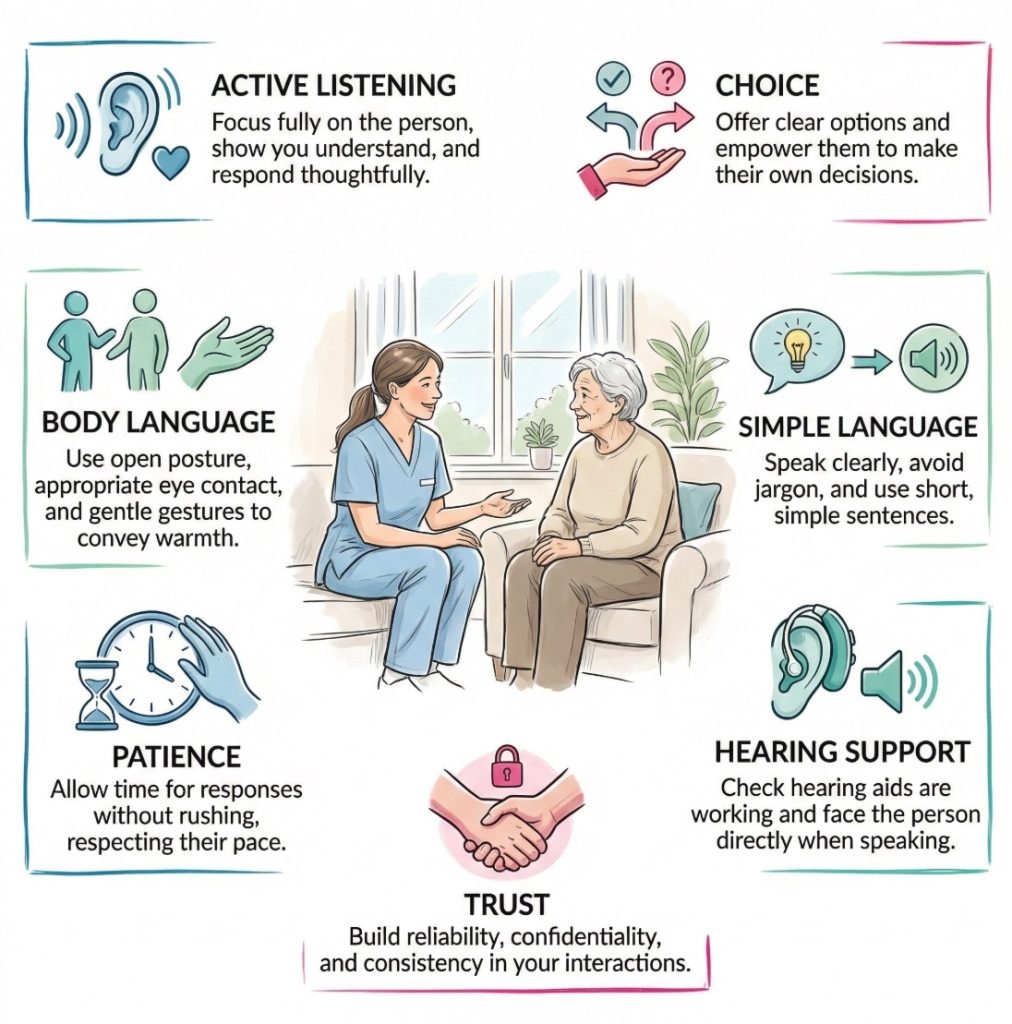
Communication has to fit the person. A worker may support someone with dementia, hearing loss, autism, aphasia, a learning disability, anxiety, or limited speech. One standard approach will not suit everyone. The worker may need to slow down, use plain words, repeat information gently, reduce background noise, use objects or gestures, or give more time for the person to respond. Guidance on communication and dignity from SCIE and Regulation 10 on dignity and respect from CQC both reflect that everyday link between communication and respectful care.
A realistic example makes this clearer. Imagine a resident in a care home who becomes distressed each morning when staff try to help with washing and dressing. A task focused response might be to repeat instructions more firmly. A better response would be different. The worker might notice that the person becomes confused when rushed, explain each step slowly, speak in a steady tone, offer simple choices, and keep the same routine where possible. The task itself has not changed. The quality of the support has.
Useful communication skills include:
- Active listening: Paying full attention to the person and not interrupting too quickly. This helps the worker notice both spoken concerns and emotional cues.
- Adaptability: Changing the approach to match the person’s needs. This may involve shorter sentences, visual prompts, or more processing time.
- Respectful language: Speaking to adults as adults and avoiding patronising language. This protects dignity and self worth.
- Checking understanding: Making sure the person has understood rather than assuming they have. This reduces confusion and supports safer care.
- Calm delivery: Keeping voice, pace, and body language steady during difficult moments. This can reduce fear and help the person stay engaged.
“Communication in care is not extra polish. It shapes trust, dignity, and the person’s sense of safety.”
What personal qualities help a care worker give good care?
Personal qualities shape how support feels to the person receiving it. This is one reason the role cannot be reduced to process alone. A worker may know the correct steps, but care can still feel poor if it is delivered without warmth, patience, or respect. In daily work, qualities such as compassion, empathy, patience, honesty, calmness, and reliability have a direct effect on wellbeing.
Compassion means recognising that the person may be dealing with pain, loss, frustration, or fear. It is not the same as pity. Pity creates distance. Compassion leads to thoughtful support. A person who needs help with personal care may feel embarrassed about losing privacy. A compassionate worker notices that emotional side of the situation and adjusts their manner. They may speak quietly, explain what they are doing, protect privacy carefully, and avoid drawing unnecessary attention to the task.
Patience is another essential quality. People receiving care may take longer to move, decide, speak, or process information. Some may ask the same question repeatedly. Some may refuse support and then ask for help a short time later. A patient worker does not turn delay into pressure or irritation. They recognise that slow responses may be linked to pain, confusion, fear, or reduced confidence. That patience helps the person stay involved and helps the worker avoid making the situation worse.
Reliability deserves equal weight. It is discussed less often than compassion, but it is just as important. In care, reliability means turning up on time, following the care plan, carrying out agreed support properly, recording information accurately, and passing concerns to the right person. From the worker’s point of view, that may feel routine. From the person’s point of view, it may be the difference between feeling settled and feeling anxious.
Personal qualities that strengthen care include:
- Empathy: Trying to see the situation from the person’s point of view rather than judging it from the outside.
- Patience: Giving time without making the person feel like a burden.
- Honesty: Being open about concerns, mistakes, or limits in the role.
- Reliability: Providing steady support that people and colleagues can depend on.
- Respect: Treating each person as an individual with their own history, identity, beliefs, and preferences.
- Emotional steadiness: Remaining calm in difficult moments so the person feels safer.
A common counterpoint is that personal qualities cannot replace training. That is true. Warmth without skill can still lead to poor care. The reverse is also true. Technical knowledge without humanity can feel harsh and impersonal. Good care needs both.
How do practical skills support safe and person centred care?
Practical skills are the day to day abilities that allow a care worker to carry out support safely and effectively. These include helping with washing and dressing, supporting mobility, assisting with nutrition and hydration, using equipment correctly, following infection prevention measures, keeping records, and noticing when something is not right. These tasks may look routine, but they require accuracy, consistency, and sound judgement.
Practical tasks are never separate from person centred care. Helping someone get dressed is not only about suitable clothes and physical support. It is also about asking what they would like to wear, recognising cultural or personal preferences, allowing choice where possible, and helping them maintain dignity. The task and the person’s experience should be considered together. CQC reflects this through Regulation 9 on person centred care and Regulation 12 on safe care and treatment.
Moving and handling is a good example of why practical care must be done properly. Helping someone stand, transfer, or reposition is not simply a matter of effort. It depends on using the agreed method, recognising risk, and knowing when equipment or extra support is required. If a worker improvises because they are in a hurry, both the individual and the worker may be harmed. The HSE guidance on moving and handling in health and social care shows how closely safe systems, training, and proper technique are linked.
Practical skill also includes knowing the limits of the role. A care worker may notice pain, skin changes, unusual tiredness, increased confusion, or a drop in appetite. Their role is not usually to diagnose the cause. Their role is to notice the change, support the person appropriately within their responsibilities, and report it through the right process. This is practical competence too. It is not glamorous. It is essential.
Examples of practical skill in daily care include:
- Personal care: Supporting someone to wash, dress, or use the toilet while preserving privacy and encouraging independence.
- Mobility support: Using the correct technique and equipment rather than relying on guesswork.
- Nutrition and hydration: Noticing when a person is eating or drinking less and recording this clearly.
- Routine support: Helping people keep familiar patterns that make them feel settled and secure.
- Accurate recording: Writing clear notes so other staff know what happened and what needs follow up.
“Practical care is never only physical. It includes safety, judgement, privacy, and choice.”
When should a care worker use observation, judgement, and reporting skills?
Observation is one of the most valuable parts of care work because people do not always say directly that something is wrong. A person may become quieter, more restless, less interested in food, more withdrawn, less steady, or unusually upset. These may seem like small details, yet they can be early signs that something has changed. Good care workers pay attention to these shifts because they often tell an important story.
Observation becomes especially important in long term care and in settings where staff know the person well. When a worker knows someone’s usual mood, routine, appetite, and communication style, it becomes easier to spot a difference. Continuity helps here. Familiar staff are often better placed to notice change early, though good records also help newer staff build the same picture over time.
Judgement sits alongside observation. It means thinking carefully about what has been noticed and deciding what to do next. A worker may ask whether the change is new, whether it affects safety or comfort, whether it needs recording, and whether it should be reported. This does not mean making clinical decisions. It means using common sense, professional awareness, and knowledge of what falls within the role.
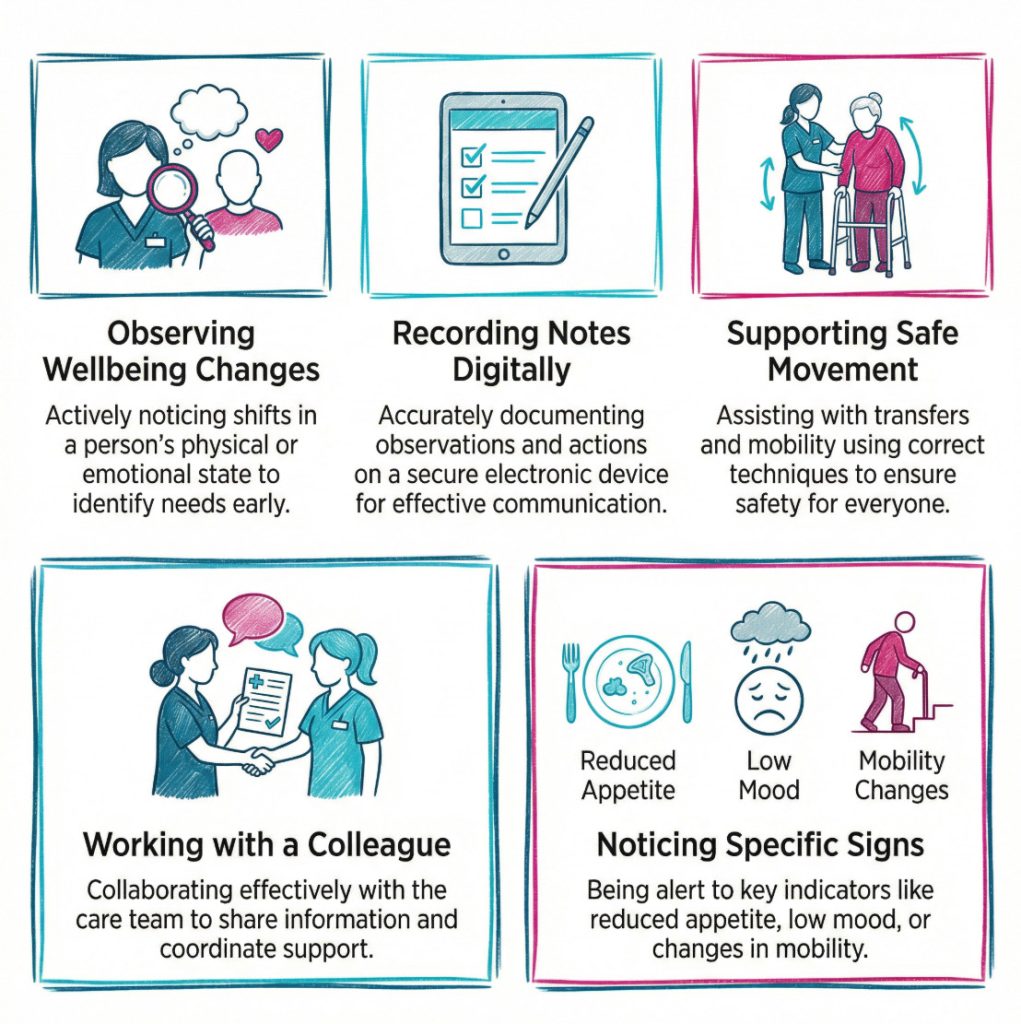
A simple example shows how this works. Imagine a home care worker visiting a man who is usually chatty and ready for breakfast. On this visit he seems drowsy, says he does not feel hungry, and struggles more than usual to stand. A weak response would be to assume he is merely tired. A better response would be to note the difference from his usual presentation, give appropriate support, record the change, and report it according to local procedure. The worker may not know the reason, but they have still done something important by noticing and acting.
Observation and reporting are especially important when there are signs of:
- A change in health: Such as pain, weakness, poor appetite, or sudden confusion.
- A change in mood or behaviour: Such as withdrawal, fear, agitation, or unusual distress.
- Possible abuse or neglect: Such as unexplained injuries, poor care, or signs that someone feels unsafe.
- Unsafe practice: Such as a colleague ignoring agreed procedures or cutting corners.
- Reduced decision making ability: Where the person may be struggling to understand or weigh up a choice.
Safeguarding sits behind much of this. So does the Care Act statutory guidance and the Mental Capacity Act information on NHS. Both shape the way concerns, risk, choice, and protection are approached in adult social care.
How should a care worker record information properly?
Record keeping is a professional skill that supports continuity, safety, and accountability. Good records help colleagues know what happened, what changes were noticed, what support was given, and whether anything still needs to be done. Without clear records, important information may be lost between visits or shifts.
A strong record is factual, relevant, and clear. It should describe what happened in plain language rather than using vague terms. For example, writing “Mr Patel ate half his lunch, drank one glass of water, and said he felt sick afterwards” is far more useful than writing “poor intake”. The first version helps other staff see what actually happened. It may also help them spot a pattern if similar entries appear over several days.
Good recording also shows respect for the person. Care workers often handle private information about health, personal care, emotions, relationships, and behaviour. That information should be recorded appropriately and shared only in the proper professional context. Writing should stay respectful. Records are not the place for careless comments, frustration, or personal opinions that cannot be supported by fact.
The quality of recording affects real care. If notes are unclear, delayed, or incomplete, the next worker may miss something important. If records are accurate and timely, they help the team respond properly and support the person more consistently. This is one reason record keeping should be seen as part of care, not as something separate from it.
Good recording usually includes:
- Facts: What was seen, heard, or done.
- Relevant detail: Information that affects care, safety, comfort, or follow up.
- Plain wording: Clear language that colleagues can read easily.
- Timeliness: Recording close to the event so details are not lost.
- Action taken: Who was informed and what happened next.
A short checklist can help here.
- Check the wording: The note should say what happened, not what the writer guessed.
- Check the timing: The entry should be made promptly while the detail is fresh.
- Check the tone: The wording should stay professional and respectful.
- Check the follow up: Any concern should show what action was taken.
Where do teamwork, boundaries, and professional standards fit into the role?
Care work depends heavily on teamwork. A worker may spend time alone with a person, but the wider support often involves other care workers, senior carers, nurses, social workers, therapists, managers, and family members. Good teamwork means sharing information properly, giving a clear handover, respecting each person’s role, and staying focused on what is best for the individual.
This is important because care is rarely delivered in one moment by one person. It builds over time through many interactions. If one worker notices that a resident is eating less but fails to mention it, the next worker may assume everything is normal. If a home care worker records a concern clearly and informs the office or a senior member of staff, the next visit can be planned more safely. Teamwork turns separate pieces of information into joined up care.
Professional boundaries are part of good teamwork and safe practice. Care workers often build close relationships with the people they support. Warmth can be positive, but the relationship still needs clear limits. Boundaries help workers stay consistent, protect fairness, and avoid decisions based on over involvement. They also protect the person from blurred roles and protect staff from pressure that sits outside their responsibilities.
Professional standards give the role its framework. In England, care practice is shaped by the Care Certificate, the Care Act guidance, the Mental Capacity Act on NHS, the Equality Act 2010, safeguarding duties, and CQC’s standards on person centred care, dignity and respect, and safe care and treatment. A care worker does not need to be a legal specialist. They do need to know the standards that shape daily care.
Examples of teamwork and professional working include:
- Giving a proper handover: So the next worker knows what changed and what needs attention.
- Following agreed plans: So the person receives steady support from different staff.
- Respecting difference: So care reflects the person’s beliefs, identity, culture, disability, and preferences.
- Speaking up: So unsafe practice or safeguarding concerns are not ignored.
- Staying within role: So support remains safe and professionally appropriate.
Short but important. Boundaries are not coldness. They are part of safe care.
“A good team does more than share tasks. It shares information, responsibility, and standards.”
How might these skills and qualities work in different care settings?
The core skills and qualities remain broadly the same across adult care, but the way they appear may change from one setting to another. Good care is not tied to one building. The same principles apply whether support is given in a care home, in supported living, or in someone’s own home.
In home care, respect and communication are especially important because the worker is entering the person’s private space. The person may have strong routines, preferences, and expectations about how things are done. A good worker explains what they are doing, asks before moving possessions, and supports the person in a way that feels collaborative rather than intrusive. Reliability is especially visible here because delays or missed routines can affect meals, medication support, or personal care.
In a care home, teamwork and recording may be more visible. Many staff may support the same resident over a week, so clear handover and accurate records are essential. Observation also becomes especially important because workers may notice patterns in sleep, eating, mood, continence, or mobility across several shifts. Small changes can build into a bigger picture.
In supported living, the balance between support and independence can be more prominent. The worker may need to encourage decision making and daily living skills without taking over. Communication, patience, and respect for choice often sit at the front of this work. In short term reablement or support after hospital discharge, the focus may shift towards rebuilding confidence and routine. Encouragement, observation, and reporting play a strong part because progress and setbacks both need to be noticed.
A realistic cross setting example shows how the same skills travel. Imagine a person who begins refusing meals. In home care, the worker may notice unopened food in the kitchen and a lack of interest at lunchtime. In a care home, staff may notice repeated poor intake over several days. In supported living, the worker may notice that the person is no longer shopping or preparing meals. The setting changes. The skills stay the same: observation, communication, recording, and reporting.
What common mistakes can weaken the quality of care?
Studying mistakes helps show what good care looks like. Many problems in care do not begin with deliberate harm. They begin with rushed assumptions, weak communication, poor records, or a failure to notice change.
One common mistake is focusing only on the task. A worker may complete personal care, meals, or mobility support efficiently, but if they ignore privacy, choice, or emotional comfort, the care may still feel poor. Another common mistake is assuming instead of checking. A worker may assume the person understands, agrees, or feels fine because they have not objected. Silence does not always mean consent or comfort.
Poor communication between staff is another frequent weakness. A worker may notice something important but fail to record it or pass it on. This can lead to inconsistent care and missed concerns. Weak boundaries can also create problems. Becoming over involved may affect judgement, fairness, and professionalism. There is a temptation to see kindness and boundaries as opposites. They are not. Good boundaries help kindness stay safe and steady.
Common mistakes include:
- Rushing care: Completing the task quickly without enough explanation, privacy, or choice.
- Using patronising language: Speaking to adults as though they are children.
- Ignoring small changes: Missing the early signs of ill health, distress, or decline.
- Writing vague records: Using unclear wording that does not help colleagues know what happened.
- Failing to speak up: Staying silent about unsafe practice or possible abuse.
- Taking over unnecessarily: Doing things for the person that they may still be able to do for themselves.
A short comparison shows the difference.
| Weaker practice | Stronger practice |
|---|---|
| Rushing through the task | Explaining the task and supporting choice |
| Assuming all is well | Checking comfort, mood, and response |
| Writing vague notes | Recording clear facts and actions |
| Keeping concerns to yourself | Passing concerns on promptly |
| Doing everything for the person | Supporting as much independence as possible |
How can a care worker apply these skills step by step in everyday care?
A step by step view helps show how the different skills and qualities come together during a normal piece of care. The details vary by setting, but the basic pattern is often similar.
- Step 1: Prepare well. Check the care plan, know the person’s preferences, and recognise any risks or agreed support methods.
- Step 2: Introduce yourself and explain. Greet the person properly, check how they are, and explain what support is planned.
- Step 3: Support choice and involvement. Offer choices where possible and give enough time for the person to respond.
- Step 4: Carry out care safely. Use the agreed method, follow safe practice, and protect dignity throughout.
- Step 5: Observe while providing support. Notice any pain, confusion, low mood, reduced appetite, or other changes.
- Step 6: Respond within your role. Give appropriate support and report concerns through the correct route when needed.
- Step 7: Record clearly. Write what happened, what was noticed, and what action was taken.
- Step 8: Hand over and reflect. Share key information with colleagues and consider what may need to change next time.
This sequence helps in more than one setting. In home care, it supports respectful entry into someone’s personal space. In residential care, it supports continuity across shifts. In supported living, it helps balance support with independence. The order may bend a little from one situation to another, but the core approach stays much the same.
A simple mini case study shows this in action. A care worker arrives to help a woman who usually washes and dresses with light support. Today she seems flat, declines breakfast, and says her legs feel weak. The worker slows the routine, supports her safely, notices the change from normal, records the details clearly, and reports the concern to the senior member of staff. That response uses communication, observation, practical skill, and professional judgement in one short visit.
A practical takeaway list can be useful here:
- Notice the person first: Tasks should follow the person, not replace them.
- Use clear language: People are more likely to feel safe when the worker explains what is happening.
- Keep records useful: Notes should help the next worker, not create confusion.
- Act on changes: Early reporting can prevent a small concern from becoming a bigger one.
- Stay professional: Warmth and boundaries should sit together.
Conclusion and next step
The skills and qualities of a care worker form the foundation of good care. They include practical ability, but they also include the behaviours and attitudes that shape how support feels to the person receiving it. Communication, compassion, patience, observation, respect, reliability, teamwork, and clear recording all work together.
The strongest care workers usually recognise that ordinary moments carry real weight. Helping someone wash, get dressed, eat a meal, or move from bed to chair may look routine from the outside, yet these moments affect comfort, confidence, dignity, and trust. That is why the role should be seen as both skilled and deeply human.
Anyone learning about care work benefits from looking at both sides of the role at once. There is the practical side: safe support, accurate records, reporting concerns, following care plans. Then there is the human side: tone of voice, patience, privacy, consistency, and respect. One without the other leads to poor care. Together, they create support that feels safe, personal, and professional.
A useful next step is to read the Care Certificate standards alongside the CQC guidance on person centred care and dignity and respect. Those standards make far more sense once they are linked to the daily reality of care work.