

A care worker interview is a structured discussion used to judge whether a candidate can support people safely, respectfully and consistently. It is not only about sounding kind. It is also about showing good judgement, clear communication, safe boundaries and a realistic grasp of the role.
Many interview questions look simple at first. Underneath, they are testing something deeper. A question such as “Why do you want to work in care?” usually explores motivation, reliability and attitude. A question such as “What would you do if someone refused care?” looks at dignity, consent, safety and reporting.
The role sits within a clear framework. The Care Certificate standards set out core knowledge, skills and behaviours for new workers in care. CQC guidance on person-centred care expects support to reflect each person’s physical, mental, emotional and social needs. The Care Act 2014 places wellbeing and safeguarding at the centre of adult social care. The Mental Capacity Act 2005 sets out the legal principles for decision-making where capacity may be in doubt.
Good answers reflect that world. They keep the person at the centre. They also show that the worker would follow procedure, share concerns properly and stay within the limits of the role.
“Good answers sound calm, specific and safe.”
Why employers ask these questions
Employers are not looking for polished speeches. They want signs that a person would be safe to employ and safe to trust with someone’s care. Poor judgement in care can affect privacy, dignity, consent, safeguarding, moving and handling, record keeping and emotional wellbeing.
Most care worker interview questions fall into a few familiar groups. One group covers values and motivation. Another tests judgement in everyday situations. Others look at communication, teamwork, confidentiality and safe working.
Generic answers often fall flat. “I like helping people” is warm, but it tells an employer very little. A better reply links kindness to daily care. It might mention dignity, observation, accurate handovers, confidentiality, person-centred support and safeguarding. Those are not extra details. They are part of the job.
There is a practical reason for this. Care employers recruit against recognised standards, not instinct alone. Skills for Care links the Care Certificate to induction and safe practice. DBS guidance for adult social care roles reflects the same safety-led approach to recruitment.
A candidate may be warm and genuine, yet still miss the point if the answer says nothing about teamwork, records or safe escalation. Care is personal. It is also professional.
What employers are really listening for
Strong answers usually contain four features. No fancy phrasing needed. Clear thinking does the work.
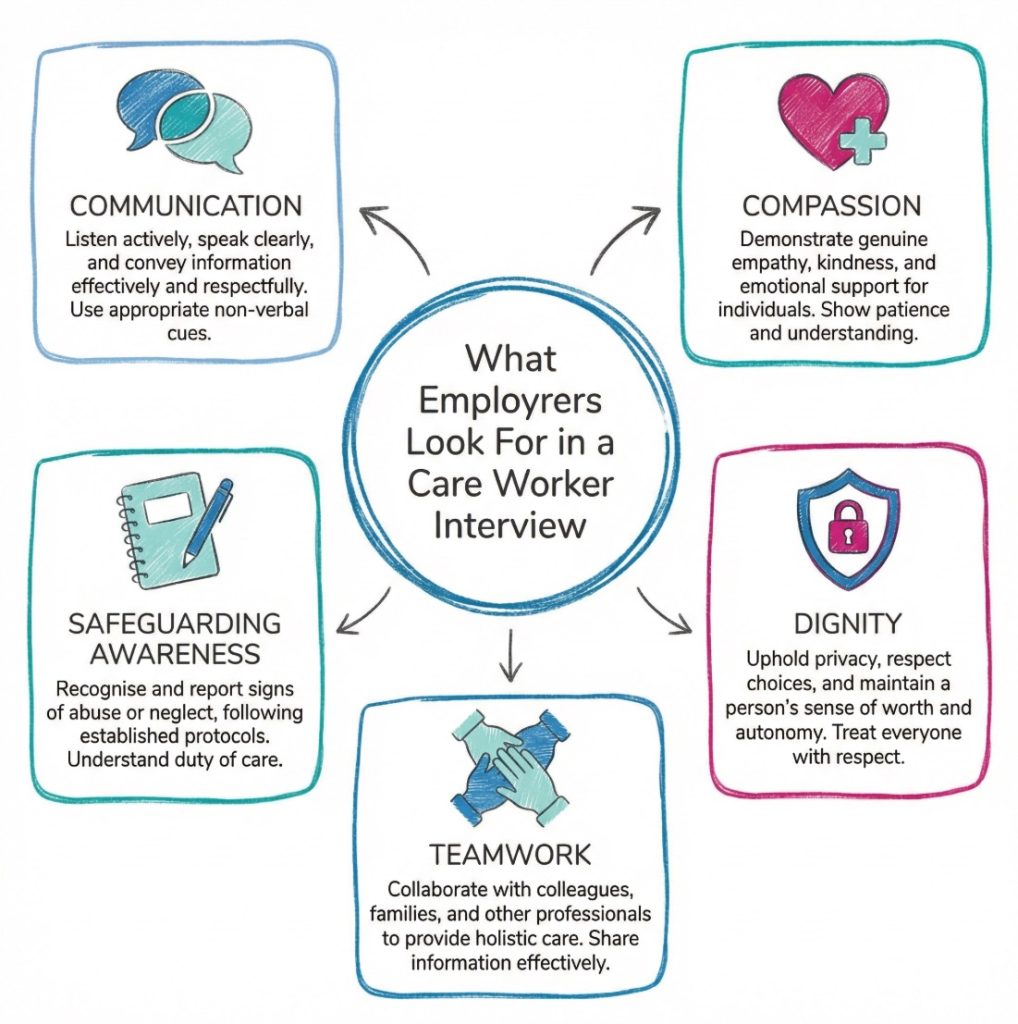
- Person-centred care: The answer shows that support should fit the individual, not the routine. This includes preferences, background, communication style, daily habits and what helps the person feel safe.
- Safe judgement: The answer shows awareness of risk, calm decision-making and sensible action.
- Professional boundaries: The answer shows that concerns would be reported properly and personal limits would be respected.
- Practical awareness: The answer sounds like real care work rather than a general wish to be helpful.
Person-centred care is a phrase that appears often in interviews. It needs plain language. In daily work, it means noticing what is important to the individual and adjusting support around that. It may mean giving someone time to choose clothes, explaining personal care in a way that reduces embarrassment, or using familiar routines to lower distress. CQC’s person-centred care guidance and SCIE’s dignity in care resources both describe care in those practical terms.
Safe judgement carries just as much weight. A worker may need to respond to refusal of care, a fall, sudden confusion, conflict in the home or a possible safeguarding concern. The answer needs to show steadiness. It should not sound forceful, casual or reckless.
Professional boundaries deserve the same care. Trust is essential in care work, but trust is not the same as secrecy or over-familiarity. A worker may be kind and approachable without accepting money, sharing private contact details or hiding concerns from managers. As one home care worker put it in a practice discussion, the job is about being warm without “slipping into being family”. That is a useful way to think about boundaries.
“Kindness on its own is not enough. Employers want kindness with judgement.”
How to answer the most common interview questions
The strongest answers are usually simple. They answer the question directly, then add a short piece of practical detail.
If asked, “Why do you want to work in care?”, a good reply usually combines empathy with realism. It should show respect for people receiving care, but it should also show awareness that the role involves teamwork, communication, records, reliability and safe practice.
If asked, “What makes a good care worker?”, the answer works best when it links personal qualities to the role itself.
- Respect: Good care workers treat people as individuals, not as tasks to finish quickly.
- Patience: People may need extra time, reassurance or a different approach.
- Observation: Small changes in appetite, mobility, mood or routine can point to a larger problem.
- Reliability: Consistent attendance and accurate reporting help other staff provide joined-up care.
- Professionalism: Warmth should sit alongside confidentiality, boundaries and safe practice.
If asked, “What does dignity mean in care?”, a strong answer should stay concrete. Dignity can be shown by knocking before entering, explaining what is happening, using the person’s preferred name, preserving privacy during personal care and speaking to the person rather than about them. SCIE’s guidance on privacy and dignity gives a useful picture of how these small actions shape someone’s experience of care.
Teamwork questions are common as well. “How do you work as part of a team?” is not really about being friendly with colleagues. It is about passing on the right information, recording clearly, respecting different roles and speaking up when something changes. A worker who notices a change but says nothing can leave the next shift with an incomplete picture.
Interviewers also listen for tone. A careful answer does not sound dramatic or over-rehearsed. It sounds like something that could genuinely be said on shift.
How scenario questions work in real settings
Scenario questions are often the strongest part of a care interview. They show how someone thinks when there is pressure, uncertainty or risk. Employers rarely expect a perfect script. They want a safe approach.
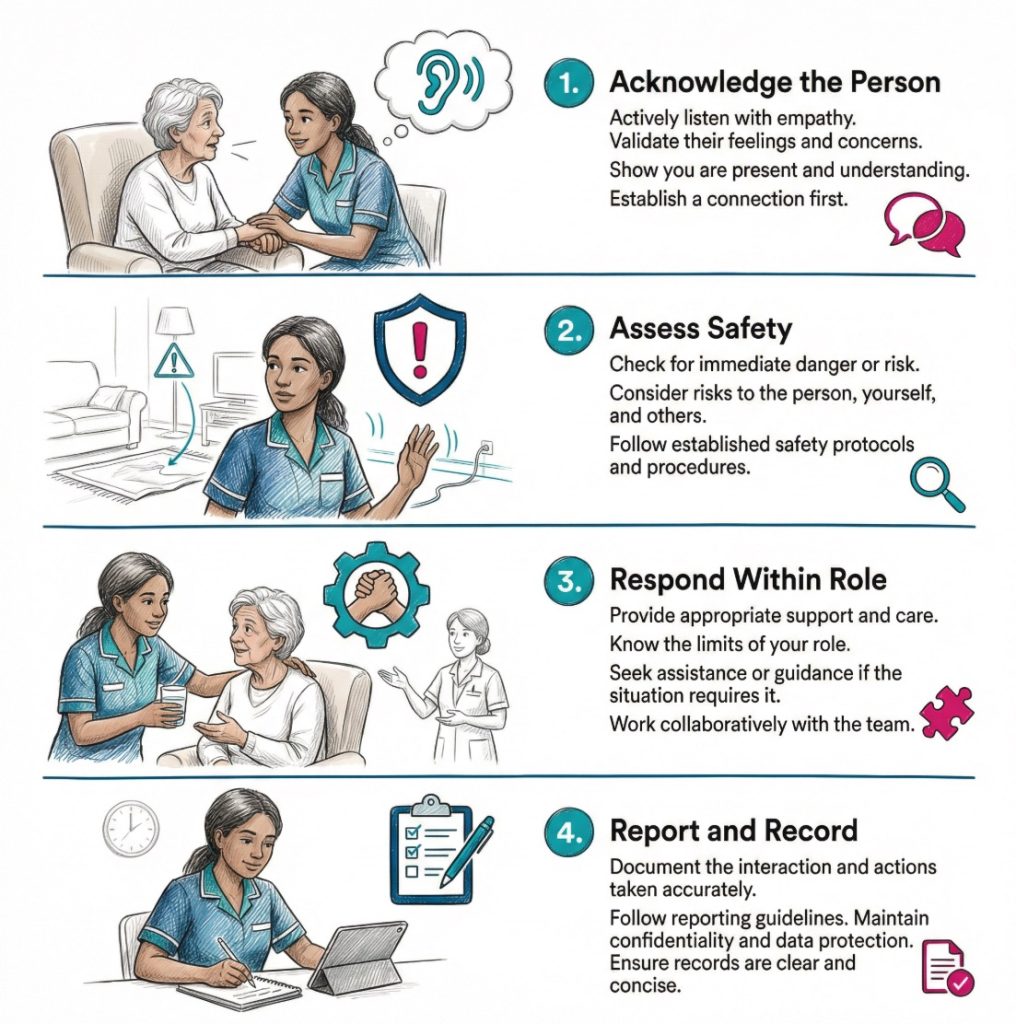
A useful method is easy to follow:
- Acknowledge the person: Start with calm communication and respect for how the person may be feeling.
- Check immediate safety: Think about risk to the person, other people and staff.
- Respond within role: Explain what action would be taken directly, without stepping beyond training or responsibility.
- Follow procedure: Record, report or escalate where needed.
- Keep dignity in view: The person should stay central throughout, not disappear behind paperwork or routine.
Take a common question: “What would you do if someone refused personal care?” Refusal does not always mean hostility. The person may be tired, embarrassed, frightened, confused or in pain. A strong answer should show that care would not be forced. It should explain that the worker would try to find the reason, explain calmly, offer reassurance, consider whether a different time or approach would help, and report or record the refusal if it created risk or affected care planning.
Safeguarding questions need a firmer tone. If the issue is suspected abuse or neglect, the answer should show that the concern would be taken seriously, recorded clearly and reported through the right route without delay. The Care Act 2014, section 42 is the main legal basis for safeguarding enquiries in England. Employers want answers that show clear reporting rather than private investigation or guesswork.
Distress and anger come up often too. If asked what would happen if a resident became upset and shouted, a strong answer would usually mention staying calm, lowering the tone of the interaction, looking for triggers such as pain or confusion, giving space where suitable and seeking support if the situation escalated. SCIE’s communication guidance is useful here because it treats communication as part of dignity, not just a way to manage behaviour.
One experienced support worker described this kind of moment very plainly: when a person is shouting, the first task is often to “slow the room down”. That rings true. Quick reactions can make things worse.
“Scenario answers work best when they show calm action, not heroic action.”
What answers may look like in different care settings
The same interview question can sound slightly different depending on the setting. The principles stay much the same, yet the detail changes.
In domiciliary care, the worker is often alone in the person’s home. Observation, lone working and prompt reporting carry more weight. If a person seems unusually confused or the home appears unsafe, a strong answer would mention immediate welfare, contact with the office or senior worker where needed, and a clear written record afterwards.
A care home brings different pressures. Handovers, daily notes and communication with senior carers or nurses may shape the answer. If a resident refuses food or personal care, the response may include reassurance, checking the care plan, passing the information on and making sure the next shift knows what happened.
Supported living often places more emphasis on independence. A good answer should not sound as though staff take over because it is quicker. If a person wants to make choices about meals, clothes or activities, support should usually focus on informed choice and agreed risk management rather than control.
Healthcare support or rehabilitation settings may bring more questions about safe transfers and observation. The HSE guidance on moving and handling in health and social care is relevant here. Interview answers sound stronger when they mention training, assessed plans, equipment and asking for help where needed.
| Setting | What employers often listen for | Example of a stronger answer |
|---|---|---|
| Domiciliary care | Observation, lone working, reporting | A change in mood or alertness would be noticed, reported promptly and recorded clearly |
| Care home | Teamwork, handovers, consistency | A refusal of care would be communicated to the right colleague and reflected in notes |
| Supported living | Choice, independence, boundaries | Support would focus on enabling decisions rather than taking over |
| Healthcare support | Safe movement, observation, escalation | Transfers would follow training and assessed guidance, not guesswork |
A fair counter-point sits here. Some employers may value warmth above technical detail in entry-level interviews. There is truth in that. A candidate who sounds cold and procedural will not stand out for the right reasons. The better answer brings both together: warmth, then safe action.
What to know about consent, confidentiality and safer recruitment
These topics come up because they show how a worker thinks about responsibility. They also show whether the person sees care as professional work rather than informal help.
Consent is part of respectful care. The Mental Capacity Act 2005 starts from the principle that adults should be assumed to have capacity unless it is established otherwise. It also says people should be supported to make their own decisions as far as possible. In interview terms, that means the answer should not jump too quickly to taking control. It should show explanation, patience and support for decision-making.
The Equality Act 2010 also sits in the background here. People may need information explained differently because of disability, language needs, culture, religion or communication style. Good answers show that support would be adapted fairly and respectfully, not delivered in exactly the same way to everyone.
Confidentiality is another regular theme. A strong answer should show that private information would be protected and shared only where appropriate for care or safety. The NHS guide to confidentiality in health and social care makes an important point here: the duty to share information can be as important as the duty to protect confidentiality. That is why safeguarding concerns should not be hidden behind a mistaken idea of privacy.
Safer recruitment sits behind the whole process. The DBS adult social care guidance explains how eligibility for checks relates to role content and responsibilities. This helps explain why interviewers spend so much time on judgement, values and scenarios. Care recruitment is meant to reduce risk before employment starts.
A short checklist helps bring these points together:
- Consent: The answer should show explanation, agreement and respect for the person’s choices where possible.
- Capacity: The answer should avoid assumptions and reflect the principles of the Mental Capacity Act.
- Confidentiality: The answer should show discretion without treating confidentiality as secrecy.
- Safeguarding: The answer should show prompt reporting through the right route.
- Equality: The answer should reflect fair, respectful support for people with different needs and backgrounds.
- Recruitment: The answer should reflect the safety-led nature of the role.
Common mistakes that weaken answers
The most common mistake is vagueness. “I would help them and make sure they were all right” sounds caring, but it does not show enough. An employer usually wants to hear what the worker would actually do, what they would notice and who they would tell.
Another weak point is sounding too controlling. Saying “I would make them accept care” suggests poor judgement around dignity, consent and person-centred support. Stronger answers show reassurance, explanation, alternatives and escalation where needed.
Some answers forget the professional side of care entirely. They focus on helping people but say nothing about records, confidentiality, moving and handling, reporting or safeguarding. That leaves the answer unfinished.
These mistakes come up again and again:
- Being vague: The answer sounds kind but gives no real action.
- Ignoring the person: The answer focuses on routine or staff convenience rather than the individual.
- Forgetting records: Important details are left out, especially after a refusal, fall or safeguarding concern.
- Promising secrecy: This can be unsafe where abuse or serious risk is involved.
- Over-claiming competence: A worker sounds as if they would manage everything alone instead of seeking support where needed.
- Using stock phrases: Memorised lines can sound flat if they are not backed by a realistic example.
A short answer can still be strong. It just needs a clear action, a reason and a safe next step.
Practical takeaways before a care worker interview
A good interview answer usually does three jobs at once. It answers the question. It shows safe judgement. It keeps the person in view.
This quick checklist brings those points together:
- Start directly: Answer the question first instead of circling around it.
- Use real care language: Terms such as dignity, safeguarding, consent, confidentiality and person-centred care should appear naturally where relevant.
- Add one practical detail: A small example makes the answer believable.
- Show safe limits: Mention reporting, records or asking for support when the situation calls for it.
- Keep the person central: Good care answers should never turn people into tasks.
- Match the setting: Home care, care homes, supported living and healthcare support each shape the detail slightly.
It also helps to know the role of key organisations. Skills for Care supports workforce development. CQC regulates services. NICE publishes guidance used across health and care. SCIE provides practice resources on dignity, safeguarding and communication. legislation.gov.uk gives the text of the main Acts and regulations that shape the role.
Keep it grounded. That is usually what makes an answer sound convincing.
“The strongest answer is often the one that sounds most like real work.”
How to use the STAR method for common care worker interview questions
The STAR method is a simple way to give a structured example without sounding rehearsed. STAR stands for Situation, Task, Action and Result. It works well in care interviews because employers often want evidence from real situations, not only general views.
A STAR answer should stay focused. The situation sets the scene. The task explains your responsibility. The action shows what you actually did. The result explains what happened and what the outcome was. In a care interview, the strongest answers also show dignity, safety, communication and teamwork.
This method is useful in care homes and homecare agencies because many interview questions ask about real events. These may include refusal of care, handling distress, reporting concerns, dealing with pressure, supporting dignity or working with colleagues. A short, clear example can say far more than a long general answer.
A simple way to keep STAR answers balanced is this:
- Situation: Briefly explain where you were and what was happening.
- Task: Say what you needed to do or what responsibility you had.
- Action: Focus on your own actions, not only what the team did.
- Result: Show the outcome and, where relevant, what you learned.
STAR examples for care home and homecare interviews
Below some examples of common questions a care worker may be asked in a care home or homecare interview. The wording can be adapted, but the shape of the answer should stay natural using the STAR method. These examples will vary depending on the workplace, situations and previous experience.
Question: “Can you tell us about a time when someone refused care?”
Situation: During a morning visit in a homecare role, a client who usually accepted support with washing and dressing said they did not want any help and became withdrawn.
Task: I needed to respect the person’s dignity and choice, while also making sure their wellbeing was monitored because this change was unusual for them.
Action: I stayed calm and spoke gently. I asked whether they were in pain or wanted me to come back later. I gave them space to answer and avoided rushing them. They said they felt unwell and embarrassed. I reassured them, offered a shorter visit focused on what they felt comfortable with, and checked whether they wanted me to report that they seemed unwell. I then informed the office and recorded the refusal and the change in presentation.
Result: The office arranged a welfare follow-up and the client later accepted support. My response respected their dignity, but it also made sure the change was not ignored.
This kind of answer works because it shows respect, observation and reporting. It does not sound controlling.
Question: “Describe a time when you had to respond to a safeguarding concern”
Situation: In a care home setting, I noticed unexplained bruising on a resident who also seemed more anxious than usual during personal care.
Task: My responsibility was to take the concern seriously, protect the resident’s dignity and report it properly.
Action: I did not question the resident in a leading way or make assumptions. I noted what I had seen, including where the bruising was and the change in mood. I reported it straight away to the senior carer in line with procedure and made a clear written record. I continued to support the resident calmly and respectfully while the concern was escalated.
Result: The concern was passed on quickly and reviewed under safeguarding procedures. The resident’s care was monitored more closely and the issue was not missed or dismissed.
That answer is stronger than saying “I would tell the manager” and stopping there. It shows calm judgement and proper boundaries.
Question: “Tell us about a time you worked well as part of a team”
Situation: On an evening shift in a care home, one resident became more confused than usual and was unsettled at bedtime. The shift was busy and several staff were supporting other residents.
Task: I needed to support the resident safely while making sure the rest of the team knew about the change.
Action: I stayed with the resident, used a calm tone and reduced noise around them. I spoke to a colleague so they could cover another call while I settled the resident. Once the person was calmer, I updated the senior carer, recorded the change in behaviour and handed it over clearly to the night staff.
Result: The resident settled more comfortably, and the next shift had the information they needed to keep monitoring the situation.
This shows teamwork in a realistic way. It is not only about being helpful to colleagues. It is about joined-up care.
Question: “Give an example of when you protected someone’s dignity”
Situation: While supporting a resident with personal care in a care home, I noticed they seemed embarrassed when another staff member entered the room without warning.
Task: I needed to protect the resident’s privacy and help them feel respected.
Action: I made sure the door was closed, covered the resident properly and spoke to them calmly about what I was doing. Afterwards, I raised the point with the colleague in a respectful way and reminded them that privacy during personal care is important. I also stayed alert to the resident’s comfort during future care.
Result: The resident became less anxious during support, and the point was addressed straight away rather than becoming a repeated issue.
A good dignity answer often focuses on small details. That is where dignity is either protected or lost.
Question: “Tell us about a time when you had to stay calm under pressure”
Situation: During a homecare visit, a client became upset and started raising their voice because they thought a family member had not visited when expected.
Task: I needed to keep the situation calm, reduce distress and make sure the person was safe.
Action: I lowered my voice, gave the person time to speak and did not argue with them. I acknowledged that they were upset and tried to reduce the sense of pressure in the room. Once they were calmer, I checked whether they wanted a drink and whether there was anything specific worrying them. I then reported the incident to the office and recorded the details because the distress was unusual.
Result: The person settled, the concern was shared with the wider team and future visits took that trigger into account.
That answer shows emotional control. It also shows follow-through.
Question: “Can you describe a time when you noticed a change in someone’s condition or behaviour?”
Situation: In a homecare role, a client who usually chatted and ate breakfast seemed drowsy, quiet and uninterested in food over two visits.
Task: I needed to notice whether this was a temporary dip or a sign that something had changed more seriously.
Action: I observed the difference carefully, checked whether they felt unwell, and asked simple questions without overwhelming them. I reported the change to the office, documented what I had seen and followed the agreed procedure for escalating concerns about wellbeing.
Result: The concern was followed up promptly, and the change was treated seriously rather than being written off as a bad day.
Observation is a big part of care work. STAR helps show it clearly.
Conclusion
Care worker interview questions are really questions about daily care. They test whether someone can combine kindness with safe action, respect with boundaries and calm thinking with proper reporting. That is what employers need to hear.
The best answers are rarely dramatic. They are clear, practical and grounded in the role. They show dignity, person-centred care, teamwork, observation, confidentiality and safeguarding without turning those into buzzwords. They sound like something a careful worker would actually say and do.
That is where good preparation leads. Not to memorised speeches, but to short, believable answers that reflect how good care looks in ordinary situations.