
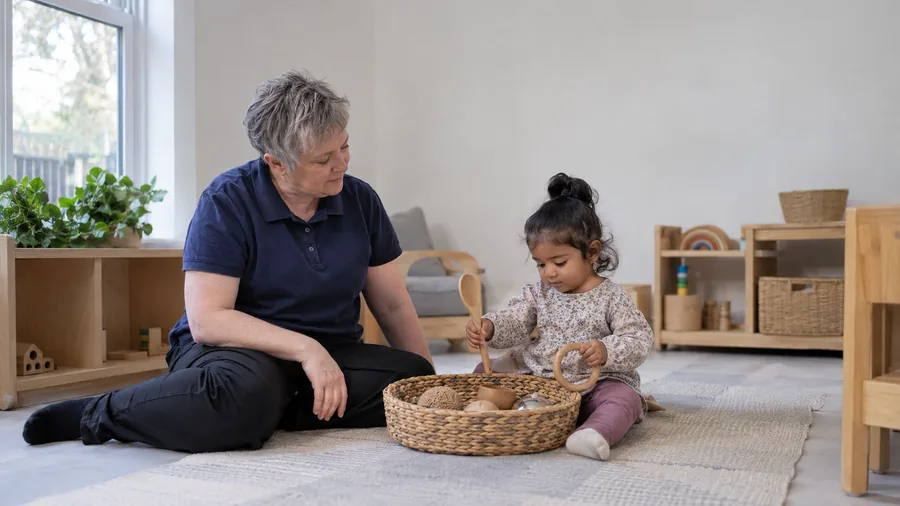
A treasure basket is a low, sturdy basket filled with safe everyday objects made from different real materials, such as wood, metal, fabric, leather, cork and natural items, for a seated baby to explore freely through touch, movement, looking, listening and mouthing. The approach is closely linked to Elinor Goldschmied’s work with babies and young children and is usually used with children who can sit independently.
A treasure basket can look modest. A wicker basket, a few well chosen objects, a baby on the floor. Yet it often leads to long stretches of concentrated play. Babies do not need every resource to flash, sing or light up. They need variety they can feel, hold, turn and test for themselves.
This approach fits well within early years provision in England. It sits comfortably alongside the Early Years Foundation Stage statutory framework, the non statutory Development Matters guidance, and the wider picture of safe, responsive care shaped by the Childcare Act 2006. It also reflects the emphasis on careful observation, strong relationships and suitable environments found in early years inspection guidance.
“A treasure basket gives a baby something real to investigate, not something designed to perform for them.”
The value of a treasure basket lies in its simplicity. A baby reaches, grasps, mouths, taps, drops, compares and repeats. The adult watches closely and keeps the space safe. That is the whole shape of it. Simple. But rich.
What is a treasure basket and what makes it different?
A treasure basket is a sensory collection for babies who can sit up on their own. It usually contains real objects rather than toys built for one fixed purpose. The basket itself is not the important part. The objects are. They need to feel different from one another and offer enough contrast to hold a baby’s attention.
A toy box often contains items that suggest a particular use. A rattle is shaken. A button is pressed. A pop up toy is pushed. A treasure basket works differently. A baby may mouth a wooden ring, rub a silk scarf against their cheek, turn over a shell, tap a spoon against the floor or stare at the shine on a metal lid. The object does not tell the child what to do.
That freedom is a strength. Babies at this stage learn through direct sensory experience. They learn by handling, repeating and comparing. Metal feels colder than wood. Cork feels lighter than a bunch of measuring spoons. Velvet drags against the skin in a different way from cotton. These differences give the play its depth.
The language around treasure baskets can sound more technical than it needs to be. Sensory play means play that involves the senses, especially touch, sight, sound and movement. Open ended means there is more than one way to use the object. Heuristic play is often the next stage, where toddlers use collections of objects to fill, empty, stack, sort and combine.
Here is a useful comparison.
| Approach | Main age or stage | What the child does | What adults focus on |
|---|---|---|---|
| Treasure basket | Seated babies | Explore single objects through the senses | Safety, observation, emotional security |
| Toy box play | Wide age range | Use toys designed for specific actions | Choice of toys, interaction, routine play |
| Heuristic play | Older babies and toddlers | Combine, post, stack, fill and empty objects | Space, collections of objects, patterns in play |
A treasure basket is not a decorative display and it is not a box of random bits. It is a planned collection. The best ones feel thoughtful from the first moment a baby reaches in.
Why use a treasure basket in early years?
A treasure basket works because it gives babies real sensory information. A wooden spoon feels warm and firm. A metal whisk feels cool and springy. A leather purse gives resistance. A natural sponge changes shape in the hand. A baby can feel these differences long before they could describe them.
This kind of exploration supports concentration. Many adults are surprised by how long a baby will stay with one object when the object is genuinely interesting. They may turn it over for several minutes, tap it, mouth it, stop, look, and start again. That repeated testing is not empty play. It is how early learning often looks.
There is physical development in every small action. A baby leans forward to reach into the basket. They steady their trunk. They bring an object to the midline. They pass it from one hand to the other. They release it and look for where it has gone. All of this strengthens coordination and control. The NHS guide to child development is helpful for the broader picture of early physical and sensory growth.
Language grows alongside the play. Babies communicate through gaze, movement, sound and expression well before spoken words arrive. A calm adult can support this by adding a few simple comments linked to what the child is already doing. “You found the smooth one.” “That made a softer sound.” Brief. Clear. Enough.
“The basket is not there to entertain the baby. It is there to give the baby something worth exploring.”
The emotional side is just as important. A baby who feels secure with a familiar adult nearby is more likely to explore with confidence. That links closely to the EYFS emphasis on positive relationships and the role of the key person. In many settings, a treasure basket becomes one of the clearest ways to see what a baby likes, what they avoid and what helps them settle.
A fair counterpoint is that some people see treasure baskets as old fashioned when there are so many commercial sensory toys on the market. The answer is not that every manufactured toy is poor. Many are perfectly useful. Real objects simply offer a wider range of texture, weight, temperature and sound than a set of similar plastic items. That is why treasure baskets still hold their place.
When is the right time to use a treasure basket?
A treasure basket is usually most suitable when a baby can sit independently and stay stable while reaching, handling and mouthing objects. The classic age range often given is around five to ten months, though the child’s stage is more useful than the exact age.
Observation comes first. A baby who still needs too much physical support may not be ready. A baby who is already moving rapidly around the room may dip in and out too quickly for the original treasure basket format to work well. In those cases, the approach can be adapted or shifted towards later heuristic play.
The timing within the day also shapes the session. Treasure baskets tend to work best when the baby is calm, alert and comfortable. A child who is hungry, tired or unsettled may not engage for long. In a nursery, this may mean a quiet patch after routine care. In a childminding home, it may suit the morning better than the late afternoon.
There is no need to leave a treasure basket out all day. It works far better as a focused experience with close supervision. The baby needs an adult nearby who can keep the space safe and notice what is happening. That is especially important because objects may be mouthed.
This is also where judgment comes in. One short, well supported session can reveal more than a long period where the basket is simply present in the room. The pace should be unhurried, but the setup should still be intentional.
How does a treasure basket support learning and development?
A treasure basket supports physical, cognitive, communication and emotional development all at once. That may sound broad, but the links are easy to see when a baby is actually using one.
Physical development begins with posture and reach. The child sits, shifts their weight and reaches into the basket. Their hands work in different ways depending on the object. They grip a spoon differently from a scarf. They need a different action for a cork coaster than for a bunch of measuring spoons. Those small differences build skill.
Cognitive development is there too. Here, cognitive simply means early thinking. The baby tests what happens when they shake, tap, squeeze, drop or mouth something. They notice difference. They repeat actions. They compare. A baby who returns to the same object several times is not stuck. They may be checking what they have already discovered.
Communication grows through shared attention. A baby looks at an object, then at the adult, then back again. A pause. A sound. A lifted eyebrow. These moments are the beginning of interaction around an object or event. The adult’s role is not to talk all the way through it. The adult notices, names lightly and stays present.
“What looks like simple play is often careful testing, repeated over and over until the baby has had enough.”
Personal, social and emotional development is woven through the whole experience. A baby who can choose freely often appears more settled and more purposeful. A familiar adult close by helps create the security needed for exploration. This sits well with the idea of responsive care supported by the Department for Education and with the wider expectation that babies need strong relationships as well as stimulating environments.
For children with emerging additional needs, a treasure basket can also provide a clearer view of sensory preferences. The NICE guidance on children’s attachment and the NHS overview of sensory differences and child development are useful starting points when practitioners are thinking about how children respond to sensory experiences more broadly. A basket is not an assessment tool. It is a careful play experience that can show useful patterns.
What should go in a treasure basket?
A strong treasure basket includes safe objects with real contrast. The point is not to collect attractive things. The point is to offer difference. Wood, metal, cork, leather, natural objects and fabric all bring something distinct.
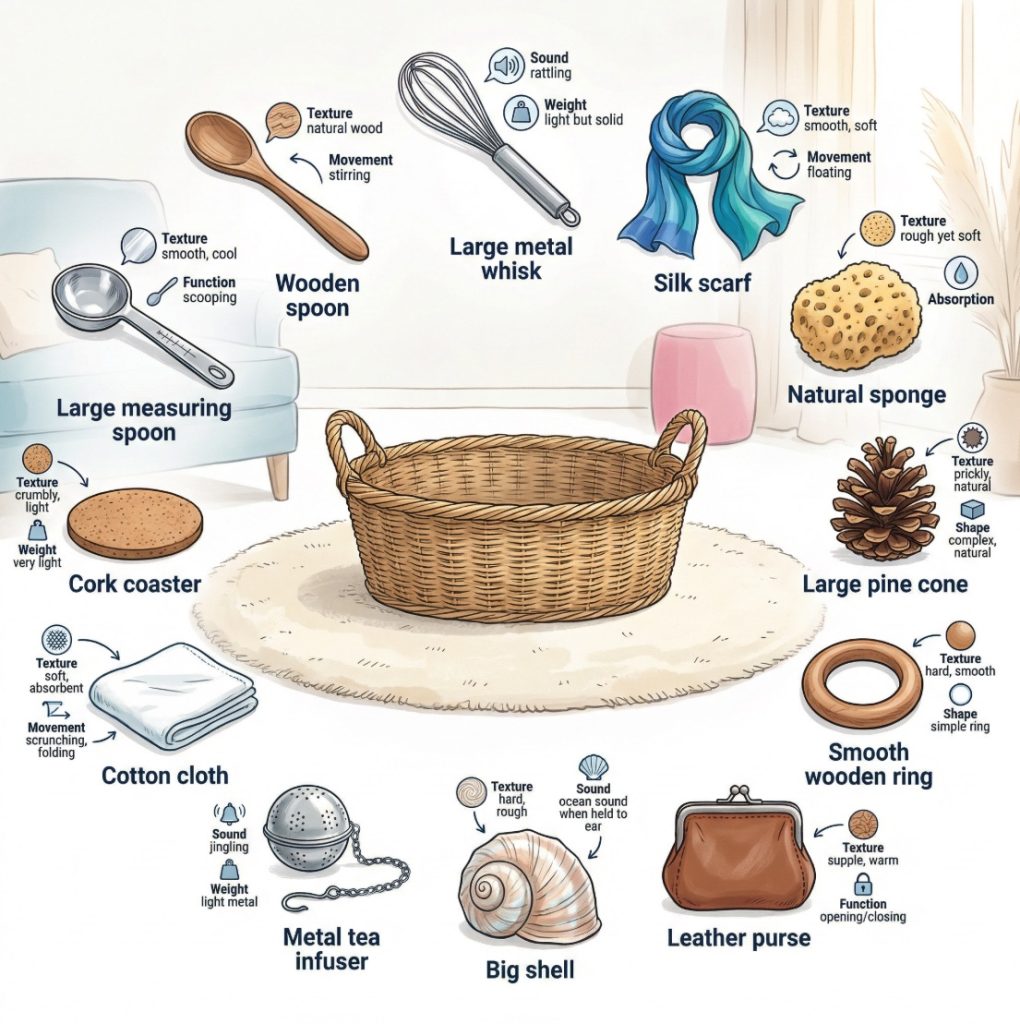
A mixed selection may include wooden spoons, smooth wooden rings, large metal whisks, measuring spoons, tea infusers, cork coasters, leather purses, silk scarves, cotton cloths, natural sponges and large shells. Each object should be big enough, durable enough and simple enough for a baby to investigate safely with close supervision.
It helps to plan the contents by type.
- Wooden objects: Wooden spoons, napkin rings and smooth bangles feel warm and steady. They are easy to grasp and satisfying to mouth or tap.
- Metal objects: Large whisks, measuring spoons and smooth lids feel cool and often create stronger sound contrast. They can catch the light in ways babies find interesting.
- Fabric items: Silk scarves, cotton cloths and velvet pouches move differently in the hand and against the skin. They soften the overall collection.
- Natural objects: Large shells, loofahs and natural sponges often have less regular surfaces and shapes. They offer texture that manufactured toys rarely match.
- Leather or cork items: Leather purses and cork coasters add a different firmness and feel. They stop the basket becoming too similar overall.
A basket full of similar plastic toys will usually feel flatter than a basket built from mixed real materials. This is one of the clearest reasons treasure baskets remain useful. The variation does the work.
A caveat here is that natural does not always mean suitable. A beautiful pine cone may splinter. A shell may chip. A ribbon may fray. Each object still needs the same careful checking as any manufactured resource. The Health and Safety Executive and Food Standards Agency guidance for early years settings both reinforce the wider principle that materials used with young children need regular checking, cleaning and safe storage.
Remember to always think about safety when choosing the items.
How do you use a treasure basket step by step?
The best treasure basket sessions are simple, but they are not casual. The adult prepares the space, checks the resources and stays present throughout. A calm setup helps the baby focus on the objects rather than the activity around them.
A step by step approach keeps the experience grounded.
- Choose the basket: Use a low, sturdy basket with no rough edges or broken parts. It should sit firmly on the floor and be easy for a seated baby to reach into.
- Select varied objects: Gather a broad mix of safe items made from different real materials. Aim for contrast in texture, weight, shape and sound.
- Check every item: Look for cracks, loose parts, peeling surfaces, splinters, sharp edges, rust, frayed threads or anything that could break off.
- Prepare the space: Sit the baby on a firm, comfortable surface with enough room to balance and reach easily. Keep noise and movement around them low.
- Stay close: Supervise throughout. The baby leads the exploration while the adult protects the space and stays emotionally available.
- Use light language: Add a few simple words when they fit the moment. Avoid turning the session into a running commentary.
- Review afterwards: Clean mouthed items, dry them properly and note anything useful about the child’s choices, concentration or sensory interests.
The setup can look different from one place to another. In a nursery baby room, a key person may sit with one baby while another practitioner covers the wider group. In a childminding home, the basket may be offered in the living room during a quieter patch of the morning. In a school nursery, it may be used with younger children or those who still benefit from this kind of seated sensory experience.
A short case example makes the pattern clearer. A baby in a nursery room reaches into the basket and pulls out a metal tea infuser. They mouth it briefly, then tap it against a wooden spoon. They pause, listen and repeat the action. The key person watches and says, “You heard that.” The baby looks up, smiles, then returns to the same two objects. That small sequence contains sensory comparison, repetition, shared attention and confidence.
How should adults respond during treasure basket play?
The adult’s role is quiet but active. Treasure basket play is not a hands off activity. The adult supervises, notices detail, supports emotional security and protects the baby’s concentration.
One common mistake is doing too much. Adults can feel tempted to hand over objects, name each one in turn or show the baby what to do. That often weakens the experience. The child no longer has full control of the exploration. A treasure basket works best when the baby is allowed to choose, return, reject and repeat.
Useful adult responses are usually simple.
- Watch closely: Notice what the child picks first, returns to or ignores. Those patterns often reveal sensory preferences.
- Stay calm: A settled adult helps create a settled space. Babies often explore for longer when the adult nearby is still and attentive.
- Use spare language: A few words linked to the child’s action can support communication. Too much talk can pull the child out of the play.
- Protect concentration: Reduce interruptions and stop other children from taking over the space if needed.
- Reflect afterwards: Think about what the child seemed drawn to and how the basket could be adjusted next time.
This links directly to the role of the key person in the EYFS. A practitioner who knows the baby well is often the best person to notice subtle changes in interest, sensory comfort and confidence. The NSPCC and Skills for Care both emphasise the wider importance of safe, attentive adult practice and suitable staff knowledge when young children are in care settings.
There is a balance to strike. Silence all the time is not the aim. Constant talk is not the aim either. A warm, observant adult who joins the child’s focus at the right moments is usually what helps most.
Where do safety, hygiene and the legal framework fit?
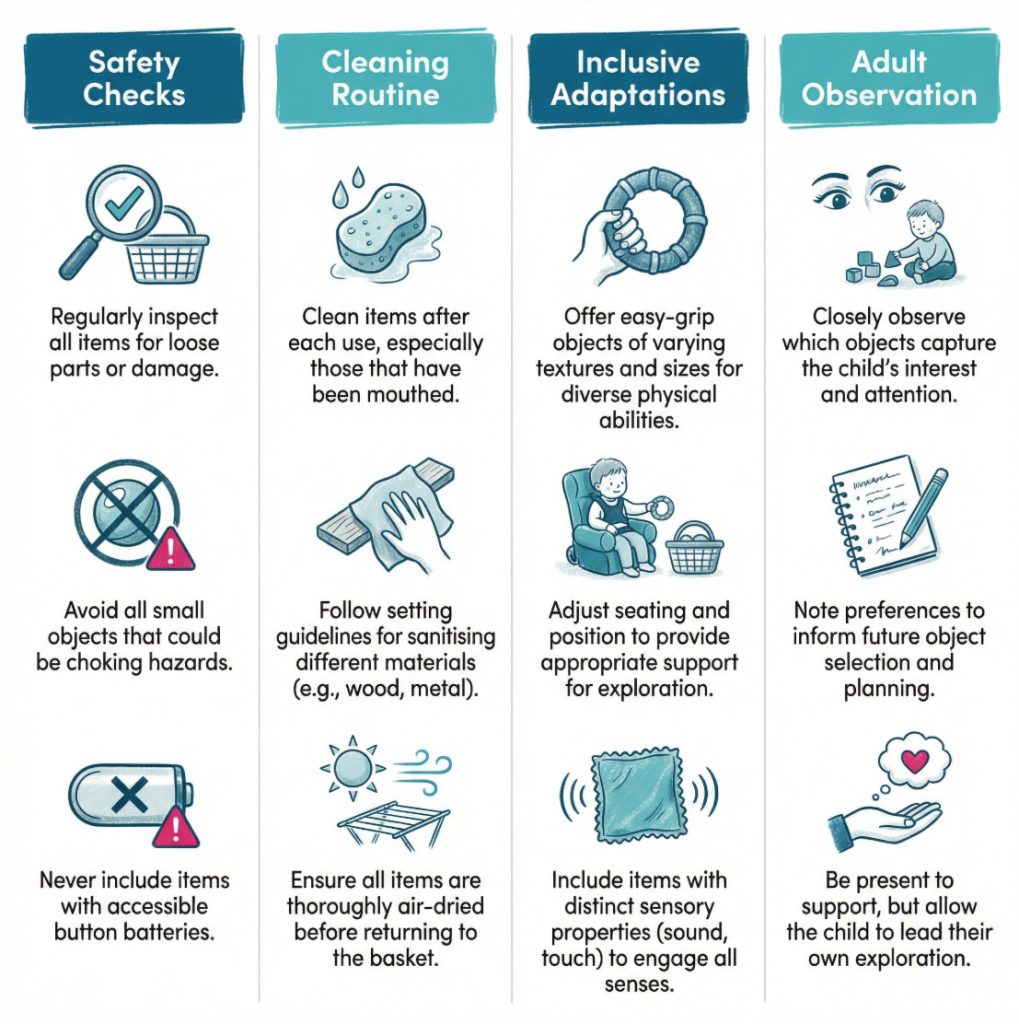
Safety sits at the centre of treasure basket use because babies often explore with their mouths as well as their hands. That means every object has to be suitable for mouthing under close supervision, large enough not to present a choking risk, and strong enough not to break apart.
The EYFS statutory framework sets mandatory requirements for safeguarding and welfare in England, including suitable premises, equipment, supervision, health and risk assessment. Treasure basket play needs to sit within that wider duty of care. The Childcare Act 2006 provides part of the legal foundation for how early years provision is regulated.
Hygiene needs the same attention. If a baby mouths an item, it should be cleaned before going back into the basket. Different materials need different cleaning methods. Metal may be straightforward to wash and dry. Fabric may need laundering. Some natural materials can become unsuitable over time because they break down or are difficult to clean thoroughly.
The most useful England specific bodies and documents include the following.
- Department for Education: Publishes the EYFS statutory framework and Development Matters.
- Ofsted: Regulates and inspects most registered early years provision in England through its early years inspection guidance and resources.
- Childcare Act 2006: Sets part of the legal basis for early years regulation in England through the full Act on legislation.gov.uk.
- NHS: Offers wider child health and development information, including Start for Life guidance.
- NICE: Provides evidence based guidance relevant to children’s health and wellbeing through the NICE website.
“A treasure basket is only as good as its upkeep. Safe objects, clean objects, checked objects.”
A practical checklist helps here.
- Size: Objects should be large enough not to pose a choking hazard.
- Condition: Items should be free from cracks, splinters, loose pieces and peeling surfaces.
- Material: Objects should be non toxic and suitable for repeated handling and cleaning.
- Cleanliness: Mouthed items should be removed, cleaned and dried properly.
- Supervision: A baby should never be left alone with the basket.
- Storage: Resources should be stored safely and checked again before reuse.
Where might treasure baskets be used in practice?
Treasure baskets can work well across different early years settings, though the setup changes with the context. The principles stay the same. Safe objects. Careful observation. Child led exploration.
In a nursery baby room, the basket often works best as a one to one or very small group experience. This keeps supervision tight and gives the adult enough space to notice what each baby does. A short note afterwards can be enough to record patterns in play without turning observation into paperwork for its own sake.
In a childminding setting, the basket may sit very naturally within the home environment. Many of the best objects are familiar household items used in a new way. The main issue is usually managing a mixed age group so older children do not bring unsafe small parts into the space or crowd the baby during the session.
In a two year old room, the original treasure basket may start to give way to heuristic play. Children at this stage often want to put objects into containers, line them up, carry them, stack them and combine them. The basket can still be a starting point, but the resources and layout usually need to change.
In a Reception linked environment, the classic format is less likely to be the main approach for most children. Still, the principles continue through sensory collections, loose parts and other open ended materials. The thread running through all of these is the same: real things, careful adults and time to explore.
Here are a few realistic examples.
- Nursery baby room: A practitioner notices one baby consistently choosing cold metal objects. The next basket includes more safe metal items to see whether that preference continues.
- Childminding home: A childminder offers a basket of fabric, wood and cork on a rug while older children are drawing nearby. The baby explores quietly for fifteen minutes with close supervision.
- Two year old provision: Staff move from a classic treasure basket to a heuristic play collection with tins, lids, chains and scarves for filling and emptying.
- Family link: A parent hears that their baby spent a long time exploring a leather purse and textured cloth. They recognise the same preference at home, which helps build continuity between home and setting.
What are the most common mistakes to avoid?
One of the most frequent errors is using objects that are too similar. A basket full of bright plastic items can look tidy and appealing to adults, but it often offers less sensory contrast than a basket made from mixed real materials. Babies need difference.
Another weak point is adult over involvement. When the adult keeps demonstrating, passing objects over or praising every action, the child loses the space to explore freely. Treasure basket play is not a performance and it is not a test.
Poor safety checks can also undermine the whole experience. Real objects are excellent resources when they are maintained properly. They are poor resources when they are cracked, frayed, chipped or dirty. A basket should be checked before use, not just when it is first assembled.
A few other mistakes come up often.
- Wrong timing: A tired, hungry or unsettled baby is less likely to engage deeply.
- Too many objects: An overfilled basket can feel cluttered rather than rich.
- Noisy surroundings: Too much movement and noise can shorten concentration.
- Weak observation: If adults never notice what the baby is drawn to, much of the value is lost.
- No adaptation: A basket should change as the child changes.
There is also a common misunderstanding worth clearing up. Treasure baskets are sometimes treated as a fashionable add on rather than a serious part of baby room provision. They are not a trend piece. They are a careful way of offering sensory play, observation and responsive care through ordinary objects.
Why this approach lasts in early years practice
Treasure baskets have stayed in early years practice for good reason. They respect how babies actually learn. They do not rush the child. They do not depend on noise, speed or novelty. They offer time, texture and choice.
They also fit the wider shape of good early years work in England. The EYFS expects safe environments, suitable equipment, close relationships and thoughtful support for development. Treasure baskets sit comfortably within that framework when adults use them well and maintain them properly.
The approach also supports reflective practice. A baby’s choices in a treasure basket can tell adults a great deal about sensory preferences, concentration and confidence. Those observations can shape later planning, small changes to the environment and conversations with families.
The next sensible step for a setting is often very small. Not a large order. Not a themed display. A careful basket, a short list of checked objects, a quiet space and an adult who has time to watch.
Conclusion
A treasure basket is simple in appearance and detailed in purpose. It gives a seated baby the chance to explore real materials through touch, movement, sight, sound and mouthing while a trusted adult stays close by. That combination can support concentration, physical development, early communication and emotional security.
Used well, it becomes far more than a basket of objects. It becomes a focused way of seeing what a baby notices, prefers and returns to. It also reminds adults that strong early years practice is often built from ordinary things used with care.
The best treasure baskets are not the most expensive. They are the safest, the most varied and the most thoughtfully maintained. That is what gives them their lasting value.