
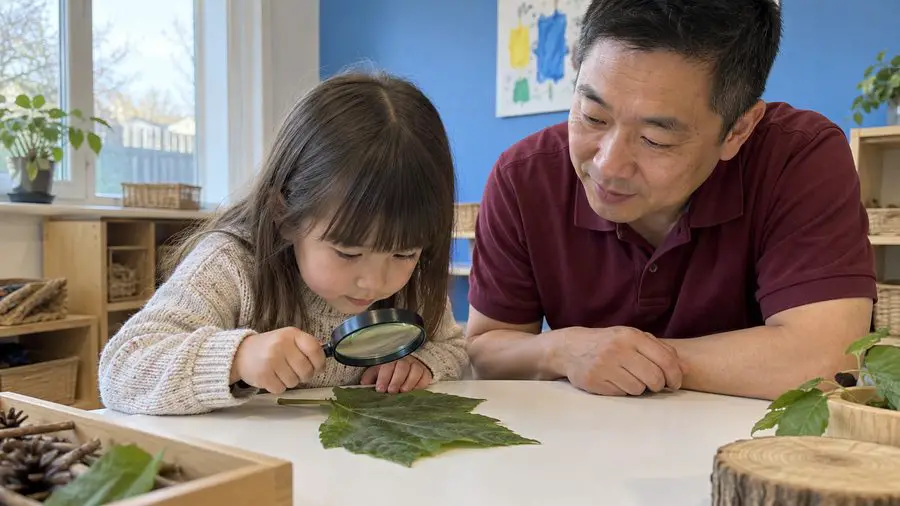
Perceptual development is the process through which babies and young children take in sensory information, organise it, and use it to work out what is happening around them.
This includes more than sight, sound, touch, taste and smell. It also includes how the brain interprets movement, balance, body position and internal sensations. A child uses perceptual development when they recognise a familiar face, judge the height of a step, notice that two shapes are different, or turn when they hear their name.
Perceptual development sits underneath daily life in the early years. It supports movement, communication, play, attention, self care, early reading and early mathematical thinking. A child who can process what they see, hear and feel with more ease will often find it easier to explore, join in and cope with routines.
The EYFS statutory framework in England places sensory exploration, co ordination and positional awareness within the wider picture of early learning and care. The Development Matters guidance reflects the same broad view of development through relationships, play and the environment.
“Perception turns sensation into action. That is why it runs through play, movement, language and daily routines.”
This is one topic, but it reaches into many parts of early childhood. Nursery rooms, childminding settings and reception classrooms all rely on children being able to sort out sound, space, touch and movement well enough to take part. Every day.
Why perceptual development shapes early learning
Perceptual development helps a child make sense of the environment. When spaces, voices, objects and routines feel easier to read, children often seem more settled and more confident.
That has a direct link with communication. Listening is not the same as hearing. A child has to notice the right sounds, separate them from background noise and connect them to meaning. The Department for Education’s early years provider guidance on listening and understanding reflects this distinction clearly.
Physical development is tied in as well. Children use perception when they balance, avoid obstacles, place their feet on steps, use cutlery, turn pages and move around other children. The physical development section for early years providers links early movement to sensory exploration, co ordination and positional awareness.
Perceptual development also supports early literacy and mathematics. Children rely on it when they track across a page, compare shapes, spot patterns, sort by size and use words such as under, behind and next to. These skills grow through repeated, practical experiences rather than isolated drills.
A common counter point is that young children simply grow out of perceptual difficulties as they mature. Sometimes that happens. Many small wobbles settle with time, practice and good provision. Yet persistent patterns across home and setting can affect participation, confidence and access to learning. That is why careful observation stays important.
“A child who seems inattentive may be working hard just to sort out the room.”
Perceptual development also links with emotional wellbeing. Busy, noisy or visually crowded spaces can be manageable for one child and exhausting for another. The NICE quality standard on health and wellbeing in under 5s and the NICE guidance on social and emotional wellbeing in the early years both support joined up thinking about children’s development, relationships and support.
What perceptual development includes
Perceptual development covers several connected systems. They overlap all the time, which is why a child may cope well in one type of activity and struggle in another.
| Area | What it involves | Everyday example |
|---|---|---|
| Visual perception | Making sense of what is seen | Finding a coat peg or matching shapes |
| Auditory perception | Processing sound patterns and spoken language | Hearing the difference between similar words |
| Tactile perception | Interpreting touch, texture and pressure | Reacting to sand, glue or wet sleeves |
| Spatial perception | Judging where the body and objects are in space | Fitting through a gap or placing a block |
| Vestibular processing | Managing balance and movement | Climbing, spinning or stopping safely |
| Proprioception | Sensing body position and effort | Carrying a heavy box or pressing too hard with a pencil |
| Interoception | Noticing internal body signals | Sensing hunger, thirst or discomfort |
The language can sound specialist at first, but it describes everyday early years experiences. A toddler who repeatedly climbs onto a low platform may be learning through balance and body awareness. A reception child who cannot find their things in a crowded cloakroom may be finding visual information harder to organise in a busy space.
One practitioner might describe it more simply: the child is “fine until the room gets busy, then everything seems to go at once”. That rings true in many settings. It also captures the point neatly.
The NHS Best Start in Life guidance on early learning and development supports the wider idea that early experiences shape communication, confidence and learning from the start. Vision and hearing checks also form part of the picture. The NHS page on eye tests for children and the NHS page on hearing tests explain how difficulties can be picked up early.
How perceptual development begins in babies
Perceptual development starts from birth. Babies notice contrast, movement, touch, sound and changes in position long before they can explain any of it.
In the first months, babies often show this through gaze, turning, stilling, reaching and changes in expression. A baby may stare at a face, quieten at a familiar voice, follow a moving object briefly, or react to a sudden sound. These are early signs that sensation is beginning to take on meaning.
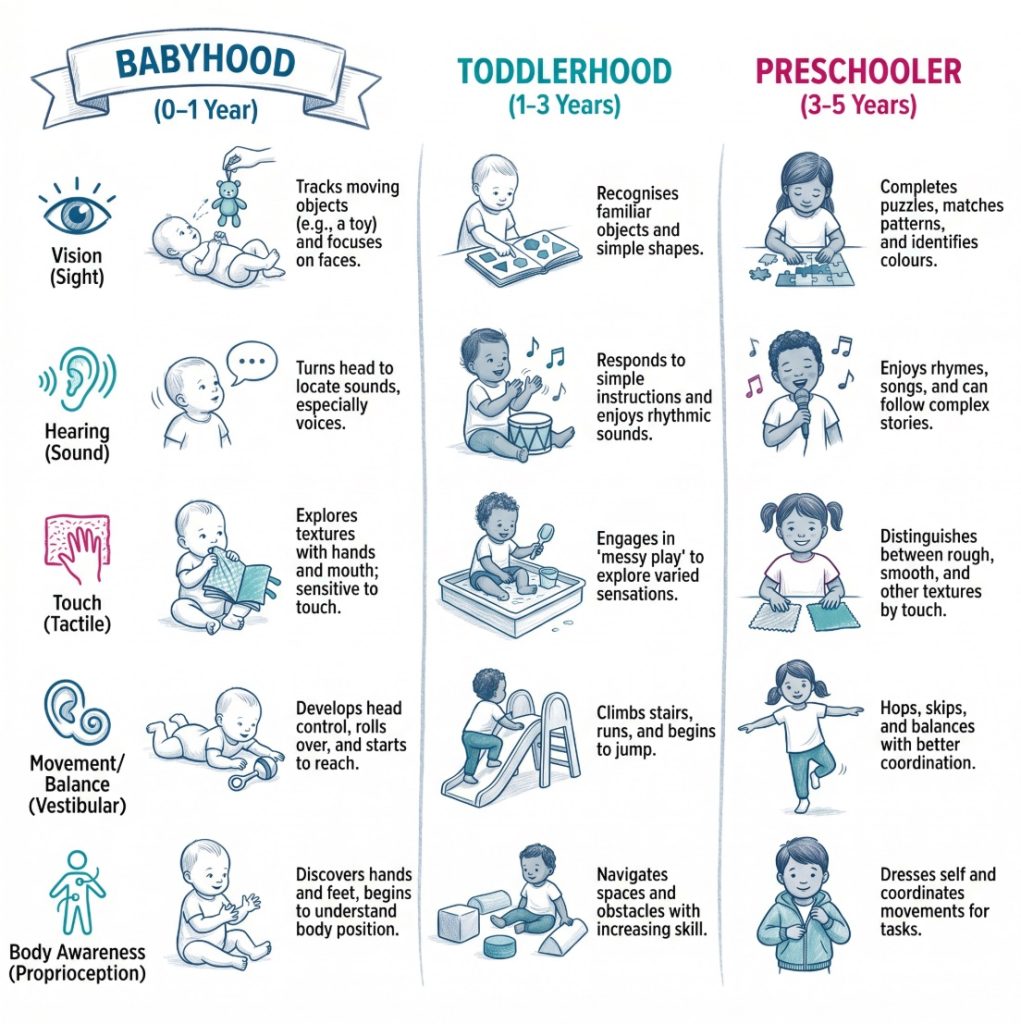
As movement develops, perception and action start working closely together. Rolling, reaching, crawling and pulling up all provide information about distance, effort, balance and body position. Floor play supports this well because it gives the baby time and space to work things out through action.
A key person in a baby room may notice that one baby is absorbed by slowly moving ribbons, while another responds most strongly to songs and repeated voice patterns. A childminder may notice that a baby mouths, grasps and drops objects over and over. Those are useful clues.
- Face to face interaction: Babies learn from watching expressions, mouth movements and eye gaze during close contact.
- Repeated songs and phrases: Familiar sound patterns help babies anticipate what comes next.
- Safe sensory objects: Different textures, weights and shapes give babies something to compare.
- Movement experiences: Rolling, reaching and crawling build body awareness and spatial knowledge.
A parent might put it in plainer words: “He kept dropping the spoon just to watch where it went”. That sounds ordinary because it is ordinary. It is also early perceptual learning.
The child vision screening programme shows how public services in England monitor early visual development. That does not turn perception into a medical issue by default, but it does place sensory development within a wider framework of early identification.
How perceptual development changes in toddlers and older children
During the toddler years, perceptual development becomes more active and more deliberate. Toddlers repeat actions because they are comparing outcomes. They drop, throw, bang, carry, hide, fill and empty because they are learning about force, sound, movement and position.
That kind of repetition can look untidy or aimless. It rarely is. A toddler who rolls cars down a slope again and again may be noticing speed, sound, angle and surface. A child who keeps climbing on and off a low step may be refining balance and judgement.
Body awareness and spatial perception become more obvious at this stage. Toddlers work out whether they can fit through a gap, where to place a foot, how far to reach and how much force to use. These skills affect climbing, feeding, building, dressing and moving through shared spaces.
By the preschool and reception years, many children become better at visual and auditory discrimination. They notice smaller differences between shapes, symbols, sounds and patterns. That supports matching, sorting, puzzle work, rhyme, phonics, mark making and following more complex routines.
“Repetition is often a child’s way of testing the world, not a sign that nothing new is happening.”
A reception child may use perceptual skills when finding a name card, copying a simple model, tracking across a page, hearing the difference between speech sounds, or moving around a busy classroom safely. These are ordinary demands, but each one depends on how well the child can organise incoming information. Slowly at first. Then with more confidence.
Where perceptual development appears in different settings
Perceptual development shows up across the whole day. It is not confined to sensory trays, themed activities or specialist equipment.
In a nursery baby room, it may appear in the way a baby studies a face, reaches for a hanging object, reacts to a change in tone, or settles when held and rocked. Staff support this by slowing interactions, giving babies time to focus and offering objects with different textures, shapes and weights.
A preschool room brings different demands. Perceptual development often appears in block play, obstacle courses, songs, picture books, sorting games and outdoor movement. A child uses it when they work out how to balance blocks, follow a route, match picture cards or join in with an action rhyme.
Childminding settings often show the clearest examples because so much happens through ordinary routines. Finding shoes, walking to the park, carrying a cup, helping to tidy toys into baskets and spotting familiar landmarks all involve perception. Small tasks. Big learning.
In a reception class, perceptual development can be seen in phonics, writing, art, PE, construction and classroom routines. A child may need to hear fine differences in sounds, track visually from left to right, copy from a model, judge spacing on the page and move around a crowded cloakroom with confidence.
Mini examples from practice
- Nursery example: A three year old leaves group time most days but joins well in a quieter story group. The room layout, sound level and proximity to other children may be affecting how well the child can process what is going on.
- Childminding example: A two year old becomes upset at handwashing time. The noise of the tap, the feel of wet hands and the shift in temperature may all be part of the reaction.
- Reception example: A child knows many sounds orally but struggles with visually busy worksheets. Simpler layouts and practical matching tasks may reveal stronger knowledge than the written sheet suggests.
The Early years inspection toolkit is useful here because it reflects the expectation that settings know children well and can explain how provision supports participation and progress.
How adults can observe perceptual development step by step
Observation is one of the most useful tools in this area. It does not need to be elaborate, but it does need to be specific.
A practical sequence
- Observe the child: Notice what the child seeks, avoids, repeats or finds difficult.
- Look at the context: Check the room, group size, noise level, lighting, timing and transitions.
- Consider the task demand: Work out whether the activity depends on listening, visual sorting, balance, body control or tolerance of touch.
- Adjust one feature at a time: A calmer space, a clearer layout or extra movement may change how the child responds.
- Review the pattern: Compare what happens across different times of day and across home and setting.
This sequence fits neatly with the graduated response set out in the SEND code of practice. In England, early years settings are expected to identify needs early, plan support, try it out and review the effect. The role of the SENCO sits within that process.
Observation works best when it stays grounded in what can actually be seen and heard. One difficult afternoon does not reveal a fixed pattern. Repeated observations across situations are more useful than quick conclusions.
Useful points to notice
- What the child seeks: Movement, deep pressure, music, messy play or visual detail can all give clues.
- What the child avoids: Noise, bright light, glue, sand, wet sleeves or crowded spaces may affect participation.
- How the child moves: Balance, bumping, stopping, climbing and handling objects can reveal how body based information is being processed.
- How the child listens and looks: Tracking, response to name, locating objects and following spoken information are all relevant.
- How the child manages routines: Snack time, lining up, carpet time and tidy up often place heavy sensory demands on children.
“Behaviour often looks clearer once the sensory load of the moment is taken seriously.”
How adults can support perceptual development through play and routine
Children usually develop perceptual skills best through play, movement, conversation and repeated routines. Formal teaching has a place, but it is rarely enough on its own.
Language helps a great deal. When adults talk about what children are seeing, hearing and doing, they help children connect sensation to meaning. Words such as rough, smooth, louder, quiet, under, behind, near and straight can sharpen those links.
The environment also shapes what children can do. A calm space with fewer competing sounds and clearer visual organisation may help one child engage. Another may need strong movement, heavy work or repeated sensory experiences before they can settle into a quieter task. Both patterns can appear in the same room.
A worker might sum it up by saying that one child “needs to move before he can listen”. That is not unusual. It is often a realistic description of how regulation and perception work together.
Practical supports
- Predictable routines: Familiar cues and sequences can reduce confusion during transitions.
- Time to repeat actions: Children often need repetition to compare, refine and remember.
- Movement rich play: Crawling, climbing, pushing, pulling and balancing support body awareness.
- Open ended resources: Blocks, playdough, water, sand and loose parts offer rich sensory information.
- Clear descriptive language: Precise vocabulary helps children connect perception to action.
- Partnership with families: Home and setting observations together give a fuller picture.
The Council for Disabled Children’s guide on the Equality Act in early years is helpful when thinking about reasonable adjustments in settings. The legal basis itself sits in the Equality Act 2010, which places duties around reasonable adjustments for disabled children.
When practitioners should look more closely
Children develop at different rates, so variation is expected. There are times, though, when patterns are persistent enough to justify closer attention.
Signs that may prompt closer observation
- Frequent bumping or misjudging space: This may show that movement and spatial information are hard to organise.
- Strong reactions to everyday sound, touch or movement: Distress that regularly affects play or routine is worth noting.
- Difficulty locating items or following visual information: This may appear in puzzle work, tidying, dressing or table tasks.
- Limited response to spoken information: Hearing, attention or auditory processing may all need consideration.
- Persistent avoidance of common sensory experiences: Certain textures, surfaces or noises may be affecting participation.
- A pattern across settings: Similar observations at home and in the setting usually carry more weight than one isolated incident.
This does not point automatically to a diagnosis or a fixed condition. It does show that the child’s experience needs a closer look. The NHS hearing tests page and NHS eye tests for children page are relevant reference points because hearing and vision can affect how perception looks in daily life.
What standards, roles and legal duties are relevant in England
Perceptual development is not a separate legal category in England, but it sits within several important frameworks and duties.
The EYFS statutory framework is the main statutory framework for early years providers. It sets standards for learning, development and care from birth to five. Since 1 September 2025, providers in England have been expected to follow the updated framework.
The Development Matters guidance is non statutory, but widely used. It supports professional judgement and curriculum thinking across childminding settings, nurseries, nursery schools and reception classes. It is particularly useful because it presents child development as broad, connected and rooted in everyday experience.
The SEND code of practice applies in England and covers the 0 to 25 system. It supports early identification, partnership with parents and carers, and the graduated response. In early years provision, the SENCO has a key role in co ordinating support and helping staff think carefully about access and inclusion.
Ofsted is also part of the picture because Ofsted registered settings are inspected against the EYFS requirements. Practice around observation, inclusion and support should therefore be rooted in what children actually experience across the day.
The Equality Act 2010 is relevant where sensory or perceptual differences affect access to the environment or daily experiences. Reasonable adjustments can relate to layout, routine, equipment or the way support is organised.
Common mistakes and a quick checklist
Perceptual development can be misunderstood when adults look only at the surface of a child’s behaviour or focus too narrowly on activities.
Common mistakes
- Treating behaviour as simple non compliance: A child may be overloaded, disoriented or trying to avoid discomfort.
- Looking only at the child: Noise, clutter, timing and transitions often shape what a child can manage.
- Using too many adult led tasks: Play, movement and routine often reveal more than formal tasks do.
- Mistaking repetition for lack of progress: Repeated actions can be part of careful experimentation.
- Ignoring family insight: Patterns at home may explain what happens in the setting, and the reverse is true.
- Jumping quickly to labels: Close observation and thoughtful support usually provide a stronger starting point.
Practical checklist
- Observe specific moments: Record what happened, where, with whom and what changed before and after.
- Review the environment: Check sound, light, layout, visual clutter and movement demands.
- Notice strengths as well as difficulties: A child may show strong perceptual skills in one context and struggle in another.
- Use clear language: Precise words for space, texture, sound and movement help children build connections.
- Compare across settings: Shared observations between home and setting often sharpen the picture.
- Keep support proportionate: Small changes can sometimes unlock a great deal.
Conclusion
Perceptual development is how young children sort out sensory information so they can move, play, communicate and take part in the world around them.
It shapes far more than sensory play. It affects how children listen, balance, notice, compare, regulate and join in with daily routines. That is why it runs through nursery care, childminding practice and reception provision from the start.
A clear view of perceptual development helps adults read children more accurately. It shifts attention from labels and assumptions towards the child’s actual experience of sound, space, touch and movement. That gives a stronger basis for inclusive early years practice in England.
The most useful next step is usually careful observation linked to the setting’s ordinary routines, environments and relationships. That is where perceptual development is most visible. And where support is most likely to work.