
This online positive risk taking course is designed for adult social care workers who support people to exercise choice, develop independence and pursue meaningful personal outcomes. It explains how staff can respect autonomy while taking reasonable steps to prevent foreseeable harm.
This free course covers risk enablement, mental capacity, supported decision-making, proportionate safeguards, professional responsibilities, escalation, record keeping and review. Learners will also explore how positive risk taking contributes to safe, caring, responsive and person-centred practice.
Why Take This eLearning Course?
Positive risk taking is an important part of person-centred adult social care. When decisions are planned, informed and reviewed properly, people can retain greater control over their lives without staff ignoring safety, legal duties or professional responsibilities.
This course will help you to:
- Support informed choice without automatically removing all uncertainty
- Recognise the difference between risk enablement and unsafe practice
- Balance personal rights, preferences and foreseeable harm
- Apply proportionate and least-restrictive safeguards
- Involve people meaningfully in decisions about their support
- Identify when management or professional advice is required
- Respond appropriately to safeguarding and emergency concerns
- Develop clear actions, contingencies and review arrangements
- Produce accurate and defensible records
- Communicate agreed plans consistently across teams and services
Learning Outcomes
By the end of this course, you will be able to:
- Define positive risk taking and risk enablement in adult social care
- Explain how appropriate risk taking supports autonomy and wellbeing
- Distinguish planned risk enablement from reckless, negligent or unmanaged practice
- Apply the autonomy-supporting principles of the Mental Capacity Act 2005
- Describe decision-specific capacity and supported decision-making
- Assess goals, benefits, hazards and possible consequences
- Select proportionate and least-restrictive safeguards
- Recognise role boundaries and situations requiring escalation
- Record and communicate the reasoning behind risk-enabled decisions
- Review plans following changes, incidents or near misses
Positive Risk Taking in Adult Social Care Course Outline
The course is organised into six modules, progressing from the principles of positive risk taking through assessment, planning, professional accountability, recording and quality practice.
Module 1: Understanding Positive Risk Taking and Risk Enablement
Learners will explore the meaning of positive risk taking and risk enablement, including how chosen outcomes, shared understanding, balanced assessment, agreed safeguards and ongoing review contribute to responsible practice. The module explains how suitable risk taking can support autonomy, dignity, confidence, independence and community participation. It also distinguishes person-centred risk enablement from reckless, negligent or unmanaged practice and considers examples involving domestic activities, community travel, relationships and social participation.
Module 2: Rights, Capacity and Professional Duty
Learners will examine the five autonomy-supporting principles of the Mental Capacity Act 2005 and consider how capacity relates to a specific decision at a particular time. The module covers practical ways to support decision-making through accessible communication, suitable timing, interpreters, advocates and people who know the individual well. It also introduces Care Act wellbeing and participation principles and explains how staff can balance duty of care with personal rights, informed preferences and the need for safe, lawful support.
Module 3: Assessing Risk and Agreeing Proportionate Support
Learners will begin with the person’s chosen goal, reasons and expected benefits rather than focusing only on hazards. They will consider strengths, previous experience, communication needs, capacity, consent, likely consequences and the possible harm caused by preventing an activity. The module explains how to compare alternatives and select proportionate safeguards involving equipment, skills, staff support or environmental changes. It also covers action planning, named responsibilities, warning signs, contingencies, communication and review triggers.
Module 4: Roles, Responsibilities and Escalation
Learners will examine the responsibilities of care workers, social workers, qualified professionals and managers within risk-enabled practice. The module explains the importance of working within competence, following agreed plans, recording changes and referring concerns through the correct route. It identifies decisions that may require management, clinical, safeguarding or legal advice and describes when workers should escalate urgently, contact emergency services or stop an activity that exceeds their authority or ability. Common mistakes, such as blanket restrictions, unsupported assumptions and undocumented changes, are also addressed.
Module 5: Recording, Reviewing and Communicating Decisions
Learners will explore the information needed to create a clear record of a risk-enabled decision, including the person’s wishes, decision support, hazards, benefits, alternative options, agreed safeguards and individual responsibilities. The module explains how to separate facts, observations, opinions and uncertainty so that reasoning is proportionate, transparent and auditable. Learners will also consider how to review decisions after changes, incidents or near misses and how to communicate current plans lawfully and consistently during handovers, service transfers and changes in circumstances.
Module 6: Positive Risk Taking and Quality Care
Learners will consider how positive risk taking supports safe, caring, responsive and person-centred adult social care. The module examines balanced assessments, safe systems, active monitoring, personal identity, choice, confidence, accessible information, reasonable adjustments and partnership working. Learners will use reflective questions to consider realistic decisions in home care, supported living, care homes and day services, connecting the person’s intended outcome with lawful duties, role boundaries, proportionate safeguards and defensible professional reasoning.
Target Audience
This course is suitable for:
- Care and support workers in adult social care
- Senior care workers and team leaders
- Registered managers and service managers
- Social workers and care coordinators
- Personal assistants and domiciliary care staff
- Staff working in supported living, care homes or day services
No previous specialist knowledge is required.
FAQ
Who is this course suitable for?
This course is suitable for people who assess, plan, deliver, supervise or review adult social care. It is relevant to frontline workers, managers, social workers and other professionals who support people to make choices and pursue greater independence.
Do I need any previous experience?
No previous specialist knowledge is required. The course introduces the main principles clearly while also providing useful guidance for experienced staff who want to strengthen their approach to risk-enabled practice.
What will I learn on this positive risk taking course?
You will learn how to identify a person’s desired outcome, consider possible benefits and harm, support decision-making, choose proportionate safeguards and record the reasoning behind an agreed plan. The course also covers capacity, escalation, review and professional accountability.
Will this course help with day-to-day care practice?
Yes. The course uses practical situations involving everyday activities, community travel, relationships and participation. It will help you consider how agreed safeguards, contingencies and review arrangements can be applied in routine support.
Does the course cover practical risk assessment skills?
The course explains a structured approach to identifying goals, benefits, hazards, consequences, existing strengths and suitable safeguards. It also shows how to assign responsibilities and establish clear review and escalation arrangements.
Does it cover relevant responsibilities and good practice?
Yes. The course considers the Mental Capacity Act 2005, Care Act wellbeing and participation principles, duty of care, safeguarding responsibilities, professional role boundaries and safe, caring and responsive practice.
How does the course address mental capacity?
The course explains that capacity must be considered in relation to a particular decision at a particular time. It covers the presumption of capacity, practical decision support, respect for unwise decisions, best-interests decision-making and the least-restrictive principle.
How long does the course take?
The course is self-paced and usually takes around 1 hour to complete.
Will I receive a certificate?
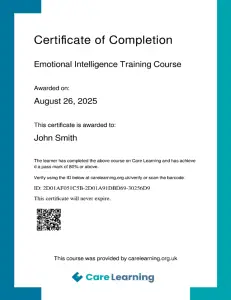
Yes. A certificate is issued after successful completion.
Positive risk taking requires more than accepting uncertainty. It depends on meaningful involvement, informed reasoning, proportionate support, clear accountability and regular review. This course provides a practical foundation for supporting choice and independence while maintaining safe and responsible adult social care.
Enrol now to build your understanding of positive risk taking in adult social care.