
Managing risk is a fundamental part of providing safe, effective, and person-centred care. In health and social care settings, professionals must balance safety with dignity, independence, and individual choice. Risk assessments help identify potential hazards, reduce harm, and support informed decision-making for people who use services and those who support them.
This free Risk Assessments in Health and Social Care Training Course provides learners with a clear and practical understanding of risk assessment principles, legal responsibilities, and how to apply risk management in everyday care practice.
Why Take This eLearning Course?
Risk is present in all care environments, from moving and handling to medication, safeguarding, and lone working. When risks are not properly assessed or reviewed, they can lead to accidents, poor outcomes, regulatory breaches, and harm to individuals and staff.
This free course will help you to:
- Understand what risk and hazards are in a care context
- Carry out effective risk assessments confidently and correctly
- Meet legal and regulatory responsibilities
- Balance safety with choice, dignity, and independence
- Reduce accidents, incidents, and near misses
- Improve care planning and service quality
Learning Outcomes
By the end of this course, learners will be able to:
- Define risk, hazards, and near misses in health and social care
- Explain the purpose and benefits of risk assessments
- Understand key UK legislation and regulatory requirements
- Identify hazards and assess who may be harmed and how
- Apply the five-step risk assessment process
- Use the hierarchy of controls and ALARP principles
- Record, review, and update risk assessments effectively
- Balance risk management with person-centred care
- Integrate risk assessments into care and support planning
Risk Assessments in Health and Social Care Course Outline
Module 1: Introduction to Risk Assessment
Learners will be introduced to the fundamental concepts of risk and hazard and how these apply within health and social care environments. This module explains the role of risk assessment in preventing harm and promoting safety for individuals, staff, and organisations. Learners will explore the benefits of effective risk management, including reducing incidents, improving quality of care, and supporting safe, well-managed services.
Module 2: Legal Framework for Risk Assessment
This module focuses on the legal and regulatory responsibilities linked to risk assessment in health and social care. Learners will gain an understanding of key UK legislation and the duties placed on employers and employees. The role of regulatory bodies, such as the Care Quality Commission (CQC), is explored to show how standards, compliance, and accountability are monitored and enforced.
Module 3: Hazard and Risk Identification
Learners will explore how to identify common hazards in health and social care settings and understand who may be harmed and how. This module covers near misses and why recognising and reporting them is vital for improving safety. Learners will also examine risks specific to vulnerable adults, including those related to mobility, medication, and mental health, and how these risks can be identified early.
Module 4: The Risk Assessment Process
This module explains the structured approach used to assess and manage risks. Learners will explore the five-step risk assessment process, the hierarchy of control measures, and the principle of ALARP (As Low As Reasonably Practicable). The module supports learners to understand how risks are evaluated, prioritised, and reduced in a proportionate and practical way.
Module 5: Balancing Safety with Individuality and Dignity
Learners will examine how risk assessment must balance safety with individual rights. This module explores the importance of individuality, independence, privacy, and dignity in care, and how these principles can be upheld alongside safety considerations. Learners will understand how positive risk-taking supports person-centred care while managing potential harm responsibly.
Module 6: Recording and Reviewing Risk Assessments
This module focuses on the importance of recording risk assessments clearly, accurately, and consistently. Learners will explore how and when risk assessments should be monitored, reviewed, and updated. The role of incident reviews and learning from errors is highlighted to show how organisations can continuously improve safety and practice.
Module 7: Working with Other Agencies
Learners will explore the value of collaboration and partnership working in effective risk management. This module explains how working with other agencies and professionals supports safer care and better outcomes. Examples of good practice are used to demonstrate shared responsibility and coordinated approaches to managing risk.
Module 8: Risk Management and Control Strategies
This module examines how control measures are implemented to minimise identified risks. Learners will understand the importance of continuous monitoring and review to ensure controls remain effective. The module also highlights the value of involving service users and their families in the risk assessment process to promote transparency, shared understanding, and informed decision-making.
Module 9: Linking Risk Assessment with Care and Support Planning
In the final module, learners will explore how risk assessment links directly to care and support planning. This includes integrating risk management strategies into personalised care plans and ensuring they reflect individual needs and preferences. Learners will understand the importance of monitoring and reviewing care plans to address risks while supporting safety, wellbeing, and independence.
Target Audience
This course is suitable for:
- Care workers and support workers
- Senior carers and supervisors
- Managers and team leaders
- Health and social care students
- Anyone responsible for assessing or managing risk in care settings
It is appropriate for induction, refresher training, and ongoing CPD.
FAQ
Do I need previous experience of risk assessments?
No. This course starts with the basics and builds your knowledge step by step.
Is this course relevant to UK health and social care?
Yes. The course is fully aligned with UK legislation, CQC expectations, and care standards.
How long does the course take?
Most learners complete the course in 1 hour, depending on pace and experience.
Will I receive a certificate?
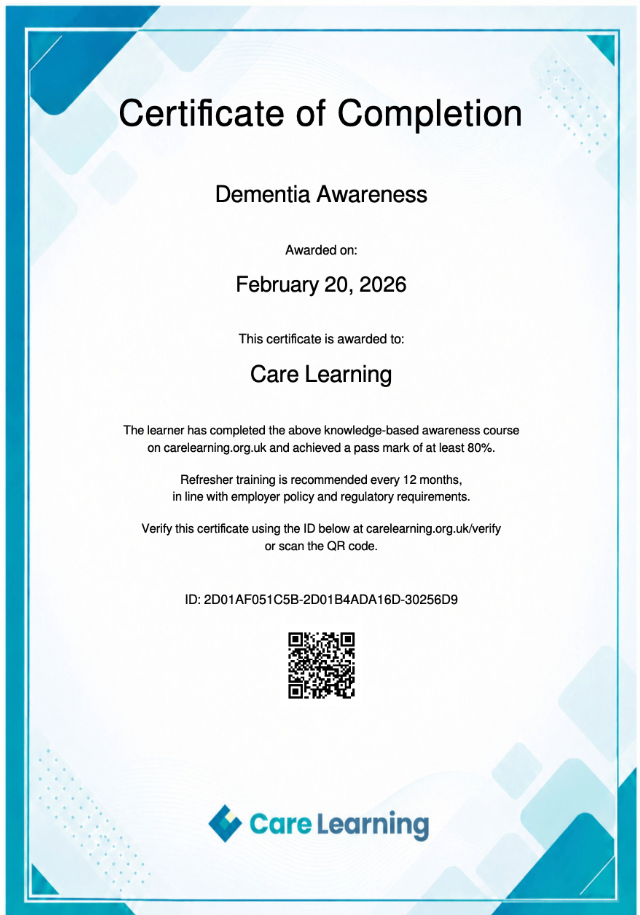
Yes. A certificate is issued upon successful completion.
Good risk assessment is not about eliminating all risk. It is about understanding risk, reducing harm, and supporting people to live safely while maintaining choice, independence, and dignity.
Enrol on the Risk Assessments in Health and Social Care Training Course today
Build safer services, strengthen professional practice, and deliver care that balances protection with person-centred support.