This First Aid Awareness course is designed for workers who need a clear understanding of how to recognise and respond to common medical emergencies. It explains the immediate actions that can protect life, prevent a condition from worsening and support recovery while qualified help is arranged.
This free first aid course covers the role and limits of an awareness-level responder, the DRABC primary survey, cardiopulmonary resuscitation, automated external defibrillators, choking, anaphylaxis, heart attacks, strokes, seizures, bleeding, burns and emergency handover. It also explains how first aid arrangements may differ across care homes, education settings, housing services and other workplaces.
Why Take This eLearning Course?
Medical emergencies can develop quickly, so workers need to recognise warning signs, call for help promptly and provide safe support within the limits of their role. This online first aid awareness course develops the knowledge needed to respond calmly, follow workplace procedures and support a person until emergency or healthcare professionals take over.
This course will help you to:
- Understand the purpose and key aims of first aid
- Recognise the limits of an awareness-level responder
- Follow a structured approach when assessing an emergency
- Identify when cardiopulmonary resuscitation may be required
- Understand how an automated external defibrillator is used
- Respond appropriately to choking and severe allergic reactions
- Recognise signs of heart attack, stroke and seizure
- Support someone experiencing serious bleeding, burns or scalds
- Communicate clearly with emergency call handlers
- Provide an accurate handover and complete appropriate records
Learning Outcomes
By the end of this course, you will be able to:
- Define first aid and explain its three main aims
- Describe the responsibilities and limits of an awareness-level responder
- Explain why emergency services should be contacted promptly
- Apply the danger, response, airway, breathing and circulation sequence
- Identify possible cardiac arrest and outline the adult CPR process
- Explain when to use the recovery position and an AED
- Distinguish between mild and severe choking
- Recognise the signs of anaphylaxis, heart attack, stroke and seizure
- Describe first aid responses for external bleeding, embedded objects and burns
- Explain effective monitoring, reporting and emergency handover
First Aid Awareness Course Outline
Module 1: First Aid Roles, Responsibilities and Arrangements
Learners will explore the meaning of first aid and its aims of preserving life, preventing deterioration and promoting recovery. The module explains what an awareness-level responder can reasonably do, why actions must remain within personal competence and workplace procedures, and why emergency help should be called early. Learners will also consider first aid arrangements across care homes, schools, housing services, community organisations and other workplaces, including equipment, trained personnel, reporting routes and access for emergency responders.
Module 2: The DRABC Primary Survey
Learners will examine the danger, response, airway, breathing and circulation stages of the primary survey. The module explains how to identify hazards, approach a person safely, check for a response, open the airway and assess breathing for no more than ten seconds. It also covers abnormal gasping, the decision to begin cardiopulmonary resuscitation and the correct use of the recovery position for an unresponsive person who is breathing normally.
Module 3: Cardiac Arrest, CPR and Defibrillation
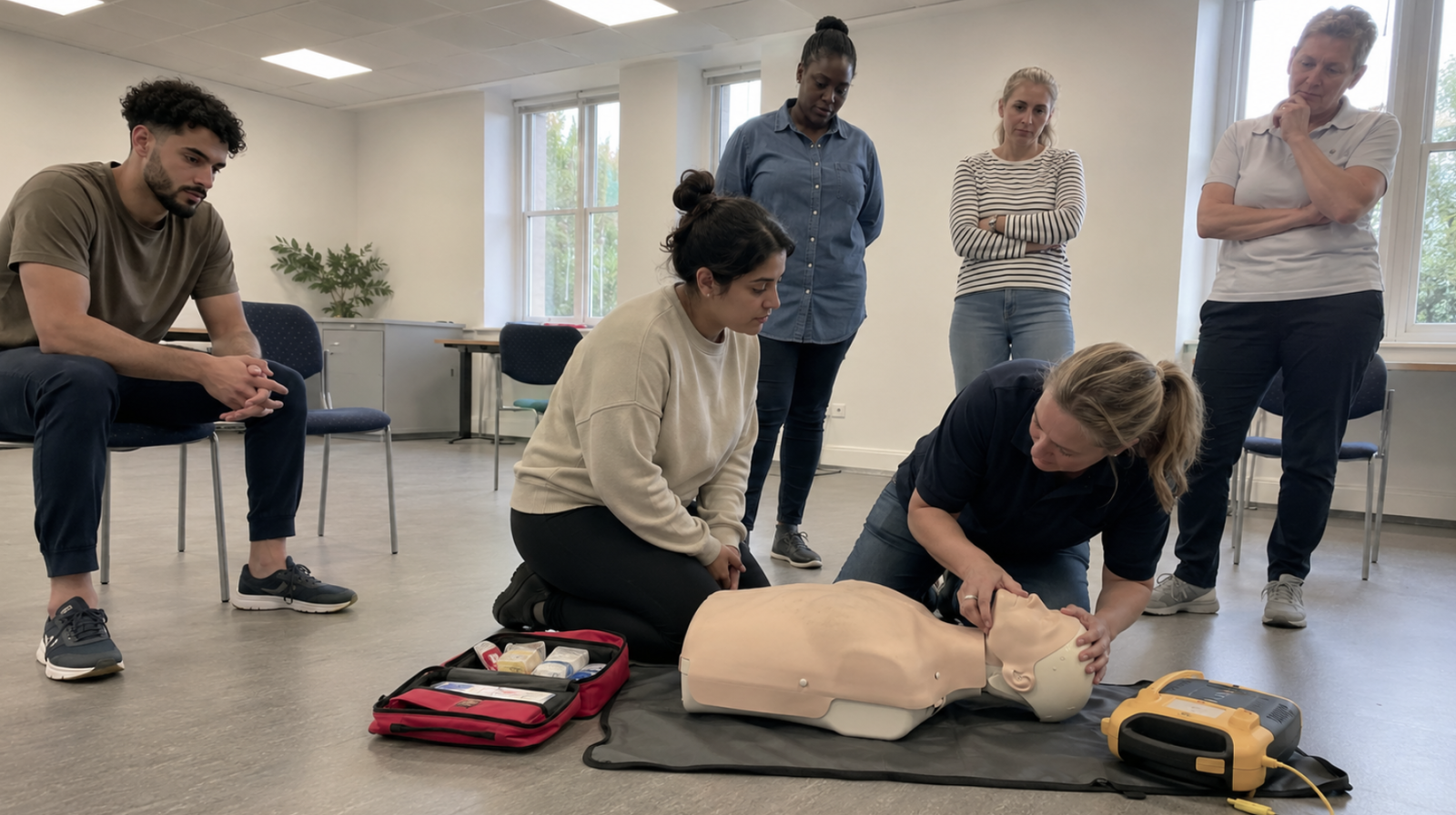
Learners will identify the main signs of possible cardiac arrest, including unresponsiveness and absent or abnormal breathing. The module outlines adult chest compressions, rescue breaths and compression-only CPR, including appropriate hand position, depth, speed and chest recoil. It also explains how to locate and use an automated external defibrillator, follow its prompts, avoid unnecessary interruptions and continue CPR until professional assistance takes over.
Module 4: Choking and Anaphylaxis
Learners will distinguish between mild choking, where a person can still cough effectively, and severe choking, where speech, breathing or coughing may be impaired. The module covers back blows, abdominal thrusts, emergency contact, repeated treatment cycles and the response when a person becomes unresponsive. Learners will also explore the signs of anaphylaxis and the importance of prompt adrenaline, an immediate 999 call, suitable positioning and continued monitoring.
Module 5: Heart Attack, Stroke and Seizures
Learners will recognise possible heart attack symptoms, including chest pressure, pain spreading to other areas, breathlessness, sweating, nausea and less obvious presentations. The module explains emergency contact, supported positioning, monitoring and the possible use of aspirin within training and local procedures. It also covers FAST stroke recognition and appropriate first aid during and after a seizure, including removing hazards, protecting the head, timing the event and identifying when an ambulance is required.
Module 6: Bleeding, Burns and Emergency Handover
Learners will examine how to control serious external bleeding using direct pressure and how to support an embedded object without removing it. The module explains the correct response to burns and scalds, including cooling with running water for at least 20 minutes, removing nearby items and covering the injury appropriately. It concludes with ongoing monitoring, communication with emergency responders, factual incident reporting and the importance of completing practical first aid, CPR and AED training where required for the learner’s role.
Target Audience
This course is suitable for:
- Care workers and support workers
- Residential and domiciliary care staff
- Housing and community support teams
- School, education and childcare staff
- Volunteers and workers in public-facing services
- Employees who require introductory first aid awareness
No previous specialist knowledge is required.
FAQ
Who is this first aid awareness course suitable for?
The course is suitable for workers, volunteers and support staff who may need to recognise an emergency, summon qualified help and provide reasonable immediate assistance. It is particularly relevant to health and social care, education, housing, community and public-facing settings. This course does not qualify you as a first aider.
Do I need any previous experience?
No previous first aid experience is required. The course provides awareness-level knowledge and introduces the key actions that may be needed while emergency assistance is arranged.
What will I learn on this course?
You will learn about first aid responsibilities, DRABC, the recovery position, CPR, AED use, choking, anaphylaxis, heart attack, stroke, seizures, bleeding, burns, monitoring and emergency handover.
Will this course help with day-to-day practice?
Yes. The course will help you recognise potential emergencies, follow a clear response sequence, contact emergency services effectively and support people safely within the limits of your role.
Does the course cover practical first aid skills?
The course explains how important first aid procedures are carried out, including CPR, the recovery position, choking interventions and AED use. As an awareness course, it does not replace practical training delivered by a competent instructor.
Does it cover relevant responsibilities or good practice?
Yes. The course explains personal safety, role boundaries, workplace arrangements, care plans, local procedures, incident reporting and the need to follow instructions from emergency call handlers and healthcare professionals.
How long does the course take?
The course is self-paced and usually takes around 1 hour to complete.
Will I receive a certificate?
Yes. A certificate is issued after successful completion.
This First Aid Awareness course provides a clear introduction to recognising medical emergencies and taking prompt, responsible action. It supports workers in building the knowledge needed to remain calm, protect the person from further harm and work effectively with emergency services.
Enrol now to build your understanding of first aid awareness.