
The Level 2 Dignity and Respect in Care in-depth course is designed for health and social care workers who provide direct support in residential services, community settings or people’s own homes. It develops the knowledge needed to recognise each person’s worth, protect their rights and provide support that respects their identity, privacy, choices and relationships.
This free course covers person-centred care, consent, communication, equality, positive risk-taking, intimate support, safeguarding, record keeping and the responsibilities that help create a respectful workplace culture. It also considers relevant legislation, regulatory expectations and practical responses to situations in which dignity may be placed at risk.
Why Take This eLearning Course?
Dignity and respect influence a person’s wellbeing, confidence, safety and willingness to engage with care. This course supports workers to recognise how everyday communication, routines and decisions can either protect or undermine the person’s sense of control.
This course will help you to:
- Recognise dignified and respectful care in everyday practice.
- Protect privacy during personal, intimate and routine support.
- Involve people in meaningful decisions about their care.
- Seek consent and respond appropriately to refusal or distress.
- Communicate respectfully with people who have different needs and abilities.
- Support cultural, religious, spiritual and personal preferences.
- Balance positive risk-taking with proportionate safety measures.
- Identify and challenge degrading, discriminatory or restrictive practice.
- Record concerns factually and use the correct reporting route.
- Contribute to a workplace culture in which dignity is consistently protected.
Learning Outcomes
By the end of this course, you will be able to:
- Define dignity and respect within health and social care.
- Explain how respectful behaviour supports person-centred care and human rights.
- Demonstrate how consent, privacy and choice should be protected during routine care.
- Identify undignified, degrading and unnecessarily restrictive practices.
- Apply respectful approaches to personal care, nutrition, communication and relationships.
- Describe how to support individual identity, equality and reasonable adjustments.
- Recognise distress and explain when care should pause or be escalated.
- Record dignity concerns using factual, objective and respectful language.
- Explain relevant legal, regulatory and workplace responsibilities.
- Select appropriate responses to dignity and respect scenarios within the care worker’s role.
Level 2 Dignity and Respect in Care Course Outline
Module 1: Understanding Dignity and Respect
Learners will define dignity and respect and examine how the two principles work together in care practice. The module explains the connection between dignity, person-centred care and human rights, including the importance of privacy, identity, choice, consent and freedom from humiliation. Learners will identify respectful everyday behaviours, recognise degrading or undignified care and consider how a person’s experiences can affect wellbeing, trust, communication and safety. Common misconceptions are challenged, and learners consider an introductory scenario involving the inappropriate disclosure of private continence information.
Module 2: Dignity During Everyday Care Tasks
Learners will explore how consent should be explained, checked, observed and revisited throughout routine support. The module covers dignified practice during washing, dressing, grooming, toileting, continence care and mealtimes, including the protection of privacy and independence. It also examines nutrition and hydration preferences, respectful communication during care tasks and the influence of the physical environment. Learners will consider privacy, identity and professional boundaries when supporting intimate or sexual needs, respond to a rushed personal-care scenario and learn how routine care outcomes should be recorded and reviewed.
Module 3: Person-Centred Choice, Identity and Control
Learners will consider the person beyond their diagnosis, support plan or immediate care needs. The module explains how to learn, record and review individual preferences while protecting confidential information. It covers everyday choices involving clothing, food, activities, routines, visitors and methods of support. Learners will examine consent, refusal and decision-specific capacity, as well as cultural, religious and spiritual needs. The module also addresses equality, protected characteristics, reasonable adjustments, personal space, relationships and positive risk-taking. Practical scenarios demonstrate how workers can support independence without ignoring agreed safety arrangements.
Module 4: Creating a Culture of Dignity
Learners will examine how workplace culture, leadership and agreed ways of working influence the quality of care. The module identifies leadership behaviours that promote dignity through role modelling, supervision, resources and consistent action. Learners will consider how to challenge disrespectful language, distinguish between feedback, complaints, safeguarding and whistleblowing routes, and involve people and families in service improvement. It also explains how to respond to complaints respectfully, create objective records of dignity concerns and use reflection to produce measurable improvements in team practice.
Module 5: Dignity in Sensitive and Complex Situations
Learners will develop their understanding of privacy and role boundaries during intimate care. The module examines person-centred support for people living with dementia and people with communication difficulties, including signs of distress, resistance or withdrawn consent. Learners will consider appropriate de-escalation and escalation within their role, along with respectful support at the end of life and after death. The module also explains how to challenge poor practice among colleagues and applies learning to dementia care and end-of-life confidentiality scenarios.
Module 6: Legislation, Regulation and Professional Responsibilities
Learners will explore the legal and regulatory principles that support dignity in care, including relevant Human Rights Act protections, Equality Act responsibilities, the Care Act wellbeing principle and the Mental Capacity Act principles. The module provides awareness of Care Quality Commission requirements connected with person-centred care, dignity, consent, safeguarding, nutrition, complaints and good governance. It also identifies differences between regulators across the four UK nations. Learners will examine the importance of employer policies, understand the limits of the care worker’s role and complete a recording, reporting and escalation task involving an allegation of humiliating care.
Module 7: Communication, Inclusion and Applied Practice
Learners will identify individual communication needs and consider how verbal, non-verbal and written communication can be adapted. The module explains the Accessible Information Standard in England and the safe use of professional interpreters, advocates and communication aids. Learners will explore how beliefs, assumptions, stereotypes and unconscious bias can influence care. It also covers the appropriate involvement of family members and support networks, confidentiality and proportionate information sharing. Final scenario-based questions and applied tasks assess the learner’s ability to recognise poor practice, protect the person, record facts, select reporting routes and remain within professional boundaries.
Target Audience
This course is suitable for:
- Care assistants and support workers.
- Residential and nursing home staff.
- Domiciliary and community care workers.
- Personal assistants providing individual support.
- New employees completing an induction in adult social care.
- Experienced workers refreshing their knowledge of dignified practice.
No previous specialist knowledge is required.
FAQ
Who is this course suitable for?
This course is suitable for staff who provide care or support in residential, community and home-based services. It may also be useful for supervisors, volunteers and other workers who have regular contact with people receiving care.
Do I need any previous experience?
No previous specialist experience is required. The course introduces the main principles clearly while also providing practical detail for workers who already have experience in care.
What will I learn on this course?
You will learn how to protect dignity through respectful communication, person-centred support, consent, privacy, meaningful choice and appropriate record keeping. You will also learn how to identify and report poor practice.
Will this course help with day-to-day practice?
Yes. The course applies dignity and respect to everyday activities such as personal care, continence support, meals, communication, relationships, recording and responding to concerns.
Does the course cover practical skills?
The course develops practical decision-making through workplace examples, scenarios and applied activities. It explains what workers should do before, during and after care tasks, including when to pause, report or seek guidance.
Does this dignity and respect in care course cover relevant responsibilities?
Yes. It provides awareness of human rights, equality, mental capacity, safeguarding, information sharing, employer procedures and relevant regulatory expectations. Workers are also reminded to remain within their training, authority and agreed role.
Is the course relevant across the UK?
The principles of dignity, respect and person-centred care are relevant across the UK. The course includes England-focused legal and regulatory content while also explaining that legislation, regulators and reporting arrangements differ in Scotland, Wales and Northern Ireland.
How long does the course take?
The course is self-paced and usually takes around 1 hour to complete.
Will I receive a certificate?
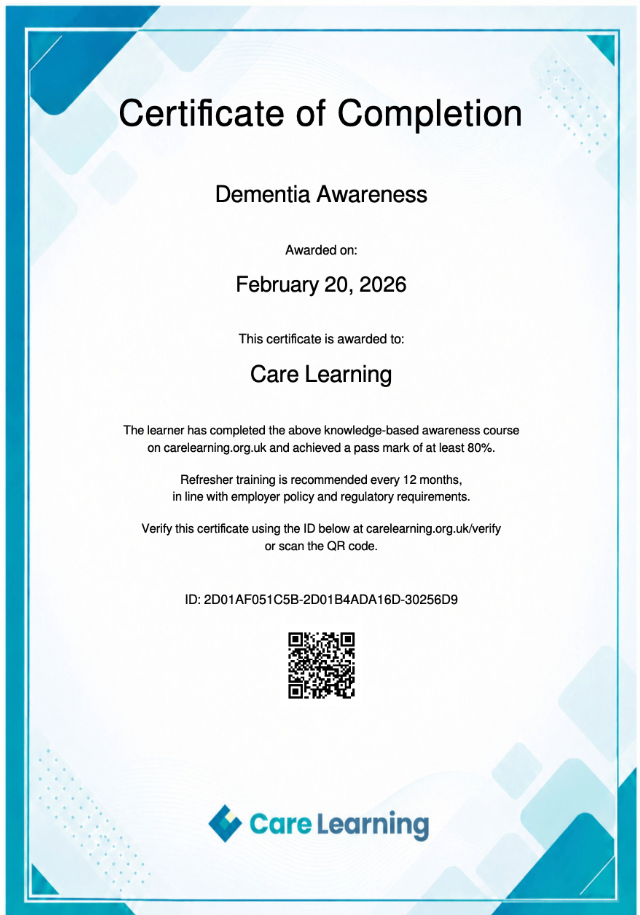
Yes. A certificate is issued after successful completion.
This Level 2 course provides a clear foundation for delivering care that protects privacy, identity, choice and personal control. It supports workers to apply respectful principles consistently, recognise concerns early and take appropriate action when a person’s dignity may be at risk.
Enrol now to build your understanding of dignity and respect in care.