This COSHH Awareness eLearning course is designed for workers who may use, handle, store or work near substances hazardous to health. It explains why COSHH is important, how exposure can happen and what workers need to know to help prevent work-related ill health.
This free course covers hazardous substances, common routes of exposure, warning labels, safety data sheets, COSHH risk assessments, control measures, safe handling, storage, disposal, spill response, monitoring, health surveillance and emergency action.
Why Take This eLearning Course?
Hazardous substances are found in many workplaces, including offices, schools, workshops, kitchens, maintenance areas, laboratories, factories and service environments. This course supports safer day-to-day practice by helping learners recognise risks, follow workplace instructions and understand how COSHH controls protect health.
This course will help you to:
- Understand what COSHH means and why it exists
- Recognise hazardous substances supplied to or created by work activities
- Identify common examples of workplace substances that may harm health
- Understand employer, employee, supervisor, contractor and visitor responsibilities
- Recognise how substances can enter the body
- Understand short-term, work-related and long-term health effects
- Use labels, hazard pictograms and safety data sheets more confidently
- Follow COSHH assessments and workplace instructions
- Understand how control measures reduce exposure
- Respond more safely to spills, leaks, exposure incidents and emergencies
Learning Outcomes
By the end of this course, you will be able to:
- Define COSHH and explain its purpose in workplace health protection
- Identify different types of substances hazardous to health
- Give examples of common hazardous substances, dusts, fumes, vapours and biological agents
- Describe key COSHH responsibilities for employers, workers and others
- List the main routes by which hazardous substances can enter the body
- Explain possible short-term, repeated and long-term health effects
- Interpret common hazard labels, pictograms and safety information
- Explain what a COSHH risk assessment is and when it should be reviewed
- Describe practical control measures, including the role and limits of PPE
- Outline safe handling, storage, disposal, spill response and emergency actions
COSHH Awareness Course Outline
Module 1: Understanding COSHH and Hazardous Substances
Learners will explore what COSHH means, why the regulations exist and how they help prevent ill health caused by hazardous substances at work. This module introduces substances supplied in containers, such as cleaning products, paints, oils, solvents and laboratory chemicals, as well as substances created during work, including dusts, fumes, vapours, mists and biological agents. It also explains how responsibilities are shared between employers, employees, supervisors, contractors, self-employed people and others who may be affected by workplace activities.
Module 2: Exposure Routes and Health Effects
Learners will examine how hazardous substances can enter the body through breathing in, skin contact, swallowing, injection and eye contact. This module explains how exposure can lead to immediate symptoms, work-related conditions such as dermatitis or occupational asthma, and serious long-term illness. It also helps learners understand why some COSHH risks are not obvious, including invisible hazards, delayed symptoms, repeated low-level exposure and risks created by familiar products or routine tasks.
Module 3: Labels, Safety Data Sheets and Workplace Instructions
Learners will find out how hazard pictograms, signal words, hazard statements and precautionary statements support safer handling and use of chemical products. This module explains the purpose of safety data sheets and how they support COSHH risk assessments, while making clear that they do not replace task-specific workplace assessment. It also covers the information workers should check before use, including product names, hazards, controls, PPE, storage, disposal and emergency action.
Module 4: COSHH Risk Assessment
Learners will understand what a COSHH risk assessment is and how it considers the substance, the task, the exposure route and the people who may be harmed. This module outlines the main steps in assessing risk, from identifying substances and checking hazards to selecting controls, recording findings and reviewing the assessment. It also explains when assessments should be reviewed, such as when new substances are introduced, work processes change, incidents occur, health concerns are reported or new safety information becomes available.
Module 5: Controlling Exposure
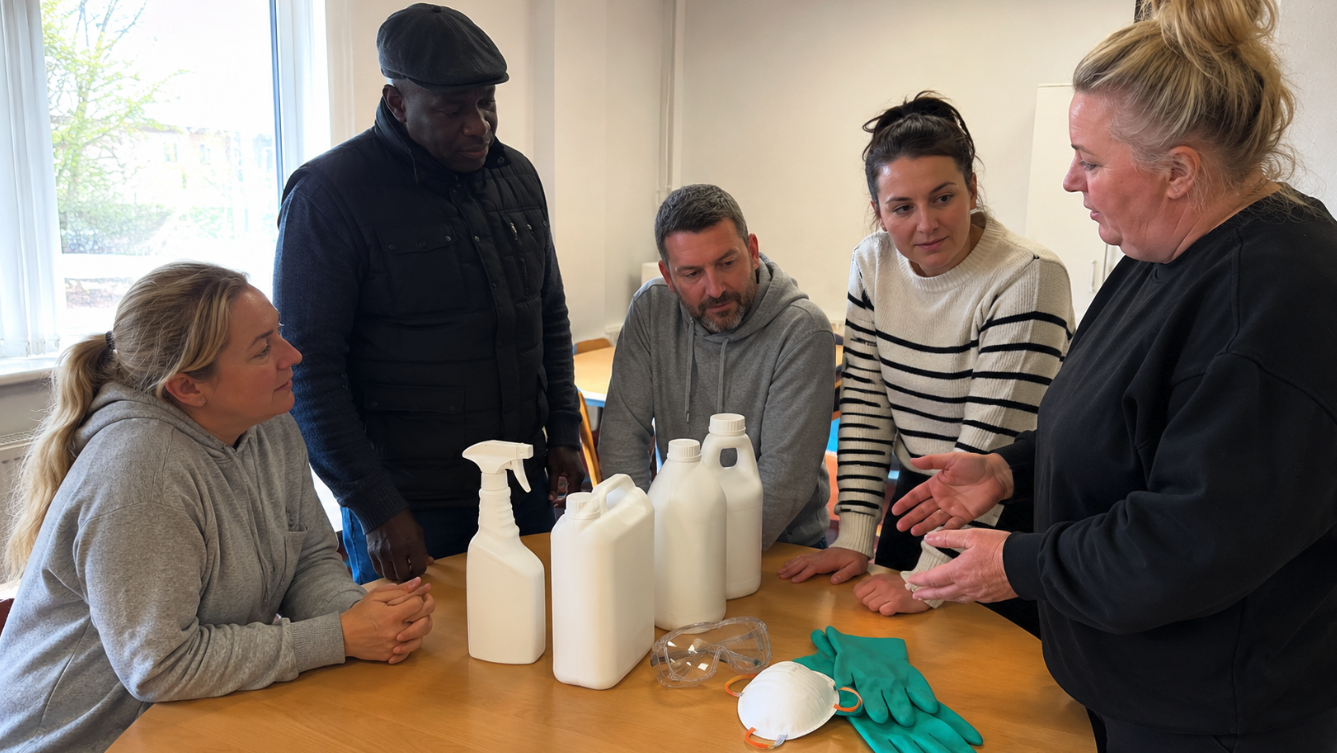
Learners will explore the hierarchy of control and understand why prevention and reduction of exposure should come before relying on personal protective equipment. This module covers elimination, substitution, reduced exposure, engineering controls, safe systems of work and practical measures such as local exhaust ventilation, closed containers, dilution systems, restricted access, housekeeping and clear labelling. It also explains the role and limits of PPE, including gloves, eye protection, respiratory protective equipment, protective clothing and the need for correct use, maintenance and replacement.
Module 6: Safe Handling, Storage, Disposal and Emergency Action
Learners will consider how safe handling and storage reduce the risk of spills, exposure, accidental mixing and unauthorised use. This module covers reading labels, following COSHH assessments, keeping containers closed, segregating incompatible substances, secure storage, waste procedures and spill response. It also explains when exposure monitoring or health surveillance may be needed and outlines what workers should do in an emergency, including raising the alarm, preventing further exposure, following first aid arrangements and reporting incidents or near misses.
Target Audience
This course is suitable for:
- Employees who use or work near hazardous substances
- Supervisors and team leaders responsible for safe working practices
- Cleaning, maintenance, facilities and site support staff
- Workers in workshops, kitchens, laboratories, schools, offices or industrial environments
- Contractors and self-employed people who may create or manage exposure risks
- New starters who need an introduction to COSHH awareness
No previous specialist knowledge is required.
FAQ
Who is this course suitable for?
This course is suitable for workers, supervisors, contractors and self-employed people who may use, handle, store or work near substances hazardous to health. It is relevant across many workplace settings where COSHH controls are needed.
Do I need any previous experience?
No. The course introduces COSHH awareness from the beginning and explains key terms, responsibilities and safe working principles in clear workplace language.
What will I learn on this course?
You will learn what COSHH means, how hazardous substances can affect health, how to recognise exposure risks, how COSHH assessments support safe work and how control measures help prevent harm.
Will this COSHH Awareness course help with day-to-day practice?
Yes. The course focuses on practical workplace awareness, including checking labels, following instructions, using controls correctly, understanding PPE limits and knowing what to do if something goes wrong.
Does the course cover practical skills?
The course covers practical knowledge that supports safer working, including safe handling, storage, disposal, spill response, checking information before use and understanding how workplace controls should be followed.
Does it cover relevant responsibilities or good practice?
Yes. The course explains key COSHH responsibilities for employers, employees, supervisors, contractors and others, and shows how good communication, risk assessment, training, supervision and maintenance support safer practice.
How long does the course take?
The course is self-paced and usually takes around 1 hour to complete.
Will I receive a certificate?
Yes. A certificate is issued after successful completion.
This COSHH Awareness eLearning course provides a clear introduction to recognising hazardous substances, understanding exposure risks and following safe workplace controls. It supports responsible practice and helps learners contribute to a safer, healthier working environment.
Enrol now to build your understanding of COSHH awareness.