This Supporting People with Dementia Level 2 course is designed for health and social care workers who provide day-to-day support for people living with dementia. It develops the knowledge needed to recognise individual needs, communicate respectfully and provide safe, person-centred care.
This free course covers dementia-related conditions, communication, identity, independence, meaningful activity, nutrition, hydration, distress, consent, care planning, recording and professional responsibilities in England. Learners will also explore practical scenarios involving refusal, sudden changes, emotional distress, escalation and care-note writing.
This is a non-regulated CPD training course. It is designed to develop knowledge and support workplace learning; it is not an Ofqual-regulated qualification and does not replace employer-led induction, supervision, competency assessment or any required regulated training.
Why Take This eLearning Course?
Supporting a person with dementia requires more than an understanding of memory loss. Workers must recognise changing abilities, respond to communication needs, protect individual rights and know when concerns require further support. This course provides practical knowledge for confident, respectful and responsible dementia care.
This course will help you to:
- Develop a clearer understanding of dementia and its different causes.
- Recognise early signs, changing needs and sudden deterioration.
- Communicate calmly with people who process or express information differently.
- Support choice, consent, independence and positive risk-taking.
- Use personal history, interests and routines to provide individualised care.
- Plan activities that promote purpose, comfort and social connection.
- Support nutrition, hydration and safe, dignified mealtimes.
- Respond appropriately when behaviour communicates distress or an unmet need.
- Produce accurate, respectful and confidential care records.
- Work within your role, care plans and workplace procedures.
Learning Outcomes
By the end of this course, you will be able to:
- Define dementia and explain how it differs from normal ageing and mild cognitive impairment.
- Describe common dementia-related conditions, signs and patterns of progression.
- Identify factors that can affect communication and apply suitable verbal and non-verbal approaches.
- Explain how validation, active listening and accessible choices can reduce distress.
- Apply person-centred principles to identity, relationships, strengths and everyday support.
- Explain consent, decision-specific capacity and proportionate risk support.
- Select and adapt meaningful activities according to individual interests and abilities.
- Recognise nutrition, hydration, swallowing and environmental concerns requiring action.
- Identify possible triggers for distress and choose proportionate de-escalation responses.
- Record, report and escalate concerns in line with legal, professional and workplace requirements.
Supporting People with Dementia Level 2 – Course Outline
The course is organised into six modules covering the knowledge and practical judgement required to support people living with dementia safely, respectfully and consistently.
Module 1: Understanding Dementia and Related Conditions
Learners will define dementia, cognitive impairment, clinical diagnosis and person-centred terminology. They will examine how dementia can affect memory, thinking, language, judgement, behaviour, relationships and everyday activities while recognising that abilities vary between individuals and situations. The module explains common early signs and the importance of objective observation and professional assessment. Learners will explore Alzheimer’s disease, vascular dementia, dementia with Lewy bodies, frontotemporal dementia, mixed dementia and less common causes. They will also consider progression, retained abilities, changing support needs, the distinction between dementia, mild cognitive impairment and normal ageing, and the importance of challenging myths, stigma and assumptions about capacity.
Module 2: Communication and Emotional Support
Learners will explore how dementia can affect understanding, processing, expression and conversation. They will identify environmental, sensory, physical and communication factors that can make interaction harder, including noise, poor lighting, pain, tiredness, rushed support and complex language. The module covers clear verbal communication, supportive body language, active listening, checking understanding and allowing sufficient response time. Learners will examine validation, emotional acknowledgement, reassurance and why confrontation or repeated correction can increase distress. They will also consider how to offer manageable choices, support communication in later stages, use touch and personal space respectfully, involve families appropriately and respond to practical situations involving repeated questions or refusal of care.
Module 3: Person-Centred Care, Identity and Independence
Learners will examine person-centred dementia care through individual needs, personal history, rights, strengths, goals and relationships. They will consider how to gather information respectfully, avoid assumptions and use life story work to support identity, conversation and meaningful activity. The module covers consent, confidentiality and the secure use of sensitive information. Learners will explore ways to maintain culture, beliefs, appearance, language, routines and valued relationships while keeping the person’s wishes central. They will identify opportunities to support independence by using prompts, adapted equipment and the least assistance necessary. The module also explains positive risk-taking, decision-specific capacity, routine consent, adapting care as needs change, person-centred care planning and the completion of factual, respectful care notes.
Module 4: Meaningful Activity, Nutrition and Wellbeing
Learners will define meaningful activity as something personally relevant, purposeful, enjoyable or comforting rather than simply organised entertainment. They will identify interests, routines and current abilities through conversation, observation, care information and appropriate family involvement. The module explains how to simplify, shorten or adapt activities, equipment and environments while maintaining choice and dignity. Learners will consider individual and group activities, familiar daily tasks and ways to promote social connection and quality of life. They will also examine supportive mealtimes, personal food preferences, independence, hydration, warning signs relating to reduced intake or swallowing, and the need to follow authorised dietary guidance. Environmental factors, sensory approaches and reflective review of activity participation are also covered.
Module 5: Distress, Unmet Needs and Proportionate Responses
Learners will explore behaviour as a possible expression of fear, pain, discomfort, confusion or another unmet need. They will learn to describe observed actions without judgement and consider physical, emotional, social, environmental, communication and routine-related triggers. The module explains structured observation, including what happened before an incident, the behaviour observed, the response provided and the outcome. Learners will identify sudden changes requiring prompt reporting, such as new confusion, reduced alertness, injury, illness or reduced food and fluid intake. They will consider calm de-escalation, personal space, reassurance, environmental adjustment and least restrictive practice. The module also covers sleep and routine, working with families and professionals, worker wellbeing and an integrated scenario involving agitation, poor intake, sleep disruption, escalation and review.
Module 6: Legal, Regulatory and Professional Responsibilities
Learners will examine the main framework influencing dementia care in England, including human rights, equality, adult social care, safeguarding, mental capacity, data protection and health and social care regulations. They will explore wellbeing, prevention and safeguarding under the Care Act 2014 and the five principles of the Mental Capacity Act 2005. The module outlines current Care Quality Commission expectations, quality statements and relevant Fundamental Standards relating to person-centred care, dignity, consent, safety, safeguarding, nutrition, governance and staffing. Learners will consider the importance of employer policies, individual care plans, role boundaries and seeking guidance when a task exceeds their competence. The module also covers accurate and confidential recording, routine and urgent escalation routes, consequences of poor practice and the knowledge required for the final scenario-based assessment.
Target Audience
This course is suitable for:
- Care assistants and support workers.
- Home-care and domiciliary care staff.
- Residential and nursing care workers.
- Day-service and community support staff.
- New employees completing dementia awareness training.
- Experienced workers refreshing their dementia-care knowledge.
No previous specialist knowledge is required.
FAQ
Who is this course suitable for?
The course is suitable for people who support adults living with dementia in residential care, home care, community services, day services or other health and social care settings. It may also support new workers who need a structured introduction to dementia care.
Do I need any previous experience?
No previous specialist dementia knowledge is required. The course is written at Level 2 and explains key terms, responsibilities and practical approaches clearly.
What will I learn on this course?
You will learn about dementia-related conditions, communication, person-centred care, meaningful activity, nutrition, hydration, distress, consent, capacity, safeguarding, recording and escalation.
How will this dementia course help with day-to-day practice?
The course uses realistic care situations to show how workers can offer choices, respond to distress, support independence, recognise changes and report concerns through the correct workplace route.
Does the course cover practical skills?
The course develops the knowledge needed to select safe and respectful approaches in everyday situations. It does not replace workplace induction, supervised practice, moving and handling training or practical competence assessment.
Does it cover relevant responsibilities and good practice?
Yes. The course explains responsibilities relating to dignity, consent, capacity, safeguarding, confidentiality, accurate recording, person-centred care and working within an agreed role. It also introduces relevant legislation and regulatory expectations in England.
How long does the course take?
The course is self-paced and usually takes around 3-5 hours to complete.
Will I receive a certificate?
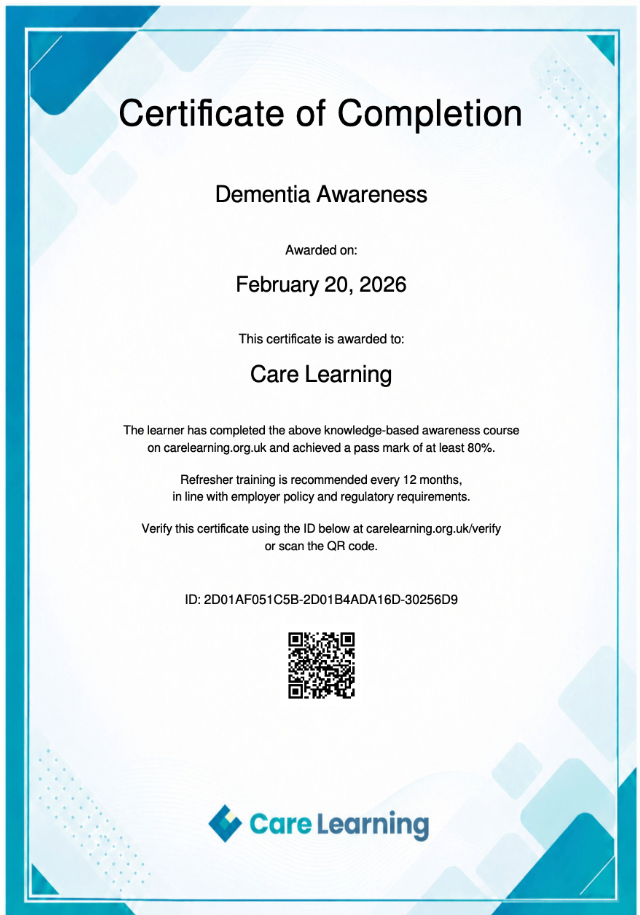
Yes. A downloadable certificate of completion is issued after successful completion of the course and assessment. This certificate confirms completion of non-regulated CPD training; it is not an Ofqual-regulated qualification.
This Supporting People with Dementia Level 2 course provides a practical foundation for delivering individualised, respectful and safe support. It helps learners understand how everyday communication, observation, recording and decision-making can protect dignity and improve the person’s experience of care.
Enrol now to build your understanding of supporting people with dementia.