This dementia ands the brain course is for health and social care workers who support people living with dementia. It introduces the neuroscience behind dementia in clear, accessible language, helping learners understand how changes within the brain can affect memory, communication, perception, movement, behaviour and everyday activities.
This free course explores brain regions, nerve cells and communication networks before examining the changes associated with Alzheimer’s disease, vascular dementia and Lewy body dementia. Learners will also consider the roles of the hippocampus and frontal lobes, practical approaches to person-centred support, urgent warning signs, professional boundaries, factual recording and appropriate escalation.
Why Take This eLearning Course?
Understanding how dementia affects the brain can help care staff respond to changes with greater confidence, compassion and professional curiosity. Rather than viewing repetition, confusion or changed behaviour as deliberate, learners can consider which abilities may be affected, what other causes should be explored and which practical adjustments may help.
This course will help you to:
- Understand how brain cells, regions and networks support everyday functioning
- Recognise how different forms of dementia can produce different patterns of need
- Interpret memory, language, perception and movement difficulties more effectively
- Respond calmly to repetition, hallucinations and changes in behaviour
- Use routines, prompts and environmental adjustments to support participation
- Recognise sudden symptoms that require urgent clinical or emergency escalation
- Record observations clearly without making unsupported diagnoses
- Consider pain, illness, medicines, sensory loss and distress as possible causes of change
- Protect dignity, choice and independence when providing support
- Work safely within care plans, organisational procedures and professional boundaries
Learning Outcomes
By the end of this course, you will be able to:
- Define key terms relating to brain cells, signals, connections and networks
- Describe the functions of important brain regions involved in daily activities
- Explain how amyloid plaques and tau tangles are associated with Alzheimer’s disease
- Describe how vascular damage and Lewy body changes can affect functioning
- Identify links between brain changes and difficulties with memory, language, perception, movement and behaviour
- Recognise stroke signs, acute confusion and other changes requiring urgent escalation
- Explain how hippocampal and frontal lobe damage may affect daily life
- Select person-centred approaches for supporting memory loss and changed behaviour
- Identify practical adjustments that can support communication, orientation and participation
- Record and report changes factually while remaining within the care worker’s role
Dementia and The Brain Course Outline
The course is organised into eight modules, moving from basic brain terminology to dementia-related changes, practical care responses and professional responsibilities.
Module 1: Understanding the Brain and Its Networks
Learners will explore basic terms used to describe the brain, including neurons, synapses, electrical signals, neurotransmitters and brain networks. The module explains how the hippocampus, temporal lobes, frontal lobes, parietal lobes, occipital lobes and brainstem contribute to memory, language, planning, perception, movement and automatic body functions. Learners will consider how several regions work together during familiar activities such as preparing food or holding a conversation, and how identifying the difficult stage of a task can guide supportive adjustments.
Module 2: Alzheimer’s Disease and the Spread of Brain Changes
Learners will examine the roles of amyloid plaques and tau tangles in Alzheimer’s disease and how these changes can disrupt communication, internal cell processes and wider brain networks. The module outlines the gradual loss of connections, death of nerve cells and shrinkage of affected brain tissue. It also considers how changes may spread from memory networks into areas involved in language, judgement, planning, visual processing, movement and recognition, while emphasising that the pattern and rate vary between individuals.
Module 3: Vascular Brain Damage and Urgent Warning Signs
Learners will explore how small vessel disease, a major stroke and multiple smaller strokes can reduce the brain’s supply of oxygen and nutrients. The module explains why the location of vascular damage can create an uneven pattern of cognitive, communication, movement, balance and emotional difficulties. Learners will also identify sudden facial weakness, arm weakness, speech changes, vision loss, severe headache, reduced consciousness and acute confusion as signs requiring urgent action, including using the FAST stroke check and calling 999 when stroke is suspected.
Module 4: Lewy Body Dementia, Fluctuations and Hallucinations
Learners will define Lewy bodies and alpha-synuclein and consider how related brain changes can affect attention, alertness, perception, sleep, movement and balance. The module explains the possible presentation of visual hallucinations, daytime drowsiness, vivid dreams, stiffness, tremor and falls. Learners will consider how to observe and record fluctuations, provide calm reassurance, reduce immediate risks and report new or worsening symptoms without confrontation, ridicule, unauthorised restraint or changes to medication.
Module 5: Individual Differences and the Limits of Neuroscience
Learners will examine why dementia symptoms differ according to the disease process, brain regions affected, stage of change, existing health, sensory needs, previous abilities, environment and personal history. The module reviews simplified links between the hippocampus, frontal lobes, temporal lobes, parietal lobes, occipital lobes and brainstem and their associated functions. It also explains why symptoms should be interpreted cautiously, as infection, pain, dehydration, constipation, medicines, sensory loss, distress and environmental factors can produce or worsen cognitive and behavioural changes.
Module 6: The Hippocampus, Memory Loss and Supportive Care
Learners will explore how the hippocampus helps form new memories and connect experiences with their context. The module explains why hippocampal damage may cause repeated questions, difficulty retaining recent conversations, problems learning new routines and a stronger reliance on established habits or familiar environments. Learners will identify supportive approaches including predictable routines, meaningful visual cues, brief communication, reduced background noise, calm repetition, manageable choices and avoiding unnecessary memory testing or correction.
Module 7: Frontal Lobes and Changes in Behaviour
Learners will examine how the frontal lobes support attention, motivation, planning, decision-making, emotional control and the ability to review actions. The module links frontal lobe changes with reduced inhibition, impulsivity, apathy, distraction, repetition and difficulty organising multi-step tasks. Learners will consider person-centred responses that explore possible causes, reduce demands and distractions, provide manageable prompts and record what happened before and after a change in behaviour.
Module 8: Applying Neuroscience to Compassionate Care
Learners will consider how knowledge of brain changes can support understanding without reducing a person to their diagnosis. The module covers practical adjustments to communication, routines, lighting, noise, meaningful activity, task support and choice across care homes, hospitals and community settings. It also addresses role boundaries, factual recording, escalation routes and reflective responses to repeated questions, visual experiences, sudden confusion, resistance during personal care and a new loss of ability. Throughout the module, learners are encouraged to preserve identity, autonomy, dignity and involvement.
Target Audience
This course is suitable for:
- Care assistants and support workers
- Senior care workers and team leaders
- Domiciliary and community care staff
- Residential and nursing home staff
- Hospital staff supporting adults with dementia
- New or existing health and social care workers seeking a clearer understanding of dementia
No previous specialist knowledge is required.
FAQ
Who is this course suitable for?
This course is suitable for care workers, support workers, senior staff and other health and social care professionals who support people living with dementia in residential, nursing, hospital, domiciliary or community settings.
Do I need any previous experience?
No previous knowledge of neuroscience is required. The course explains brain structures and disease processes in clear language and focuses on their relevance to everyday care practice.
What will I learn on this brain and dementia course?
You will learn how brain cells, regions and networks function, how Alzheimer’s disease, vascular dementia and Lewy body dementia can affect them, and how these changes may influence memory, communication, perception, movement and behaviour.
Will this course help with day-to-day practice?
Yes. The course links neuroscience with practical support, including calm communication, familiar routines, visual cues, reduced distractions, meaningful choices and adjustments that help a person participate safely.
Does the course cover practical skills?
The course develops practical observation, communication, recording and decision-making skills. It explains how to identify the part of a task a person finds difficult and how to provide proportionate support without unnecessarily taking over.
Does it cover urgent changes and escalation responsibilities?
Yes. Learners will consider stroke warning signs, acute confusion, reduced consciousness and other sudden changes that require urgent escalation. The course also explains the importance of following local procedures, documenting when symptoms began and calling 999 when stroke or another life-threatening emergency is suspected.
Can this course help staff respond to hallucinations or changed behaviour?
Yes. It explains how perceptual and frontal lobe changes may contribute to hallucinations, reduced inhibition, impulsivity, apathy or repetition. It also encourages staff to consider pain, illness, medicines, fear and environmental factors before assuming dementia is the only cause.
How long does the course take?
The course is self-paced and usually takes around 1 hour to complete.
Will I receive a certificate?
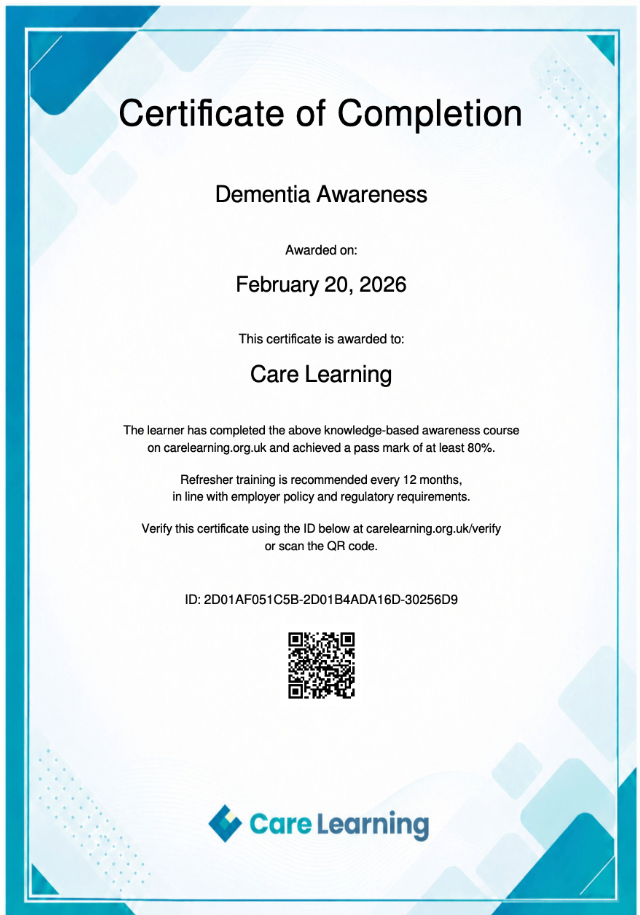
Yes. A certificate is issued after successful completion.
This course provides care staff with an accessible introduction to the neuroscience of dementia and its practical relevance. By combining knowledge of brain changes with careful observation and person-centred support, learners can respond more confidently while protecting each person’s dignity, safety, identity and remaining abilities.
Enrol now to build your understanding of the brain and dementia.