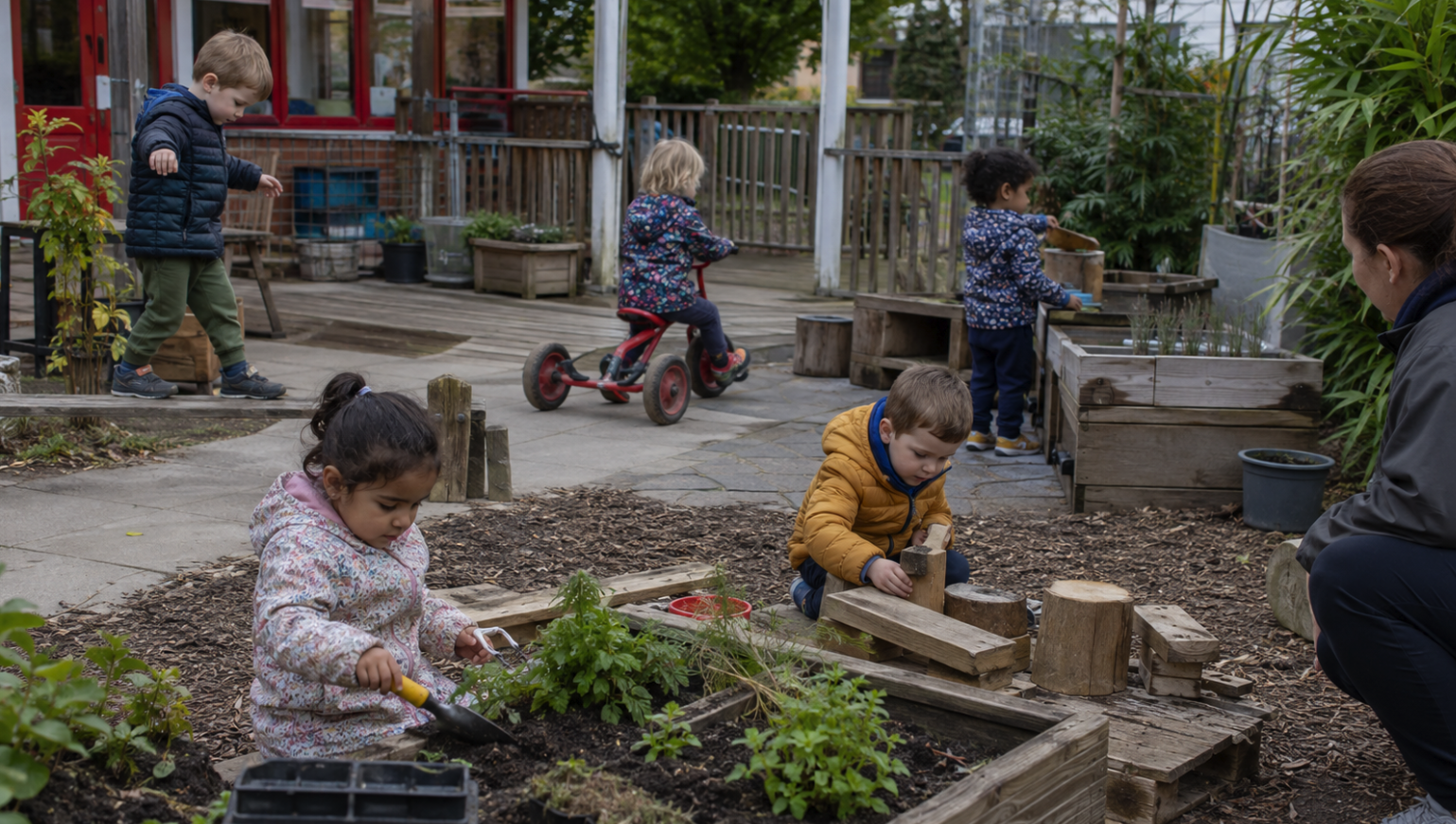
This online outdoor play in the early years course is designed for practitioners, childminders and other professionals who support young children’s learning and development. It explores how well-planned outdoor experiences can support physical development, communication, thinking, relationships, confidence and connection with the natural world.
This free course covers the role of outdoor play within the Early Years Foundation Stage (EYFS), practical ways to make effective use of different outdoor spaces and weather conditions, and the balance between child-led and adult-guided experiences. Learners will also explore risk-benefit thinking, proportionate supervision, inclusive practice, reasonable adjustments and ways to review and improve outdoor provision.
Why Take This eLearning Course?
Outdoor play is an important part of everyday early years provision. Practitioners need to create opportunities that are engaging and developmentally appropriate while considering access, inclusion, supervision and changing conditions. This course supports a balanced approach that encourages exploration and manageable challenge without losing sight of children’s individual needs.
This course will help you to:
- Understand what effective outdoor play can look like in different early years environments.
- Recognise how outdoor experiences contribute to children’s physical, cognitive, social and emotional development.
- Connect outdoor experiences with the seven EYFS areas of learning and development.
- Make purposeful use of small, shared, natural and local outdoor spaces.
- Balance child-led play with appropriately planned adult-guided experiences.
- Prepare for different weather conditions without unnecessarily limiting outdoor opportunities.
- Apply proportionate risk-benefit thinking to everyday outdoor activities.
- Support children with different physical, sensory and communication needs to participate.
- Encourage confidence, choice and managed independence during outdoor play.
- Review existing provision and identify realistic opportunities for improvement.
Learning Outcomes
By the end of this course, you will be able to:
- Define outdoor play and distinguish between child-initiated and adult-guided experiences.
- Describe key physical, cognitive, communication, social, emotional and nature-related benefits of outdoor play.
- Explain the EYFS expectations relating to outdoor access and identify links with all seven areas of learning.
- Describe the practitioner’s role in creating an enabling outdoor environment.
- Identify suitable outdoor play opportunities for different types and sizes of space.
- Explain how weather, resources and everyday routines can be managed to support regular outdoor activity.
- Distinguish between hazards, risks and benefits and identify proportionate ways to manage common outdoor risks.
- Describe how active supervision should respond to children, activities and changing conditions.
- Identify barriers to participation and explain how reasonable adjustments and practical adaptations can improve access.
- Reflect on outdoor provision and identify a realistic improvement that can be implemented and reviewed.
Outdoor Play in the Early Years Course Outline
The course is organised into six modules, moving from the foundations and developmental benefits of outdoor play through EYFS practice, practical provision, risk management, inclusion and reflective improvement.
Module 1: Understanding Outdoor Play and Its Benefits
Learners will explore what outdoor play means in the early years, including child-initiated play, adult-guided experiences and the use of different outdoor environments. The module examines how movement, balancing, climbing and active exploration can support strength, co-ordination and body control. It also considers how outdoor experiences encourage curiosity, problem-solving, language and imaginative thinking, before exploring the wider benefits for social relationships, emotional development, confidence and children’s connection with nature.
Module 2: Outdoor Play Within the EYFS
Learners will examine the EYFS expectations for outdoor access in England, including the need to provide outdoor opportunities and consider equality responsibilities. They will explore how outdoor experiences can contribute to communication and language, physical development, personal, social and emotional development, literacy, mathematics, understanding the world, and expressive arts and design. The module also considers how practitioners create enabling environments through observation, accessible resources and thoughtful interaction, and how child-led and adult-guided experiences can complement one another.
Module 3: Planning Practical Outdoor Experiences
Learners will consider how meaningful outdoor play can be provided in small yards, gardens, shared spaces, parks and suitable natural environments. They will explore practical preparation for different weather and seasonal conditions, including clothing, shelter, surfaces and changing environmental conditions. A range of experiences is considered, including movement, wheeled play, construction, creativity, gardening and nature exploration. The module also examines everyday routines for environmental checks, resources, transitions, supervision and alternative arrangements when the usual outdoor plan cannot be followed.
Module 4: Risk-Benefit Thinking and Supervision
Learners will develop a clear understanding of hazards, risks and developmental benefits in outdoor play. They will explore why risk should be managed rather than automatically eliminated and how proportionate controls can preserve worthwhile challenge while reducing unacceptable harm. Common considerations include boundaries, surfaces, climbing, water, equipment, materials, weather and ground conditions. The module also covers active supervision, appropriate adult positioning and the need to adapt arrangements when weather, equipment, group behaviour or the nature of an activity changes.
Module 5: Inclusive Outdoor Play and Participation
Learners will explore barriers that can restrict children’s participation, including physical access, sensory conditions, communication needs and adult assumptions. The module explains how accessible routes, flexible participation and individual reasonable adjustments can support meaningful inclusion. Learners will consider ways to support children with physical disabilities by understanding the individual child, working with parents or carers, reviewing access, adapting activities and preserving suitable challenge. Examples of inclusive group play demonstrate how choice, varied roles and adaptable resources can help children with different abilities participate together.
Module 6: Reflective Practice and Improving Provision
Learners will review how to identify strengths and gaps in outdoor provision by considering frequency of access, range of experiences, inclusion and barriers to participation. They will examine how adults can encourage confidence and managed independence by observing before intervening and helping children develop age-appropriate judgement. Reflective questions support teams to consider participation, barriers, adult responses, weather, variety and children’s interests. The module concludes by showing how one focused, realistic change to resources or access can be implemented, observed and reviewed before further improvements are planned.
Target Audience
This course is suitable for:
- Early years practitioners working in nurseries, pre-schools and other childcare settings.
- Registered childminders and assistants.
- Nursery and pre-school room leaders or supervisors.
- Early years managers, owners and provision leads.
- Teaching and support staff working with children in the EYFS.
- Learners, apprentices and new staff developing their understanding of early years practice.
No previous specialist knowledge is required.
FAQ
Who is this course suitable for?
The course is suitable for people who work with young children in early years environments, including practitioners, childminders, nursery staff, supervisors, managers and learners preparing for roles in the sector. It is particularly useful for anyone involved in planning, supervising or reviewing outdoor experiences.
Do I need any previous experience?
No. The course introduces the subject clearly and is suitable for both new and experienced early years practitioners. Existing practitioners can also use it to refresh their understanding and reflect on current outdoor provision.
What will I learn on this outdoor play in the early years course?
You will learn about the developmental benefits of outdoor play, EYFS expectations, enabling environments, practical activities, different spaces and weather conditions, risk-benefit thinking, supervision, inclusion and reflective improvement.
Will this course help with day-to-day practice?
Yes. The course focuses on practical decisions that arise in everyday provision, such as preparing outdoor areas, selecting adaptable resources, responding to changing weather, supervising manageable challenges and helping children participate as independently as possible.
Does the course cover practical outdoor play ideas?
Yes. Examples include movement activities, wheeled play, construction, outdoor creativity, gardening, nature exploration, water play and imaginative experiences. The course also considers how activities can be adapted to different spaces, abilities and interests.
Does the course cover EYFS outdoor play requirements?
Yes. The course explains the role of outdoor access within the EYFS in England and encourages settings to use the current statutory framework that applies to their provider type. It also explores how outdoor play can contribute to all seven areas of learning and development.
Does the course cover risk management and inclusive practice?
Yes. Learners explore hazards, risks, benefits, proportionate controls and active supervision, alongside barriers to participation, reasonable adjustments and practical ways to make shared outdoor experiences more accessible.
How long does the course take?
The course is self-paced and usually takes around 1 hour to complete.
Will I receive a certificate?
Yes. A certificate is issued after successful completion.
Outdoor play can provide rich opportunities for children to move, investigate, communicate, create and develop independence. This course gives early years practitioners a practical framework for creating inclusive, engaging outdoor experiences while managing responsibilities and risks in a balanced and proportionate way.
Enrol now to build your understanding of outdoor play in the early years.