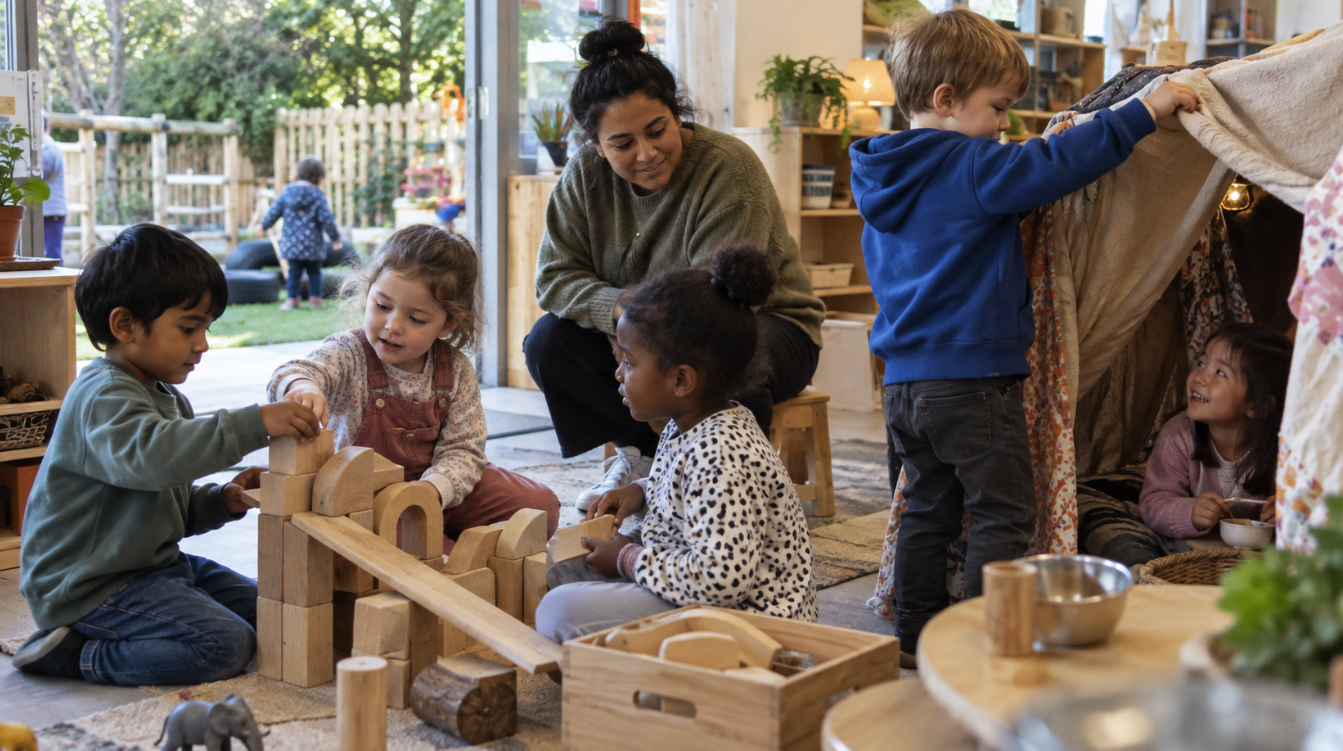
This online early years course is designed for practitioners who want to understand how influential theories and educational approaches can inform children’s learning, development and everyday experiences. It explores theoretical ideas alongside the professional judgement, observation and individualised practice required within early years provision in England.
This free course covers developmental and learning theories associated with Piaget, Vygotsky, Bandura, Bronfenbrenner, Bowlby and Ainsworth, together with Montessori, Froebelian and Reggio Emilia approaches. Learners will also consider play, communication, responsive relationships, observation, planning, inclusive practice, working with families and the appropriate professional response when concerns arise.
Why Take This eLearning Course?
Understanding early years theories can give practitioners useful perspectives on how children explore, communicate, build relationships and develop understanding. This course supports learners to use those perspectives thoughtfully rather than treating any theory as a fixed explanation of an individual child.
This course will help you to:
- Understand the difference between theory, educational approaches and pedagogy.
- Relate theoretical ideas appropriately to EYFS practice.
- Recognise how children can learn through exploration, interaction and observation.
- Reflect on the importance of responsive and dependable relationships.
- Support play, language, communication and growing independence.
- Compare Montessori, Froebelian and Reggio Emilia principles.
- Use theory to inform observation, planning and learning environments.
- Work more effectively with parents and carers when understanding children’s experiences.
- Apply developmental ideas in inclusive and strengths-based ways.
- Recognise the limits of theory and maintain appropriate professional boundaries.
Learning Outcomes
By the end of this course, you will be able to:
- Define theory, educational approach and pedagogy in an early years context.
- Explain how theoretical perspectives can inform practice within the EYFS.
- Describe key ideas associated with Piaget, Vygotsky, Bandura and Bronfenbrenner.
- Explain important concepts from attachment theory and relationship-based practice.
- Describe how play and adult interaction can support learning and communication.
- Identify key features of Montessori, Froebelian and Reggio Emilia approaches.
- Compare similarities and differences between established early years approaches.
- Apply theoretical ideas appropriately to observation, planning and learning environments.
- Explain how inclusive practice, family knowledge and individual differences affect the use of developmental ideas.
- Identify when safeguarding, SEND or other professional procedures should take priority over theoretical interpretation.
Theories and Approaches in Early Years Course Outline
The course is organised into six modules, progressing from the foundations of early years theory through influential developmental perspectives and educational approaches to practical application, inclusion and professional responsibilities.
Module 1: Understanding Theory, Approaches and Pedagogy
Learners will explore what is meant by theory, educational approach and pedagogy, and how each can influence everyday early years practice. The module explains why developmental and learning theories can be useful when considering children’s play, communication, relationships and development, while emphasising that theories provide perspectives rather than fixed answers. Learners will consider how theoretical thinking relates to the statutory EYFS and non-statutory Development Matters guidance, including the importance of observation and professional judgement. The module also examines the limits of developmental theories, recognising individual variation, different developmental pathways and the need to avoid labels, assumptions or unsupported conclusions about children and families.
Module 2: Influential Theories of Learning and Development
Learners will examine several influential perspectives on how children learn and develop. Piaget’s ideas introduce active exploration and the way children can build and adjust understanding through direct experience. Vygotsky’s work highlights social interaction, language, the zone of proximal development, scaffolding and the gradual development of independence. Bandura’s ideas focus on learning through observation, modelling and the responses children see around them. Bronfenbrenner’s perspective broadens the picture by considering the interconnected relationships, family circumstances, communities and wider environments that can influence children’s experiences. Throughout the module, learners are encouraged to treat these ideas as useful lenses rather than rigid explanations of individual development.
Module 3: Relationships, Attachment, Play and Communication
Learners will explore key ideas from attachment theory, including Bowlby’s emphasis on dependable relationships and the secure base concept, together with Ainsworth’s research into patterns of separation and reunion. The module explains why attachment categories should not be used to diagnose or label individual children or families. Learners will also consider the importance of the key person, continuity of care and responsive relationships during transitions and unfamiliar experiences. The role of play is examined as a way for children to explore, imagine, solve problems and develop ideas, while adult involvement is considered in relation to observing, extending and stepping back. The module also covers supportive communication, including listening, modelling language, allowing processing time and recognising varied communication styles.
Module 4: Montessori, Froebelian and Reggio Emilia Approaches
Learners will explore three established approaches to early childhood education. Montessori principles are considered through the prepared environment, accessible and purposeful resources, independence, repetition, observation and carefully judged adult guidance. Froebelian practice introduces the importance of play, relationships, creativity, direct experience, nature, outdoor learning and the interconnected nature of development. The Reggio Emilia approach is explored through children’s active participation, multiple forms of expression, project-based learning, documentation, relationships and the learning environment. Learners will then compare shared principles and different areas of emphasis across the approaches, considering how useful ideas can inform practice without requiring settings to reproduce a complete educational model.
Module 5: Applying Theory to Early Years Practice
Learners will consider practical examples of theory-informed observation and planning in nurseries, pre-schools and childminding contexts. The module demonstrates how practitioners can begin with factual observations and children’s interests before using theoretical perspectives to reflect on possible next steps. Learners will examine supportive adult interactions, including modelling useful language, providing appropriate scaffolding and recognising when stepping back protects children’s concentration and independence. The module also considers how theory can inform the organisation of learning environments through accessible resources, choice, active and quiet spaces, indoor and outdoor experiences and ongoing review. Finally, learners will explore the value of respectful partnership with parents and carers when understanding interests, home languages, routines, cultural experiences and children’s wider lives.
Module 6: Inclusive, Reflective and Professional Use of Theory
Learners will examine why no single theory can fully explain every child’s learning or development, considering individual variation, cultural context, evidence and professional judgement. The module promotes strengths-based and inclusive observation that recognises SEND, disability, neurodiversity, home language, identity and different ways of communicating and participating. Learners will consider adaptations that can improve access, including visual support, accessible resources, reduced sensory demands and additional processing time. The module also explains professional boundaries when concerns arise, including factual recording, appropriate information sharing and the correct use of SEND, referral and safeguarding procedures. It concludes by identifying common mistakes, such as treating stages as rigid deadlines or using theories as labels, and reinforces the importance of keeping the individual child, family, statutory responsibilities and current professional procedures at the centre of practice.
Target Audience
This course is suitable for:
- Early years practitioners working in nurseries and pre-schools.
- Childminders and other home-based early years professionals.
- Early years educators and teaching support staff.
- Nursery and early years room leaders or supervisors.
- Apprentices and learners developing their knowledge of early childhood practice.
- Professionals who want to refresh their understanding of early years theories and approaches.
No previous specialist knowledge is required.
FAQ
Who is this course suitable for?
This course is suitable for people working with young children in early years settings, including nursery and pre-school practitioners, childminders, early years educators, support staff and learners preparing for work in the sector.
Do I need any previous experience?
No specialist knowledge of developmental theory is required. The course introduces the main concepts clearly and connects them with practical early years situations.
What will I learn on this early years theories and approaches course?
You will explore influential learning and developmental theories, attachment and relationship-based practice, Montessori, Froebelian and Reggio Emilia approaches, and the practical use of theory in observation, planning, interaction and learning environments.
Will this course help with day-to-day practice?
Yes. The course connects theoretical ideas with practical decisions such as when to support or step back, how to organise environments, how to respond to children’s communication and how to use observations when considering suitable next steps.
Does the course cover practical skills?
The course focuses on knowledge and its application to everyday practice. It includes practical examples of observation, language modelling, scaffolding, planning, environmental organisation, play support and working with parents and carers.
How does the course relate to the EYFS?
The course explains that theory can provide useful perspectives but does not replace the EYFS. Learners consider how theoretical ideas can inform interactions, environments and planning while statutory learning, development, assessment, safeguarding and welfare requirements remain central.
Does the course cover inclusive practice and SEND?
Yes. Learners consider how developmental ideas can be used flexibly and inclusively, with attention to children’s strengths, communication, identity, neurodiversity, disability, SEND and individual access requirements. The course also explains the importance of following appropriate professional procedures where concerns arise.
Does the course cover safeguarding and professional responsibilities?
Yes. The course makes clear that developmental theories are not diagnostic tools and must not be used to explain away concerns about a child’s safety or wellbeing. Safeguarding concerns should always be recorded and reported through the setting’s agreed procedures.
How long does the course take?
The course is self-paced and usually takes around 1 hour to complete.
Will I receive a certificate?
Yes. A certificate is issued after successful completion.
Understanding early years theories and approaches can strengthen reflective practice by giving practitioners different ways to consider children’s learning, relationships and experiences. This course supports a balanced approach in which theory informs thinking while observation, inclusion, family knowledge, professional judgement and the individual child remain central.
Enrol now to build your understanding of early years theories and approaches.